Elastic and Inelastic Collisions FRQ Practice

Responses receive AI feedback against a rubric after submission. Scores are practice estimates.

Question 1 of 5

A cart of mass m moves at speed v toward a stationary cart of mass 3m. They stick on a horizontal frictionless track. (a) Derive their final speed. (b) Find the ratio of final to initial translational kinetic energy. (c) Explain the fate of the missing kinetic energy.
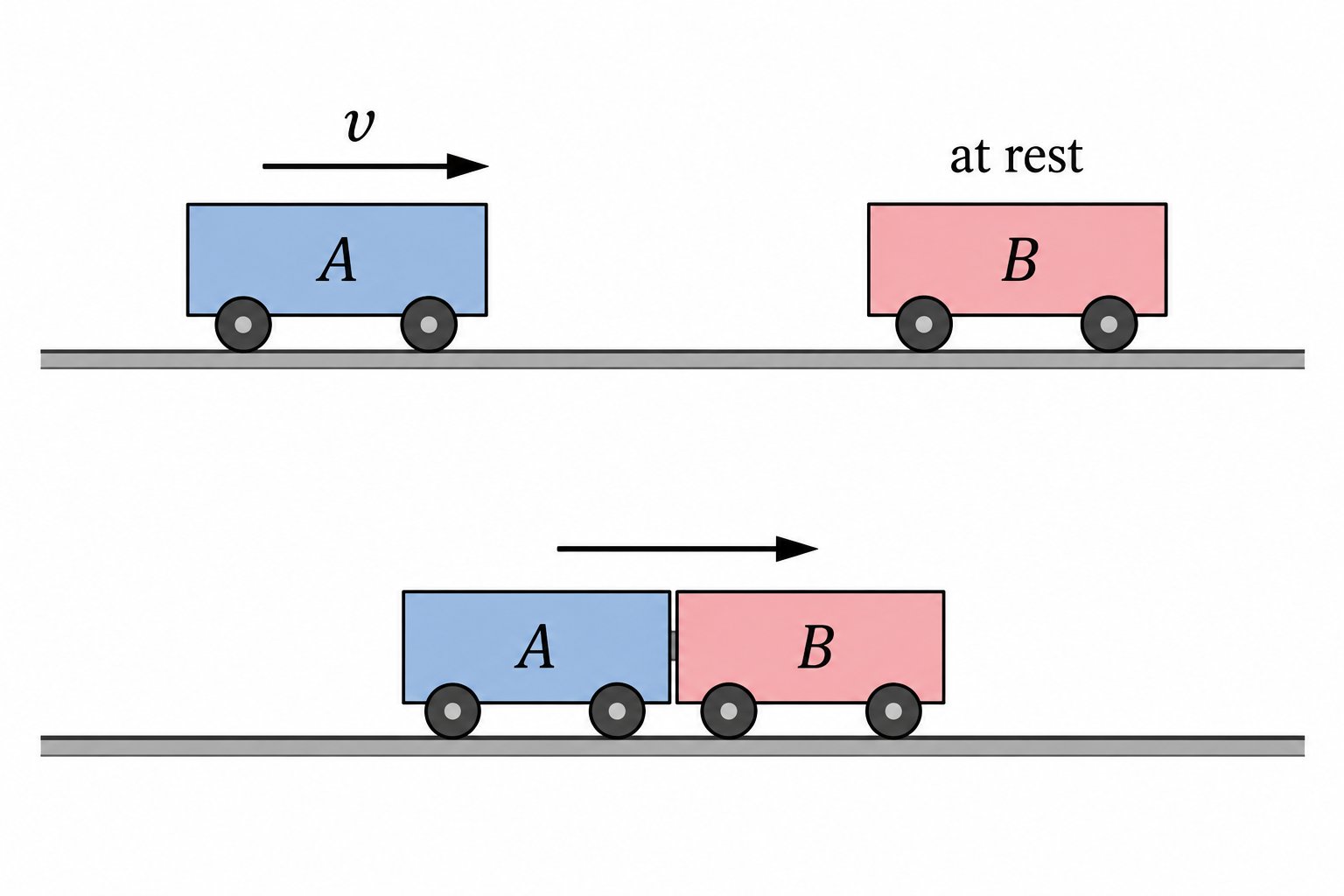
A cart strikes a stationary cart and they join, moving in the original incident direction.

Schematic: cart sizes, distances, and velocity-arrow lengths are not to scale.

Question 2 of 5

Two 1 kg carts collide on a level track with negligible external impulse and work. Their measured velocities are in the table. (a) Test momentum conservation. (b) Determine whether the collision is elastic or inelastic. (c) Explain whether the carts have to stick for your classification.

Cart Initial v (m/s) Final v (m/s)
A 3 0.5
B -1 1.5

Question 3 of 5

Design an experiment to compare the elasticity of magnetic bumpers and hook-and-loop bumpers on two carts. (a) Specify measured quantities and timing. (b) Define a numerical measure of kinetic energy retained. (c) Describe controls and uncertainty checks.

Question 4 of 5

Two equal-mass carts collide elastically. Their initial velocities are +u and -2u. A proposed final state has velocities -2u and +u. (a) Verify momentum conservation. (b) Verify kinetic energy conservation. (c) Explain why verifying only momentum would not establish elasticity.

Question 5 of 5

A 0.020 kg projectile embeds in a 0.980 kg block initially at rest on a frictionless horizontal surface. The pair then moves at 2.0 m/s. (a) Find the projectile's initial speed. (b) Calculate kinetic energy converted during the collision. (c) Explain why kinetic energy conservation cannot be used to find the initial speed.