Elastic and Inelastic Collisions MCQ Practice

Question 1 of 10

Which condition defines an elastic collision for an isolated two-object system?

  1. A. The objects have equal masses.
  2. B. Total kinetic energy is unchanged between before and after the collision.
  3. C. Each object keeps its own kinetic energy.
  4. D. The objects stick together.

Question 2 of 10

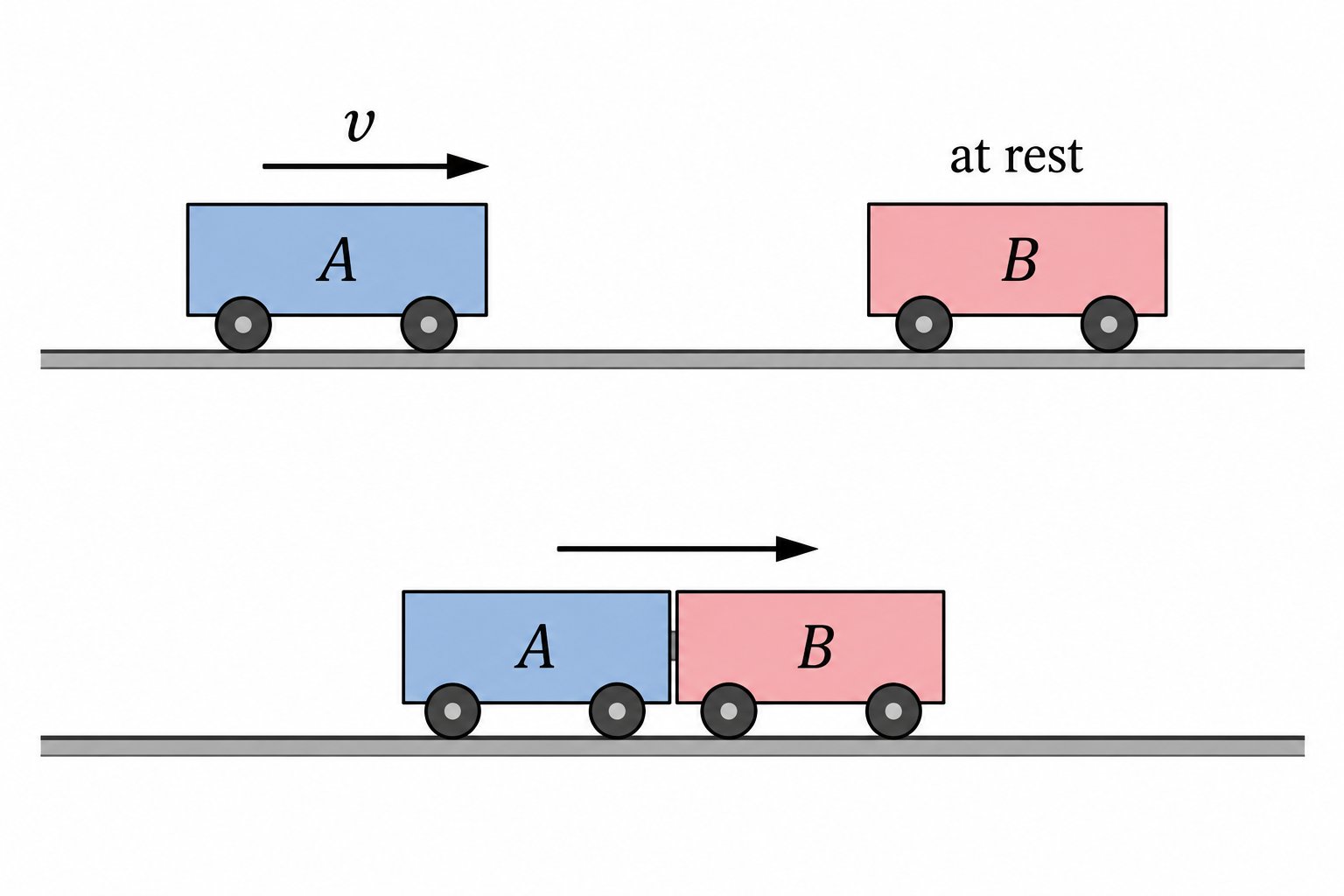
A cart of mass m moving at speed v collides with a stationary cart of mass m. They stick together on a level frictionless track. What fraction of the initial kinetic energy remains as translational kinetic energy?

A moving cart collides with a stationary cart and the carts move together afterward.

Schematic: cart sizes, distances, and velocity-arrow lengths are not to scale.

  1. A. 1/4
  2. B. 0
  3. C. 1/2
  4. D. 1

Question 3 of 10

Two carts have total kinetic energy 10 J before a collision and 7 J afterward. External work is negligible. Which statement is correct?

  1. A. The collision is elastic because energy is always conserved.
  2. B. 3 J of total energy is destroyed.
  3. C. Momentum must decrease by 30%.
  4. D. The collision is inelastic; 3 J is converted to other energy forms.

Question 4 of 10

Two identical carts collide elastically on a frictionless track. One initially moves at +3 m/s and the other is at rest. Which final velocities are consistent with the collision?

  1. A. 0 and +3 m/s
  2. B. +1.5 and +1.5 m/s
  3. C. -3 and 0 m/s
  4. D. +3 and +3 m/s

Question 5 of 10

Two identical carts approach each other with equal speeds and stick. External impulse is negligible. What happens to their total momentum and translational kinetic energy?

  1. A. Both quantities reverse sign.
  2. B. Momentum remains zero; translational kinetic energy decreases to zero.
  3. C. Both momentum and kinetic energy remain nonzero.
  4. D. Momentum decreases; kinetic energy remains constant.

Question 6 of 10

A moving object rebounds from a stationary object, and the two objects separate. Which conclusion follows from separation alone?

  1. A. The collision must be perfectly inelastic.
  2. B. Total momentum cannot be conserved.
  3. C. The collision could be elastic or inelastic.
  4. D. The collision must be elastic.

Question 7 of 10

In an isolated collision, object A loses 4 J of kinetic energy while object B gains 4 J. Which classification is supported?

  1. A. Perfectly inelastic
  2. B. Inelastic with 8 J lost
  3. C. Impossible because energy cannot transfer between objects
  4. D. Elastic

Question 8 of 10

A 1 kg cart at +4 m/s sticks to a stationary 3 kg cart. What is the final kinetic energy?

  1. A. 2 J
  2. B. 8 J
  3. C. 4 J
  4. D. 16 J

Question 9 of 10

A student measures both carts' masses and signed velocities before and after a collision. Which calculation directly tests whether the collision is elastic?

  1. A. Check whether the collision duration is short.
  2. B. Compare the sum of one-half mass times speed squared before and after.
  3. C. Compare the two final speeds only.
  4. D. Check whether both final velocities are positive.

Question 10 of 10

Two isolated carts collide with a spring bumper. During maximum spring compression, their total kinetic energy is below its initial value. Does this observation alone show that the collision is inelastic?

  1. A. Yes; springs always dissipate energy.
  2. B. No; each cart must retain its original speed.
  3. C. No; elastic potential energy can later return to kinetic energy.
  4. D. Yes; kinetic energy must be constant at every instant of an elastic collision.