Question 1 of 10
A constant net force of 12 N east acts on a cart for 0.25 s. What impulse does it deliver?
- A. 48 N s east
- B. 3.0 N s west
- C. 12 N s east
- D. 3.0 N s east
A constant net force of 12 N east acts on a cart for 0.25 s. What impulse does it deliver?
A 0.20 kg ball approaches a wall at 5 m/s to the right and rebounds at 3 m/s to the left. What is the net impulse on the ball, taking right positive?
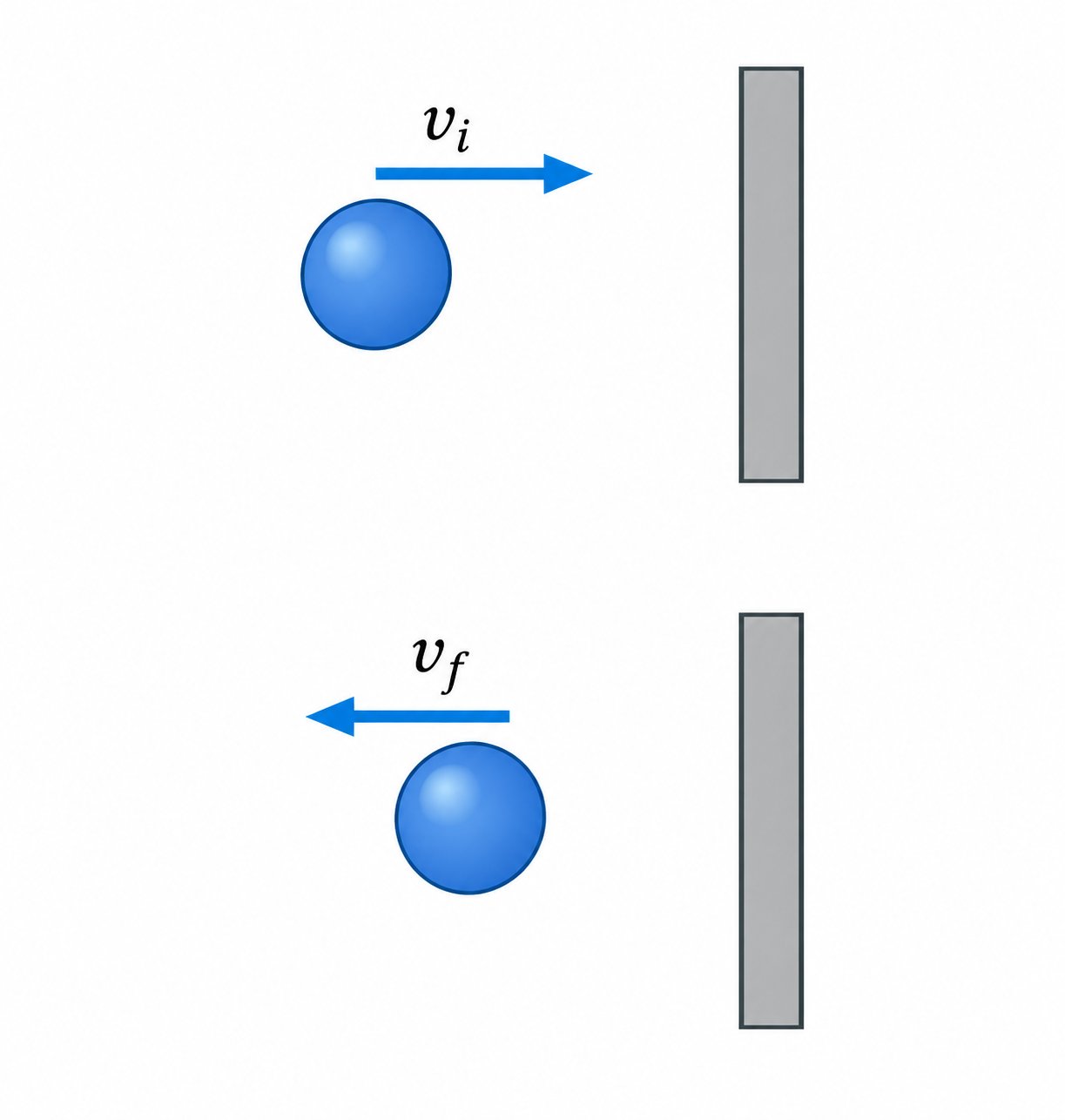
Schematic: cart sizes, distances, and velocity-arrow lengths are not to scale.
A cart experiences the net force-time graph shown. What is the impulse from 0 to 4 s?
Two padded barriers stop the same cart from the same initial velocity. Barrier Q doubles the stopping time relative to barrier P. How do the magnitudes of the average net forces compare?
A momentum-time graph is a straight line from 2 kg m/s at 0 s to 10 kg m/s at 4 s. What net force acts?
A net force of +4 N acts for 2 s, followed by -2 N for 3 s. What is the total impulse?
A 2 kg cart initially moves at +1 m/s. A net impulse of -6 N s acts. What is its final velocity?
A ball is caught and stopped. Which quantity must be measured in addition to the ball mass and velocities just before and after the catch to determine the average net force?
Two net-force pulses have equal signed area under their force-time graphs but different peak values. Applied to the same cart with the same initial velocity, they produce which result?
A ball is in free fall for a short interval, with air resistance negligible. What determines the direction of the impulse due to gravity?