Conservation of Energy FRQ Practice

Responses receive AI feedback against a rubric after submission. Scores are practice estimates.

Question 1 of 5

Scenario B. A $0.50\,kg$ cart is launched by a spring on a level track. The table shows launch speed for three spring compressions. (a) Calculate the cart's kinetic energy for each trial. (b) Determine the effective spring constant from each trial using $\tfrac12kx^2=K$ and assess consistency. (c) Explain how friction would affect the calculated values of $k$. Release the cart from rest each time and neglect wheel rotational energy.

Compression (m) Launch speed (m/s)
0.10 1.4
0.20 2.8
0.30 4.2

Question 2 of 5

Scenario B. A pendulum bob of mass $m$ is released from rest a vertical height $h$ above its lowest point. Assume the bob reaches the bottom. Air drag removes a total amount of mechanical energy $E_d$ during the descent. (a) Derive the speed at the bottom. (b) State the necessary energy bound on $E_d$ for a nonnegative bottom kinetic energy. (c) Identify where the removed energy is transferred.

Question 3 of 5

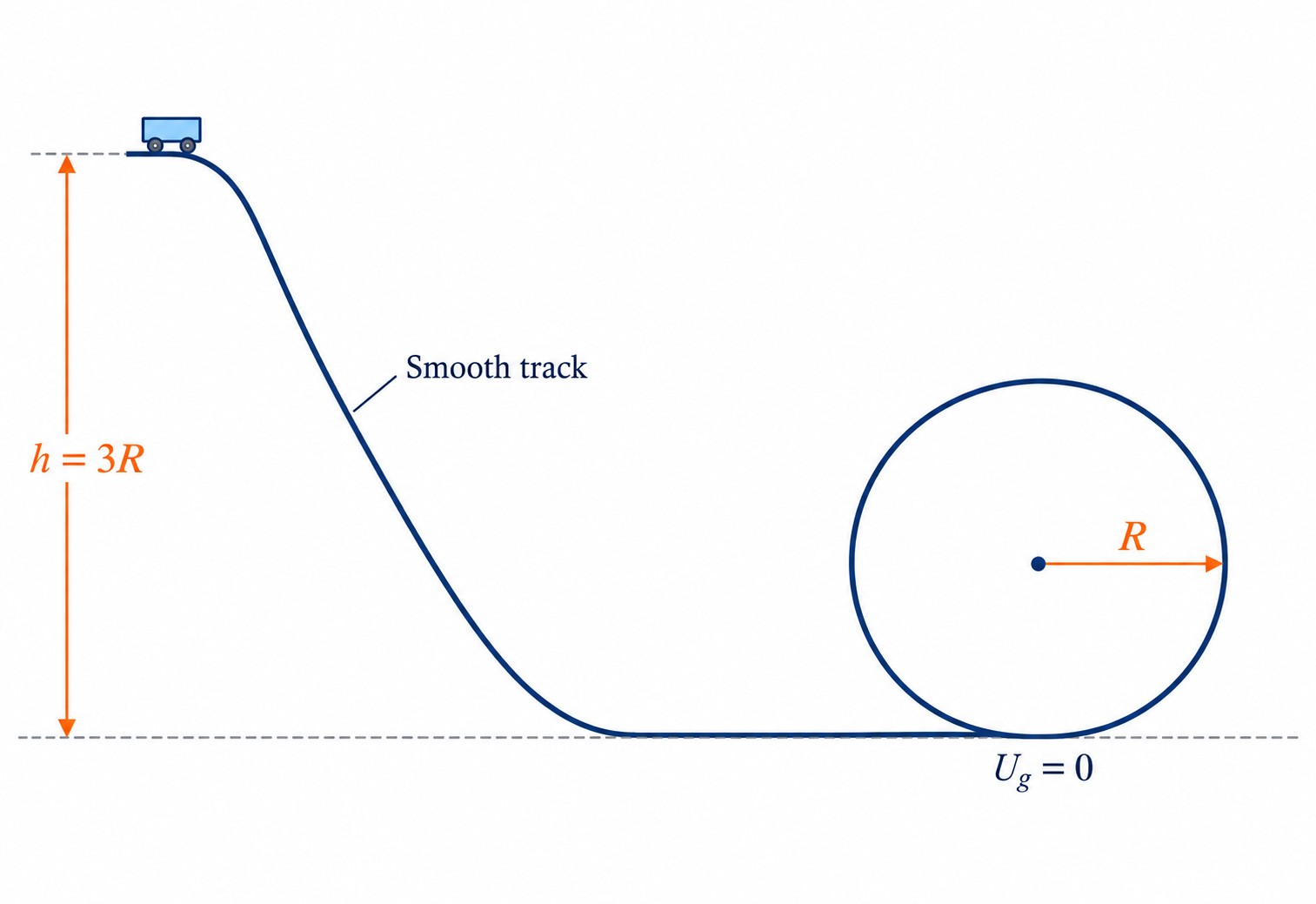
Scenario B. The pictured cart is released from rest at the labeled height $h=3R$ above the bottom of a smooth vertical loop of radius $R$. Take gravitational potential energy to be zero at the bottom. (a) Determine the cart's speed when it first reaches height $R$. (b) Determine the height at which its kinetic and gravitational potential energies are equal. (c) If a modified track exerts a constant friction force $f$ over path length $L$ from release to the bottom, derive the cart's bottom speed. The cart has mass $m$; neglect wheel rotation and air resistance. In part (c), assume it reaches the bottom.

A cart released from height h enters a vertical loop of radius R.

Question 4 of 5

Scenario B. A roller-coaster car has speed $v_0$ at height $h_0$ and later speed $v_1$ at height $h_1$. (a) Write an expression for the change in mechanical energy. (b) If that change is negative, determine the work done by nonconservative forces. (c) Explain how changing the system to include the track alters the interpretation of the same energy loss. Model the car as a particle of mass $m$, with no propulsion or other energy source.

Question 5 of 5

Scenario B. A ball of mass $m$ is released from rest and falls through a total vertical height $h$ and is caught at rest by a student's hand. For a system containing ball, student, and Earth: (a) write an energy account from release until the ball is at rest in the hand, (b) identify the final energy form corresponding to the lost gravitational potential energy, and (c) explain why momentum considerations alone cannot determine that energy transfer. Include any downward hand motion during the catch in $h$. Model the catch as passive, with no other energy-source change or energy transfer across the system boundary.