Question 1 of 10
Scenario A. A cart moves on a frictionless track through the points listed. At which point is its speed greatest?
| Point | Height (m) |
|---|---|
| P | 3.0 |
| Q | 2.2 |
| R | 1.4 |
| S | 0.6 |
- A. P
- B. Q
- C. R
- D. S
Scenario A. A cart moves on a frictionless track through the points listed. At which point is its speed greatest?
| Point | Height (m) |
|---|---|
| P | 3.0 |
| Q | 2.2 |
| R | 1.4 |
| S | 0.6 |
Scenario A. A block is released from rest 4 m above the bottom of a frictionless track. Using $g=10\,\mathrm{m/s^2}$, its speed at the bottom is closest to
Scenario A. A block slides down a rough ramp at constant speed. For the system containing the block, ramp, and Earth, which energy transfer occurs?
Scenario A. For which choice of system can a falling object be analyzed with gravitational potential energy internal to the system?
The same ideal spring launches blocks of mass $m$ and $4m$ separately from rest at the same compression on a level frictionless surface. Neglect all other energy losses. The ratio of launch speeds $v_m/v_{4m}$ is
Scenario A. A cart passes through a vertical loop on a frictionless track. Which statement is sufficient for using conservation of mechanical energy between bottom and top?
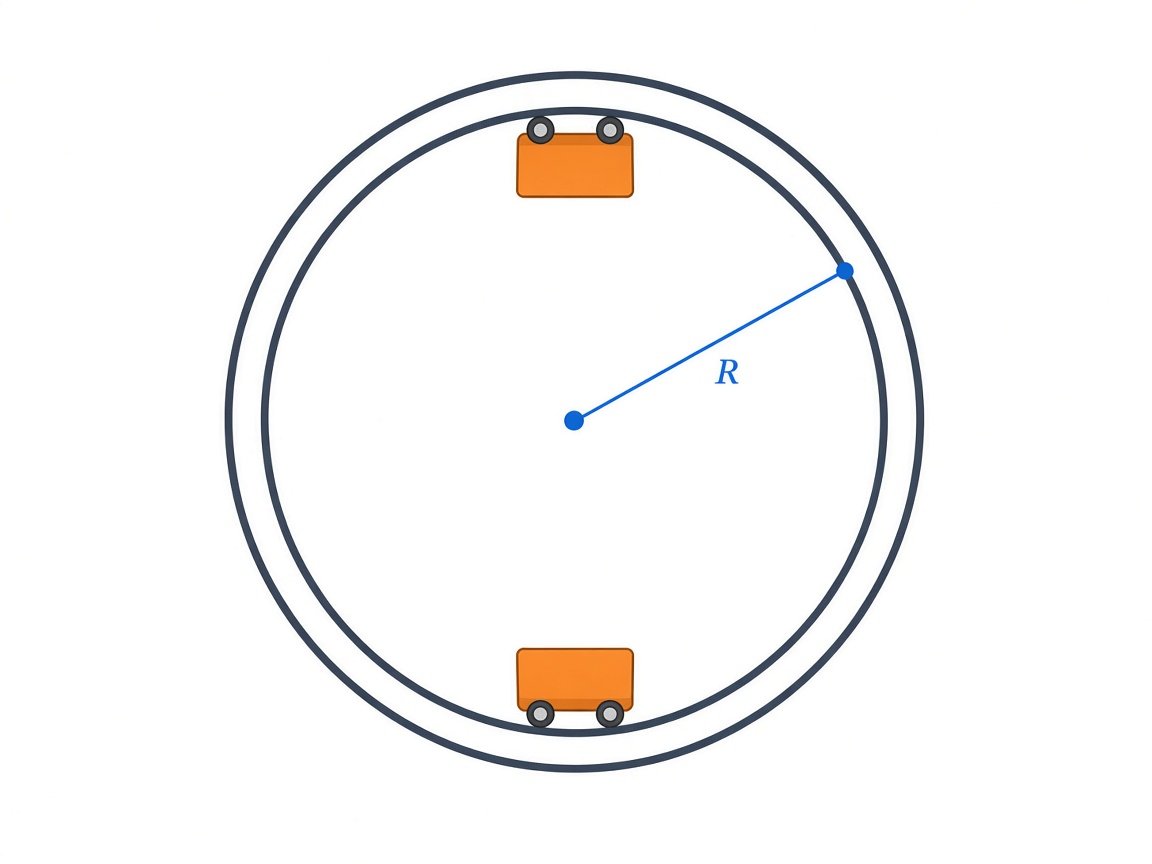
Scenario A. A motor does positive work on a cart while the cart climbs and speeds up. The motor’s work equals
Scenario A. Two frictionless ramps have different shapes but the same starting and ending heights. Identical blocks start from rest. At the ends, the blocks have
Scenario A. A pendulum bob is released from rest. Ignoring drag, when is its kinetic energy equal to its loss in gravitational potential energy?
Scenario A. Measured final kinetic energy is less than the decrease in gravitational potential energy. Which is the best inference?