Kinetic and Static Friction MCQ Practice

Question 1 of 10

A $5.0\,\mathrm{kg}$ box on a level floor has $\mu_s=0.30$ and $\mu_k=0.20$. A horizontal force of $12\,\mathrm{N}$ is applied. Using $g=10\,\mathrm{m/s^2}$, the box’s acceleration is

  1. A. $0$
  2. B. $0.40\,\mathrm{m/s^2}$
  3. C. $2.4\,\mathrm{m/s^2}$
  4. D. $0.60\,\mathrm{m/s^2}$

Question 2 of 10

A block slides down a $30^\circ$ incline with $\mu_k=0.35$. Using $g=10\,\mathrm{m/s^2}$, $\sin30^\circ=0.50$, and $\cos30^\circ=0.87$, the magnitude of its acceleration is closest to

  1. A. $1.6\,\mathrm{m/s^2}$
  2. B. $2.0\,\mathrm{m/s^2}$
  3. C. $3.5\,\mathrm{m/s^2}$
  4. D. $5.0\,\mathrm{m/s^2}$

Question 3 of 10

A block rests on a $25^\circ$ incline with $\mu_s=0.60$. Take $\tan25^\circ=0.47$. Which statement is correct?

  1. A. It remains at rest, and the static friction force on it equals $mg\sin25^\circ$.
  2. B. It remains at rest, and the static friction force on it equals $0.60\,mg\cos25^\circ$.
  3. C. It slides, because a coefficient less than $1$ cannot hold an object on a slope.
  4. D. It slides, and the friction force on it equals $0.60\,mg$.

Question 4 of 10

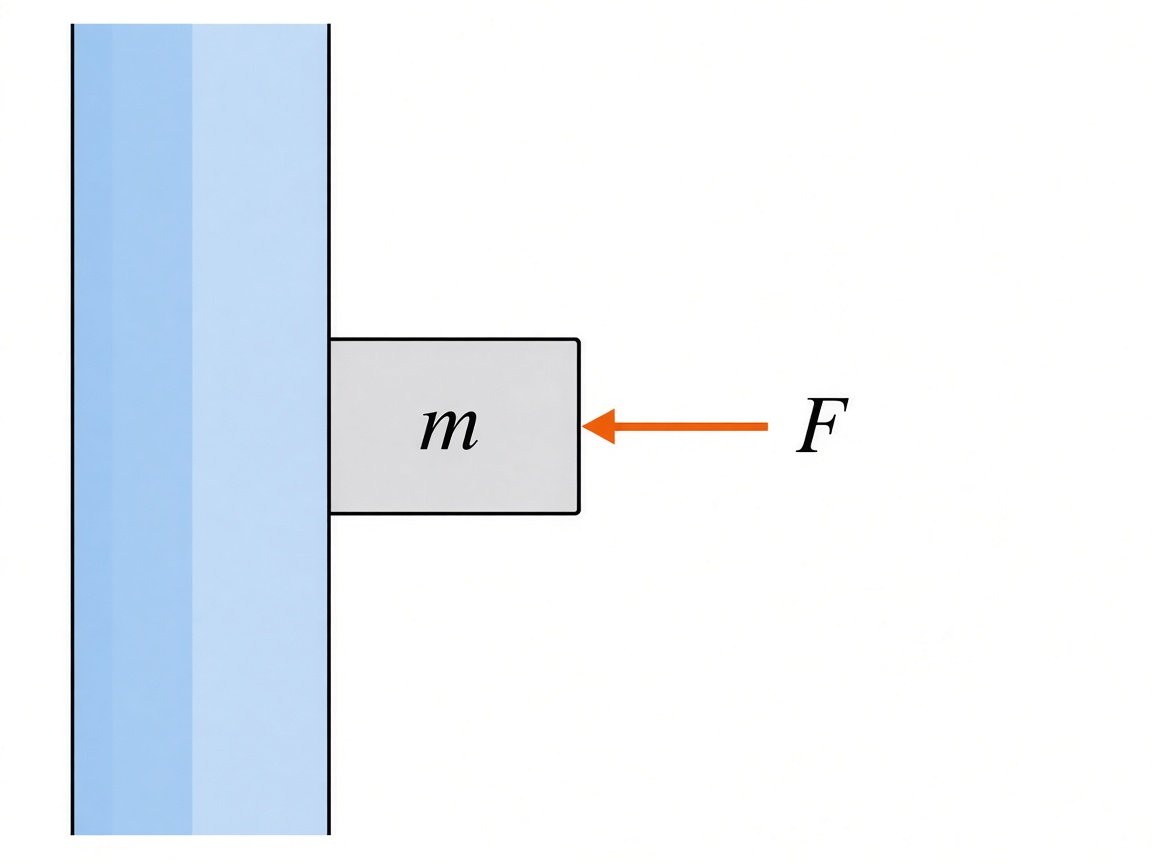
A block of mass $m$ is held against a vertical wall by a horizontal push of magnitude $F$. The coefficient of static friction between block and wall is $\mu_s$. The smallest $F$ that keeps the block from sliding down is

A block is held against a vertical wall by a horizontal force.
  1. A. $\mu_s mg$
  2. B. $\dfrac{mg}{\mu_s}$
  3. C. $mg$
  4. D. $\dfrac{\mu_s mg}{1+\mu_s}$

Question 5 of 10

Four blocks of the same material rest on the same level surface. Using the table, rank the minimum horizontal force needed to start each block sliding, greatest first.

Block Mass (kg) Contact area ($\mathrm{m^2}$)
$P$ 2.0 0.020
$Q$ 3.0 0.010
$R$ 3.0 0.040
$S$ 1.5 0.060
  1. A. $R>Q>P>S$
  2. B. $Q=R>P>S$
  3. C. $S>R>P>Q$
  4. D. $Q>R>P>S$

Question 6 of 10

Block $A$ ($1.0\,\mathrm{kg}$) rides on top of block $B$ ($3.0\,\mathrm{kg}$), which slides on a level floor; the two never slip relative to each other. Between floor and $B$, $\mu_k=0.20$. A horizontal force of $20\,\mathrm{N}$ is applied to $B$. Using $g=10\,\mathrm{m/s^2}$, the friction force the floor exerts on $B$ is

  1. A. $8.0\,\mathrm{N}$
  2. B. $6.0\,\mathrm{N}$
  3. C. $4.0\,\mathrm{N}$
  4. D. $20\,\mathrm{N}$

Question 7 of 10

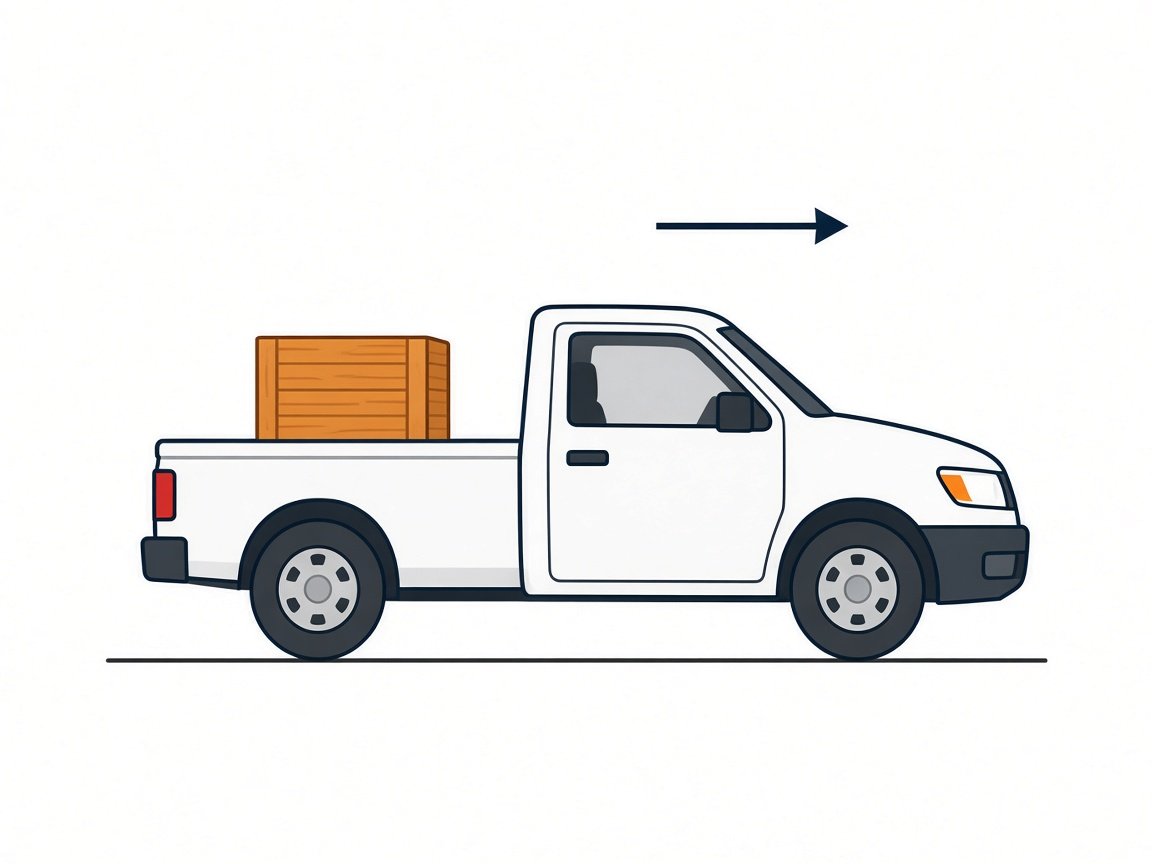
A crate rides in the bed of a pickup truck with $\mu_s=0.45$ between crate and bed. Using $g=10\,\mathrm{m/s^2}$, the greatest forward acceleration the truck can have with the crate not sliding is

A pickup truck accelerates with a crate remaining fixed relative to its bed.
  1. A. $4.5\,\mathrm{m/s^2}$
  2. B. $0.45\,\mathrm{m/s^2}$
  3. C. $10\,\mathrm{m/s^2}$
  4. D. It cannot be found without the crate’s mass.

Question 8 of 10

A heavy trunk is dragged at constant velocity across a level floor by a horizontal rope. Which statement is correct?

  1. A. The rope tension exceeds the kinetic friction force, because the trunk is moving.
  2. B. The rope tension equals the kinetic friction force, and both are smaller than $\mu_s N$ for this pair of surfaces.
  3. C. The rope tension equals the maximum static friction force.
  4. D. The friction force grows steadily the longer the trunk keeps moving.

Question 9 of 10

A block slides down an incline of angle $\theta$ with measured acceleration of magnitude $a$ (with $a<g\sin\theta$). The coefficient of kinetic friction is

  1. A. $\dfrac{g\sin\theta-a}{g\cos\theta}$
  2. B. $\dfrac{g\sin\theta+a}{g\cos\theta}$
  3. C. $\tan\theta-\dfrac{a}{g}$
  4. D. $\dfrac{a}{g\cos\theta}$

Question 10 of 10

A block is given an initial speed of $4.0\,\mathrm{m/s}$ directly up a $20^\circ$ incline with $\mu_k=0.25$. Using $g=10\,\mathrm{m/s^2}$, $\sin20^\circ=0.34$, and $\cos20^\circ=0.94$, the distance it travels along the incline before stopping is closest to

  1. A. $1.4\,\mathrm{m}$
  2. B. $2.4\,\mathrm{m}$
  3. C. $0.80\,\mathrm{m}$
  4. D. $3.2\,\mathrm{m}$