Kinetic and Static Friction MCQ Practice

Question 1 of 10

A $4.0\,\mathrm{kg}$ crate sits on a level floor with $\mu_s=0.60$ and $\mu_k=0.40$. A student pushes horizontally on it with $20\,\mathrm{N}$. Using $g=10\,\mathrm{m/s^2}$, the magnitude of the friction force on the crate is

  1. A. $24\,\mathrm{N}$
  2. B. $20\,\mathrm{N}$
  3. C. $16\,\mathrm{N}$
  4. D. $4.0\,\mathrm{N}$

Question 2 of 10

The same $4.0\,\mathrm{kg}$ crate ($\mu_s=0.60$, $\mu_k=0.40$, $g=10\,\mathrm{m/s^2}$) is now pushed horizontally with $30\,\mathrm{N}$. Its acceleration is

  1. A. $1.5\,\mathrm{m/s^2}$
  2. B. $2.5\,\mathrm{m/s^2}$
  3. C. $3.5\,\mathrm{m/s^2}$
  4. D. $7.5\,\mathrm{m/s^2}$

Question 3 of 10

A solid rectangular block rests on a table. Without changing its mass or either material, the block is tipped so that it rests on a face with half the previous contact area. The maximum static friction force between block and table

  1. A. doubles, because the same weight is now pressed onto half the area
  2. B. is halved, because the contact area is halved
  3. C. is unchanged, because $f_{s,\max}=\mu_s N$ depends on the normal force and the surfaces, not on the apparent contact area
  4. D. becomes zero until the block is pushed hard enough to re-establish contact

Question 4 of 10

Two blocks made of the same material, of masses $m$ and $3m$, are placed side by side on a board whose angle $\theta$ with the horizontal is slowly increased. Which block begins to slide first?

  1. A. The $m$ block, because less weight holds it against the board
  2. B. The $3m$ block, because gravity pulls it harder along the board
  3. C. Neither; both slip at the same angle, the one where $\tan\theta=\mu_s$
  4. D. The block with the larger contact area, whichever that is

Question 5 of 10

A box of mass $m$ on a level floor is pushed with a force of magnitude $F$ directed at an angle $\theta$ below the horizontal, and the box slides. The coefficient of kinetic friction is $\mu_k$. The magnitude of the box’s acceleration is

  1. A. $\dfrac{F\cos\theta-\mu_k mg}{m}$
  2. B. $\dfrac{F\cos\theta-\mu_k(mg+F\sin\theta)}{m}$
  3. C. $\dfrac{F\cos\theta-\mu_k(mg-F\sin\theta)}{m}$
  4. D. $\dfrac{F-\mu_k mg}{m}$

Question 6 of 10

A $2.0\,\mathrm{kg}$ block is pushed with a steady horizontal force of $9.0\,\mathrm{N}$ on each of the four surfaces in the table. Using $g=10\,\mathrm{m/s^2}$, on which surface does the block end up sliding with the greatest acceleration?

Surface $\mu_s$ $\mu_k$
$W$ 0.40 0.30
$X$ 0.55 0.35
$Y$ 0.50 0.40
$Z$ 0.30 0.25
  1. A. Surface $W$, where $a=1.5\,\mathrm{m/s^2}$
  2. B. Surface $X$, where $a=1.0\,\mathrm{m/s^2}$
  3. C. Surface $Y$, where $a=0.50\,\mathrm{m/s^2}$
  4. D. Surface $Z$, where $a=2.0\,\mathrm{m/s^2}$

Question 7 of 10

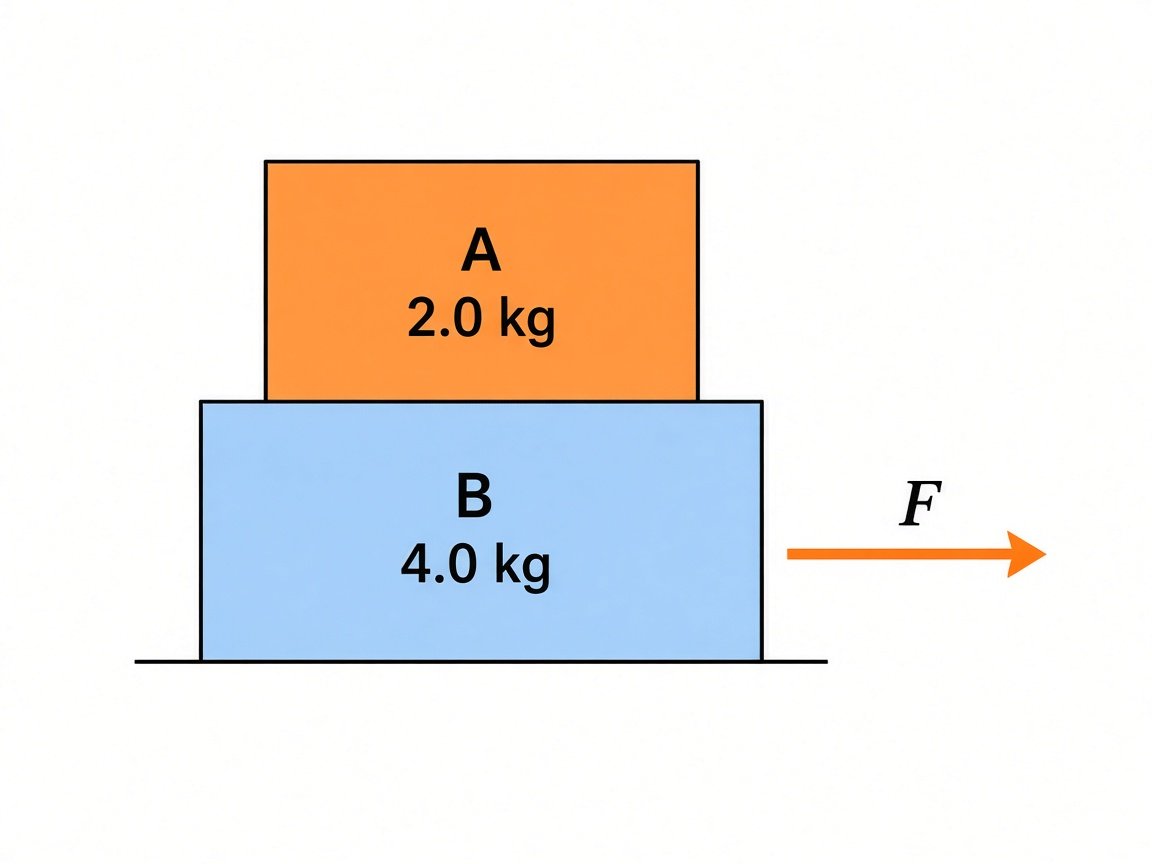
Block $A$ ($2.0\,\mathrm{kg}$) rests on top of block $B$ ($4.0\,\mathrm{kg}$), which sits on a frictionless floor. The coefficient of static friction between $A$ and $B$ is $0.40$. A horizontal force is applied to $B$. Using $g=10\,\mathrm{m/s^2}$, the largest force that can be applied without $A$ sliding on $B$ is

A 2-kilogram block rests on a 4-kilogram block while a force is applied to the lower block.
  1. A. $8.0\,\mathrm{N}$
  2. B. $16\,\mathrm{N}$
  3. C. $24\,\mathrm{N}$
  4. D. $40\,\mathrm{N}$

Question 8 of 10

A block is launched up a rough incline, momentarily stops, and then slides back down. Comparing the magnitude of its acceleration on the way up with the magnitude on the way down,

  1. A. the upward trip has the larger magnitude, because gravity and kinetic friction both act down the incline while the block rises
  2. B. the downward trip has the larger magnitude, because friction reverses and then adds to gravity
  3. C. the two magnitudes are equal, because $\mu_k$ is the same in both directions
  4. D. the upward trip has the smaller magnitude, because friction opposes gravity while the block rises

Question 9 of 10

A puck sliding at $6.0\,\mathrm{m/s}$ on a level surface with $\mu_k=0.30$ slides to a stop. Using $g=10\,\mathrm{m/s^2}$, which statement is correct?

  1. A. It slides $6.0\,\mathrm{m}$, and a puck of twice the mass launched at the same speed would slide the same distance.
  2. B. It slides $6.0\,\mathrm{m}$, and a puck of twice the mass launched at the same speed would slide $12\,\mathrm{m}$.
  3. C. It slides $12\,\mathrm{m}$, and doubling the mass halves that distance.
  4. D. It slides $3.0\,\mathrm{m}$, and the distance does not depend on $\mu_k$.

Question 10 of 10

A block of weight $30\,\mathrm{N}$ sits on a level surface while a horizontal pull is slowly increased from zero. The friction force on the block is graphed against the applied pull. The coefficients of friction for this pair of surfaces are

Friction force versus applied pull: a line of slope 1 rising from the origin to 12 N, a sudden drop to 8 N, then a horizontal line at 8 N.
  1. A. $\mu_s=0.40$ and $\mu_k=0.27$
  2. B. $\mu_s=0.27$ and $\mu_k=0.40$
  3. C. $\mu_s=0.40$ and $\mu_k=0.40$
  4. D. $\mu_s=12$ and $\mu_k=8.0$