Kinetic and Static Friction FRQ Practice

Responses receive AI feedback against a rubric after submission. Scores are practice estimates.

Question 1 of 5

A student has a wooden block, a board that can be tilted to any angle, a protractor, and a stopwatch. (a) Describe a procedure that measures $\mu_s$ between the block and the board, and state the equation used. (b) Describe a procedure that measures $\mu_k$ for the same pair. (c) Explain why these two procedures must give $\mu_s\ge\mu_k$.
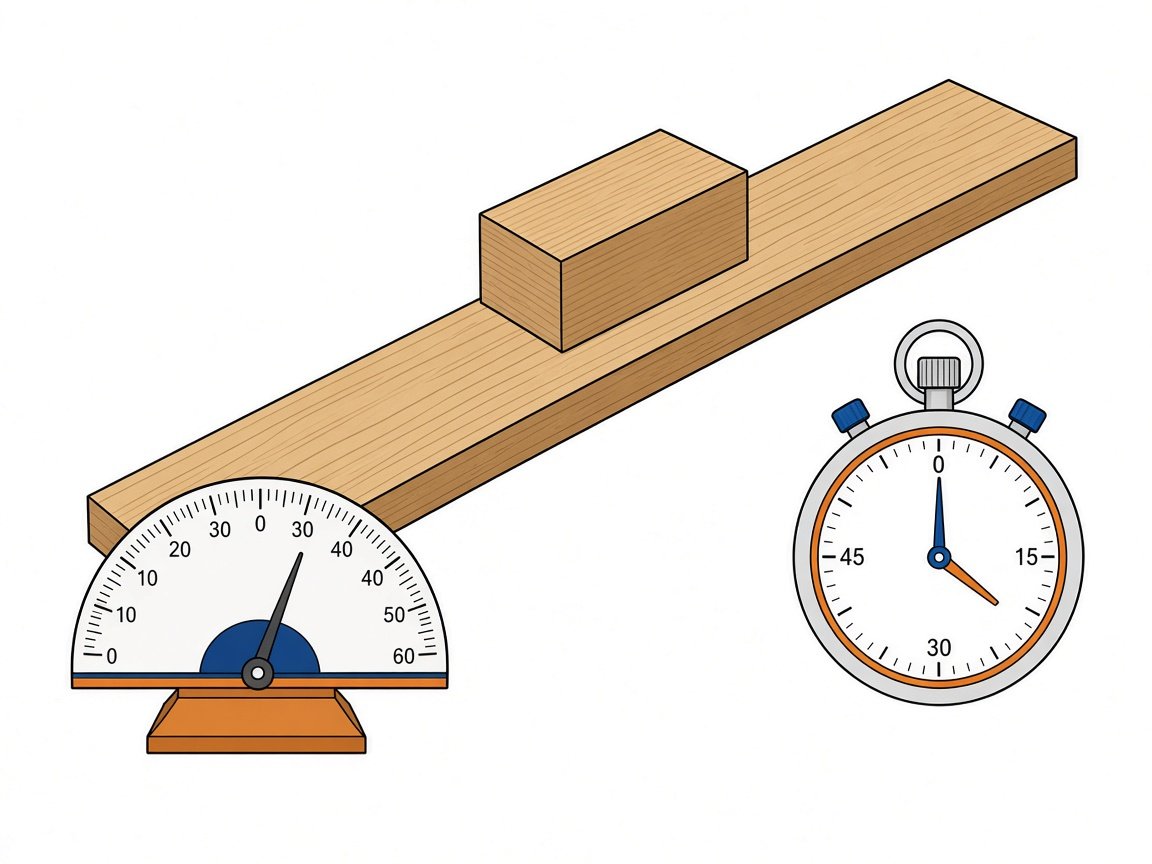
A wooden block rests on an adjustable board with a protractor and stopwatch nearby.

Question 2 of 5

A crate of mass $m$ rests on a level floor with coefficient of static friction $\mu_s$. A rope pulls on it with tension $T$ at an angle $\theta$ above the horizontal. (a) Write the vertical and horizontal component equations at the instant slipping is impending. (b) Derive an expression for the smallest tension $T_{\min}$ that starts the crate moving. (c) Explain physically why pulling at an angle above the horizontal can require less tension than pulling horizontally, even though only part of $T$ acts along the floor.

Question 3 of 5

A $20\,\mathrm{kg}$ crate on a level floor has $\mu_s=0.50$ and $\mu_k=0.30$. Use $g=10\,\mathrm{m/s^2}$. (a) A worker pushes horizontally with $90\,\mathrm{N}$. Show by calculation whether the crate moves. (b) State the magnitude of the friction force in part (a). (c) The push is increased to $110\,\mathrm{N}$. Calculate the crate’s acceleration.

Question 4 of 5

A block of weight $50\,\mathrm{N}$ on a level bench is pulled horizontally. The table lists four trials. (a) Use trials 1–3 to state the tightest bounds the data place on $\mu_s$. (b) Use trial 4 to calculate $\mu_k$. (c) Explain why trials 1–3 alone cannot determine $\mu_k$.

Trial Horizontal pull (N) Observation
1 15 block stays at rest
2 19 block stays at rest
3 21 block starts to slide
4 14 already-sliding block moves at constant velocity

Question 5 of 5

A $3.0\,\mathrm{kg}$ block on a level table is connected by a light string over an ideal pulley to a $2.0\,\mathrm{kg}$ block hanging freely. For the table surface, $\mu_s=0.35$ and $\mu_k=0.25$. Use $g=10\,\mathrm{m/s^2}$. (a) Show by calculation that the system starts moving when released. (b) Calculate the acceleration. (c) Calculate the string tension. (d) Without recalculating, explain how the tension would compare if the table were frictionless.