TOPIC 5.5 · STUDY
Environmental Effects on Phenotype
One genotype can produce more than one phenotype when the environment changes. That response is phenotypic plasticity. Soil, season, temperature, ultraviolet light, nutrition, and nearby cells are typical cues, and the genotype stays the same.
5.5.A
Same genotype, different conditions
Phenotypic plasticity is the ability of one genotype to produce different phenotypes when the environment changes. The genotype itself stays the same. Cuttings from one plant, or animals that share a genotype, make the comparison clean: a difference between treatments is environmental.
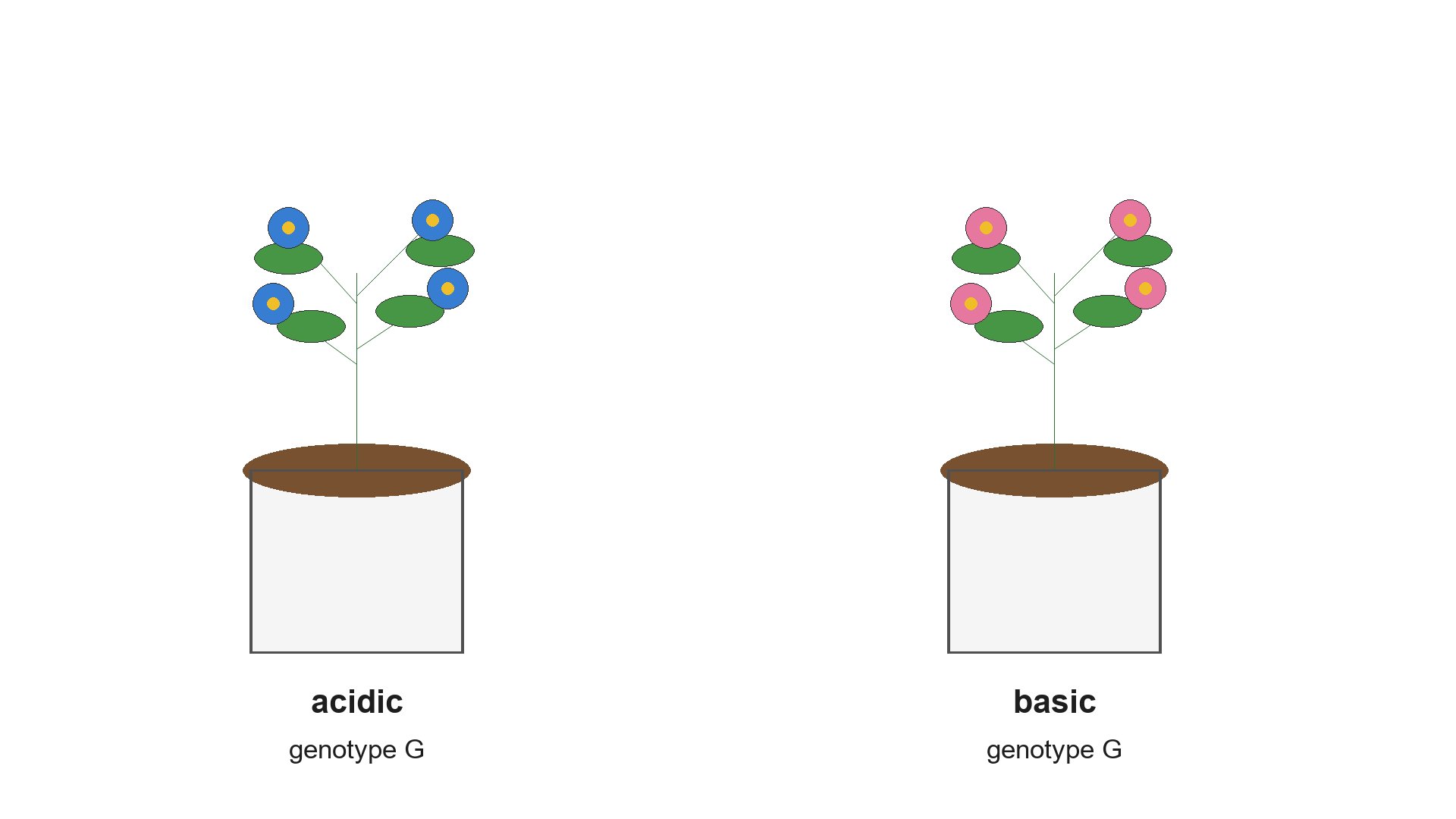
Both plants are genotype G. Acidic soil and basic soil are the environmental difference, and flower color is the phenotype that changes.
Environmental conditions influence gene expression, and that influence is how one genotype can yield more than one phenotype. The molecular controls of transcription and translation are a later unit. This topic stops at the link between conditions and phenotype.
The course examples all keep the genotype fixed. Human height and weight depend on many genes and also on nutrition, so one polygenic background can produce different adult mass on different diets. One hydrangea genotype makes blue flowers in acidic soil and pink flowers in basic soil, and cuttings follow the soil they are planted in. An arctic mammal can change fur color with the season, often with day length, so summer brown and winter white can be the same genotype. In some reptiles, nest temperature determines the sex phenotype, unlike XX/XY sex determination, which is set by chromosomes rather than by incubation temperature. More ultraviolet light can raise melanin in a genetically matched animal. Yeast and other fungi may release mating pheromone only when the opposite mating type is nearby. The nearby cell is a cue, and the haploid mating-type genotype does not change.
Percent change is $(\text{new}-\text{old})/\text{old}$, then times $100$ for a percent. A score of $40$ at a low ultraviolet dose and $52$ at a high dose changes by $(52-40)/40=0.30$, a $30\%$ increase. If a table instead lists $20\%$ males at one temperature and $80\%$ at another, the gap is $60$ percentage points. Say which quantity you are comparing.
A fair test holds genotype fixed and changes one environmental factor. Soil pH, ultraviolet dose, temperature, or day length can be the independent variable. Hue, melanin, sex ratio, or height can be the dependent variable. Matched genotypes block the alternative that a hidden genetic difference caused the change. A very small sample, or two environments that differ in several uncontrolled ways, weakens the claim. Plasticity also does not mean the trait has no genetic basis. Two genotypes can still differ in one shared environment, and one genotype can differ across two environments.
Key points
- Phenotypic plasticity is one genotype producing more than one phenotype as the environment changes.
- The environment influences gene expression. The regulatory machinery belongs to a later unit.
- Course cases include nutrition and body size, soil pH and flower color, seasonal fur, reptile nest temperature, ultraviolet light and melanin, and a mating-type cue for pheromone.
- Percent change is $(\text{new}-\text{old})/\text{old}$. From $40$ to $52$ is a $30\%$ increase.
- A fair test holds the genotype fixed and changes one environmental factor.
- Different genotypes can still differ when they share one environment.
A coat that changes color with the season is the same genotype responding to conditions, not a new mutation each season.