TOPIC 6.1 · STUDY
DNA and RNA Structure
Hereditary information is stored in DNA and, in some cases, RNA. Prokaryotes typically have a circular chromosome. Eukaryotes typically have multiple linear chromosomes packaged with histones. Both can carry plasmids. Adenine pairs with thymine or uracil, and guanine pairs with cytosine.
6.1.A
Chromosomes and plasmids
Genetic information is stored in DNA and passed to the next generation through DNA. In some cases, especially certain viruses, RNA stores that information instead. Typical chromosomes of bacteria and of plants or animals are DNA molecules. An RNA genome in a virus does not change that description of cellular chromosomes.
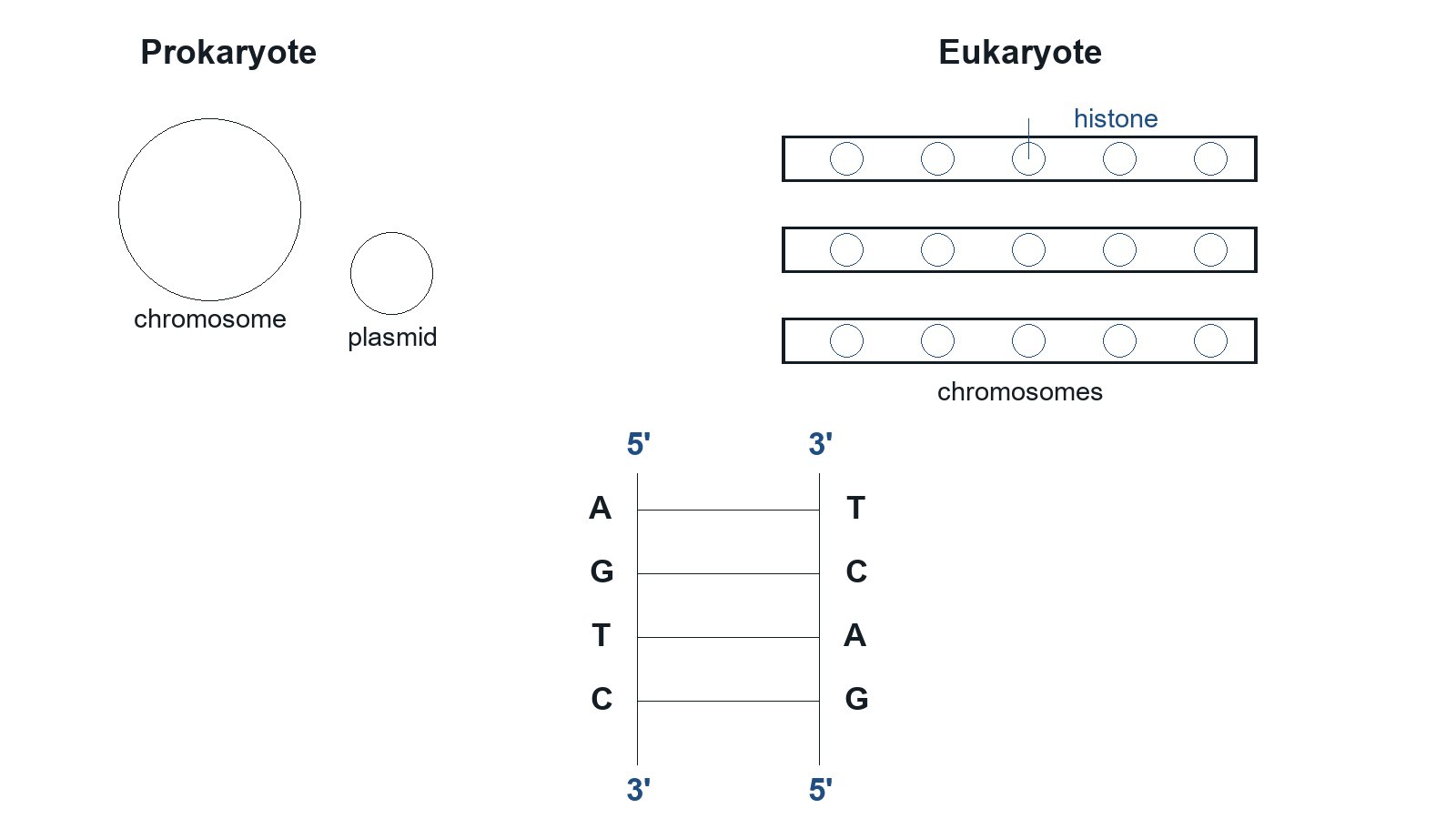
Prokaryotes typically have a circular chromosome and may carry a smaller plasmid. Eukaryotes typically have several linear chromosomes wrapped on histone proteins. On the ladder, A pairs with T and G pairs with C, and the strands run in opposite directions.
Prokaryotic cells typically have one circular chromosome. Eukaryotic cells typically have multiple linear chromosomes made of DNA. Those eukaryotic chromosomes are condensed with histones and other proteins so the long molecules can be organized in the nucleus. Removing histones lets that DNA spread out.
A plasmid is an extra-chromosomal circular DNA molecule. It can replicate apart from the main chromosome. Prokaryotes and eukaryotes can both contain plasmids. Finding only linear chromosomes in a eukaryotic cell does not rule a plasmid out. A test is to look for circular DNA that is separate from those chromosomes.
6.1.B
Base pairing
Nucleic acids use specific base pairing, and that pairing has stayed the same through evolution. One strand can specify the other, which is why DNA works as hereditary material.
Purines have two rings: adenine (A) and guanine (G). Pyrimidines have one ring: cytosine (C), thymine (T), and uracil (U). A purine pairs with a pyrimidine. In DNA, A pairs with T and G pairs with C. In RNA, A pairs with U and G still pairs with C. A does not pair with G. Two purines would be too wide for the pair, and two pyrimidines would be too narrow.
The two DNA strands are antiparallel. If one strand is written 5' to 3', its complement is written 3' to 5' so the pairs line up. The strand 5'-ATGCCA-3' pairs with 3'-TACGGT-5'. The same bases written 5' to 3' on the complement are 5'-TGGCAT-3'.
In double-stranded DNA, the amount of A equals the amount of T, and the amount of G equals the amount of C. If A is 22 percent, T is 22 percent. The other 56 percent is G plus C, so G and C are each 28 percent.
| Base | Ring class | Partner in DNA | Partner in RNA |
|---|---|---|---|
| Adenine | Purine, two rings | Thymine | Uracil |
| Guanine | Purine, two rings | Cytosine | Cytosine |
| Cytosine | Pyrimidine, one ring | Guanine | Guanine |
| Thymine | Pyrimidine, one ring | Adenine | Not used in RNA |
| Uracil | Pyrimidine, one ring | Not used in DNA | Adenine |
DNA contains deoxyribose and thymine and is usually double-stranded. RNA contains ribose and uracil and is usually single-stranded. Those differences change which base meets adenine. The purine-with-pyrimidine rule stays the same.
Key points
- Hereditary information is stored in DNA and, in some cases, in RNA.
- Prokaryotes typically have a circular chromosome. Eukaryotes typically have multiple linear chromosomes.
- Histones and other proteins condense eukaryotic chromosomes.
- Plasmids are extra-chromosomal circular DNA and can occur in prokaryotes and eukaryotes.
- Purines (A, G) have two rings. Pyrimidines (C, T, U) have one ring.
- A pairs with T in DNA and with U in RNA. G pairs with C in both.
- Strands are antiparallel. In double-stranded DNA, A equals T and G equals C.