TOPIC 6.2 · STUDY
DNA Replication
DNA replication copies hereditary information. New strands are built 5' to 3' on a parental template, so each daughter molecule keeps one old strand. Helicase unwinds the helix and topoisomerase relaxes supercoils ahead of the fork. DNA polymerase extends from RNA primers. The leading strand is continuous, and ligase joins the lagging-strand fragments.
6.2.A
Copying DNA at the fork
DNA replication copies hereditary information so daughter cells can receive it. Each parental strand is a template. Base pairing puts the complementary base on the new strand, so the sequence is preserved. The process is semiconservative: after one round, each daughter molecule has one parental strand and one new strand.
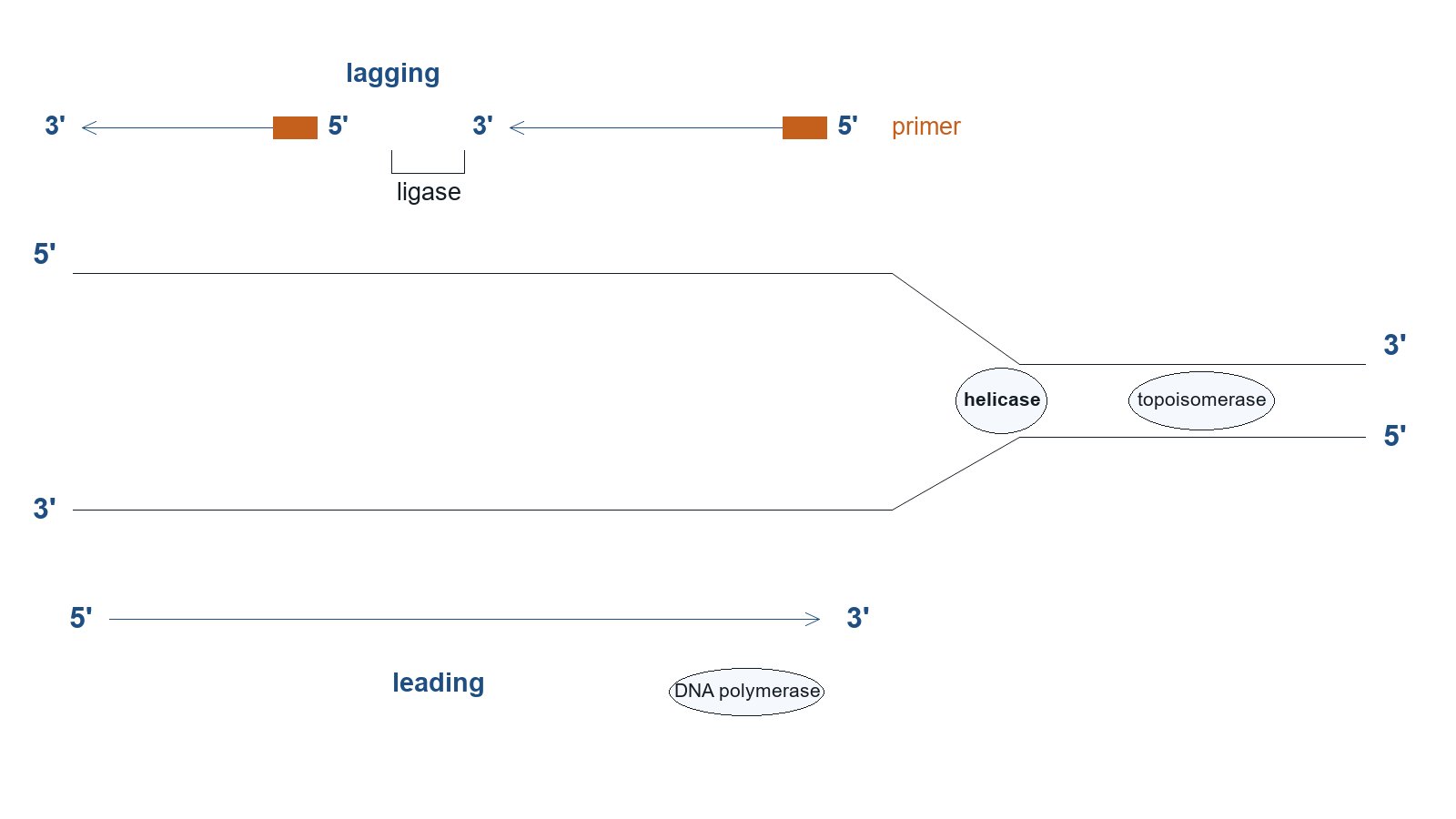
The fork opens to the right. Helicase unwinds at the fork, and topoisomerase sits ahead of it. The leading strand grows 5' to 3' toward the fork. Each lagging fragment also grows 5' to 3', but away from the fork, starting from an RNA primer. Ligase seals gaps between fragments.
Every new DNA strand is synthesized 5' to 3'. DNA polymerase can add a nucleotide only to a 3' end. The two templates are antiparallel, so the two new strands cannot both grow in the same direction relative to the moving fork. One new strand, the leading strand, grows continuously toward the fork. The other, the lagging strand, is made as short pieces as more template is exposed. Each piece still grows 5' to 3', which on that side is away from the fork. Those pieces are often called Okazaki fragments.
Helicase unwinds the helix at the fork and separates the templates. Topoisomerase relaxes supercoiling in front of the fork. If helicase stops, the strands stay paired and polymerase has no open template. If topoisomerase stops, supercoils build up and the fork stalls.
DNA polymerase cannot start a strand by itself. It needs an RNA primer, which provides a free 3' end. On the lagging strand a new primer is needed for each fragment. The RNA primers are later replaced with DNA. Ligase then joins the fragments into one continuous strand. If ligase is inactive, polymerase can still make the pieces, but they stay unjoined.
| Protein | Role at the fork |
|---|---|
| Helicase | Unwinds the parental double helix |
| Topoisomerase | Relaxes supercoiling ahead of the fork |
| DNA polymerase | Adds DNA nucleotides 5' to 3' from an RNA primer |
| Ligase | Joins fragments on the lagging strand |
For replication, know helicase, topoisomerase, DNA polymerase, and ligase. The names of other replication enzymes, including the enzyme that builds the RNA primer, are outside this topic.
Key points
- Replication keeps hereditary information continuous from one generation of cells to the next.
- New DNA is made 5' to 3' on a parental template. The product is semiconservative.
- Helicase unwinds the helix. Topoisomerase relaxes supercoils ahead of the fork.
- DNA polymerase needs an RNA primer and cannot start a strand alone.
- The leading strand is continuous toward the fork. The lagging strand is made in short pieces.
- Each lagging piece still grows 5' to 3', which is away from the fork on that template.
- Ligase joins the lagging-strand fragments after the RNA primers are replaced with DNA.