TOPIC 6.3 · STUDY
Transcription and RNA Processing
Transcription uses RNA polymerase and one DNA template strand. RNA is built 5' to 3' while the template is read 3' to 5'. mRNA carries the message, tRNA carries amino acids and anticodons, and rRNA is part of the ribosome. In eukaryotes a GTP cap, a poly-A tail, and splicing produce the mature mRNA. Alternative splicing can make more than one mature mRNA from one gene.
6.3.A
Transcription and mRNA processing
The sequence of an RNA and the way that RNA folds together determine what the RNA does. Three RNAs carry out gene expression. Messenger RNA (mRNA) carries the information from DNA to a ribosome. In a eukaryote that means from the nucleus to a ribosome in the cytoplasm. Transfer RNA (tRNA) binds one specific amino acid and has an anticodon that base-pairs with an mRNA codon. The ribosome recruits that tRNA during translation. Ribosomal RNA (rRNA) is a functional building block of the ribosome.
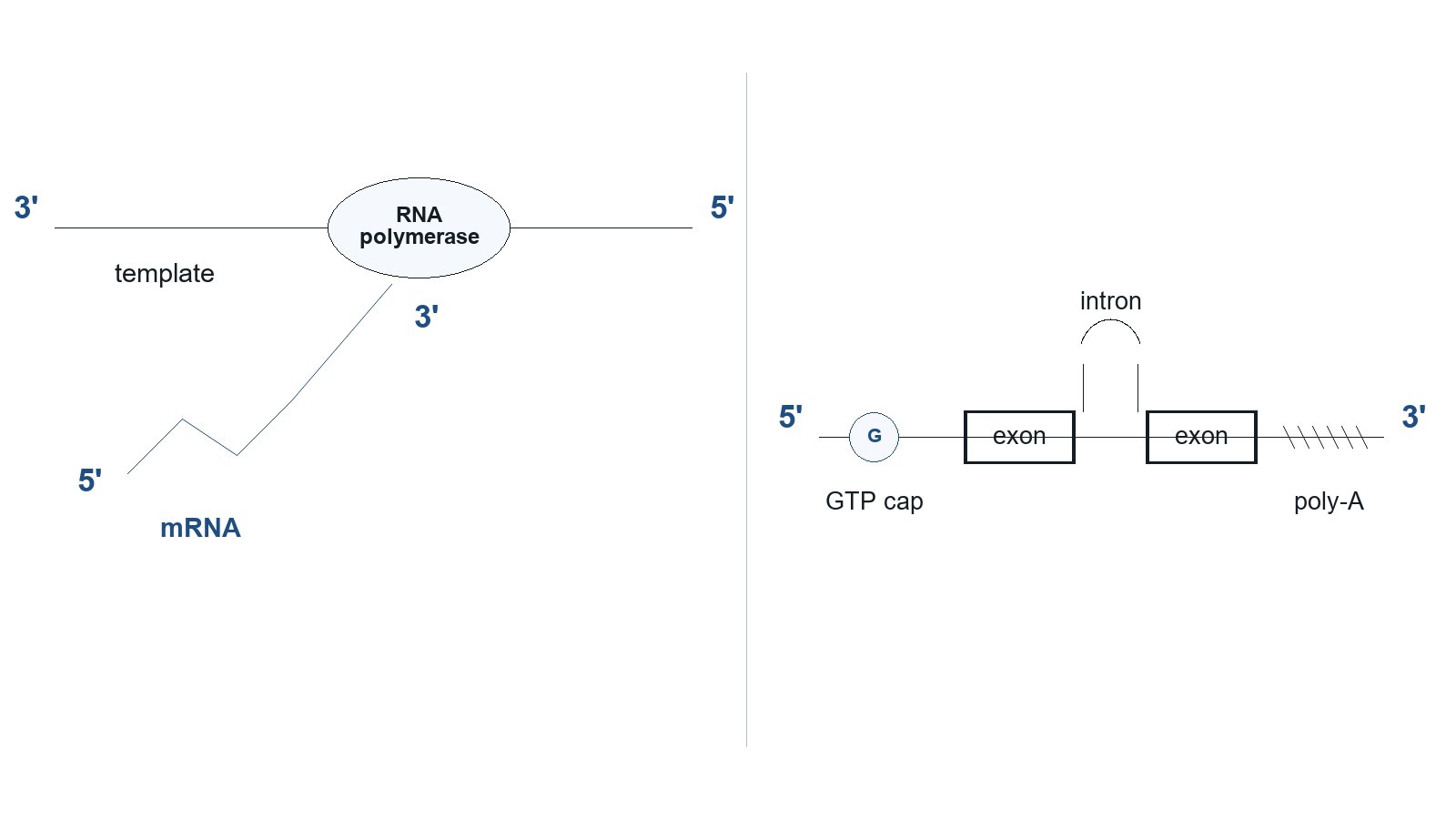
RNA polymerase reads the template 3' to 5' and builds mRNA 5' to 3'. The free end of the new RNA is the 5' end. The growing 3' end is still at the enzyme. A mature eukaryotic mRNA has a GTP cap, joined exons, and a poly-A tail. The intron is looped out between the exons and is removed.
Transcription is RNA synthesis directed by one DNA strand. RNA polymerase uses that single template strand to choose the bases in the new RNA. The enzyme reads the template 3' to 5' and synthesizes the RNA 5' to 3'. The other DNA strand of that gene, the coding strand, matches the RNA except that RNA has U where DNA has T.
Example: coding strand 5'-ATG-GCA-TTT-TAG-3'. The template is the antiparallel partner, 3'-TAC-CGT-AAA-ATC-5'. RNA polymerase reads that template and builds 5'-AUG-GCA-UUU-UAG-3'. Only one strand is the template for a given transcript. Using both strands would make two complementary RNAs, not two copies of the same message.
A tRNA shows why sequence and shape both matter. The anticodon sequence pairs with the codon, and the folded shape holds the amino acid at the other end. An mRNA's sequence is the code the ribosome will read. An rRNA's folded structure helps the ribosome work.
In eukaryotic cells the first transcript is modified before it is a mature mRNA. A GTP cap is added at the 5' end and helps the ribosome recognize the mRNA. A poly-A tail is added at the 3' end and makes the mRNA more stable. If the tail is added poorly, the mRNA tends to break down sooner and less protein is made. If the cap is missing, the ribosome may not start translation well.
Splicing removes introns and keeps exons. Alternative splicing can keep different combinations of exons, so one gene can produce more than one mature mRNA and more than one polypeptide. A transcript that keeps exons 1, 2, and 3 is not the same message as a transcript that keeps exons 1 and 3 and skips exon 2.
The cap, poly-A tail, and this splicing pattern are eukaryotic mRNA modifications. Prokaryotic transcripts are not processed in that same way before they are used.
Key points
- mRNA carries the message to the ribosome. tRNA brings an amino acid and pairs its anticodon with a codon. rRNA builds the ribosome.
- RNA sequence and RNA shape together determine what that RNA does.
- RNA polymerase uses one DNA template strand. It reads that strand 3' to 5' and makes RNA 5' to 3'.
- The coding strand matches the RNA, with T in DNA where the RNA has U.
- A eukaryotic GTP cap helps ribosome recognition. A poly-A tail makes the mRNA more stable.
- Splicing removes introns and keeps exons. Alternative splicing can make different mature mRNAs from one gene.