TOPIC 6.4 · STUDY
Translation
Translation reads mRNA codons on ribosomes in the cytoplasm, and in eukaryotes also on the rough ER. It starts at AUG, which codes for methionine. tRNA adds amino acids until a stop codon releases the protein. Many amino acids have more than one codon, and the shared code is evidence of common ancestry. Retroviruses copy RNA into DNA with reverse transcriptase before the host transcribes and translates that DNA.
6.4.A
Translation of an mRNA
A gene's phenotype link runs through a protein. The DNA sequence sets the mRNA codons, the codons set the amino acid sequence, and that polypeptide's job helps set the trait. Translation is the step that builds the polypeptide.
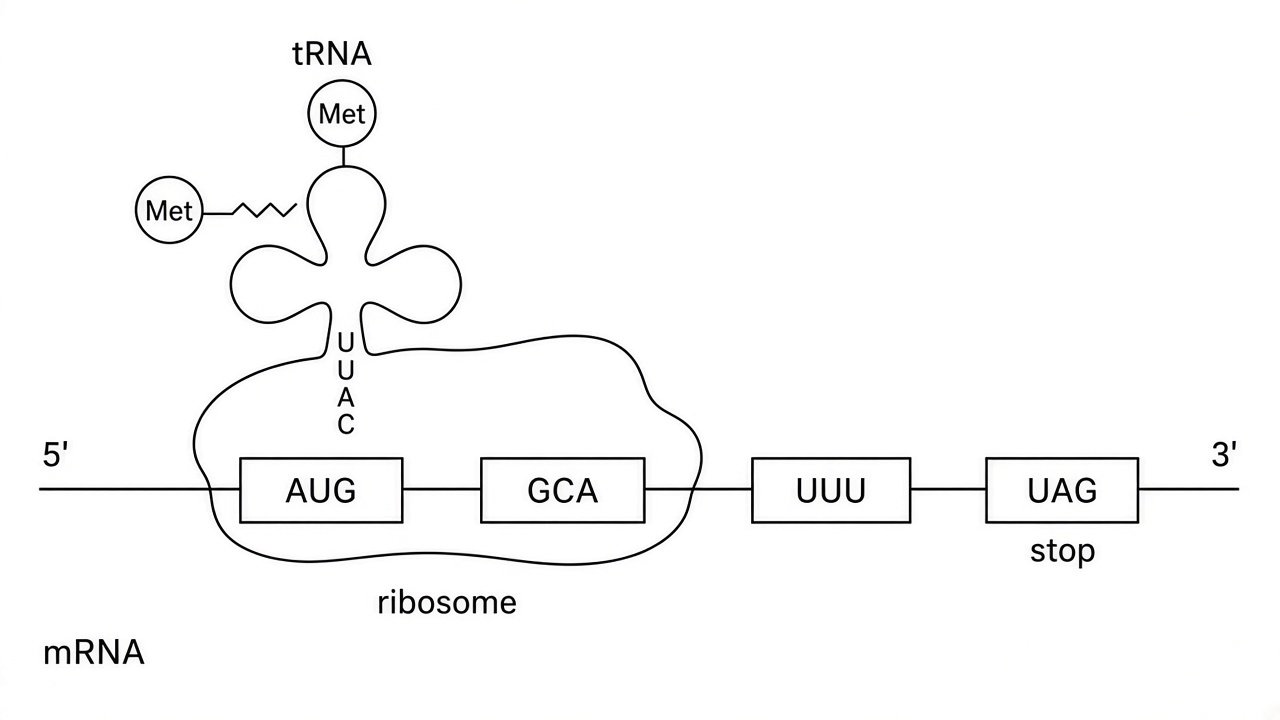
The ribosome reads the mRNA from 5' to 3'. AUG is the start codon. The tRNA that pairs there brings methionine. UAG is a stop codon and does not add an amino acid.
Translation occurs on ribosomes in the cytoplasm of prokaryotic and eukaryotic cells. In eukaryotes, ribosomes on the cytoplasmic surface of the rough ER also translate proteins, including many that will be secreted or placed in a membrane. In prokaryotes, translation of an mRNA starts while that mRNA is still being transcribed, because no nucleus separates the two steps. A eukaryotic mRNA is processed and leaves the nucleus before ribosomes translate it, so translation waits.
Translation has three stages: initiation, elongation, and termination. Initiation begins when rRNA in the ribosome interacts with the mRNA at the start codon AUG. AUG codes for methionine, and the initiator tRNA brings that amino acid. The anticodon that pairs with AUG is UAC.
The ribosome reads the nucleotides in groups of three called codons. A genetic code chart gives the amino acid for each codon. Elongation continues as each codon pairs with the anticodon of a tRNA carrying the matching amino acid. That amino acid is added to the growing chain. The chain keeps growing until a stop codon is reached.
For the mRNA 5'-AUG-GCA-UUU-UAG-3', the chart gives methionine, then alanine, then phenylalanine. UAG is a stop codon. Termination releases the finished protein. A stop codon does not add an amino acid. The same reading in a chart is how any new codon problem is solved. Memorizing all 64 codons is unnecessary. AUG as methionine, and the idea that stop codons end the chain, are the landmarks to know before you use the chart.
Many amino acids are encoded by more than one codon, so the code is redundant. GCA and GCU both specify alanine, but each codon still pairs with a defined anticodon. Different tRNAs can deliver the same amino acid. Nearly all living organisms use this same code. A human ribosome and a bacterial ribosome both read AUG as methionine. That shared code is evidence of common ancestry.
Retroviruses are a special case. Their genetic information flows from RNA to DNA. Reverse transcriptase copies the viral RNA genome into DNA. That DNA integrates into the host genome. The host then transcribes and translates the viral genes, and new virus particles are assembled.
| Stage | What happens |
|---|---|
| Initiation | Ribosome rRNA meets the mRNA at AUG, and methionine is brought in |
| Elongation | Codons are read, tRNAs deliver amino acids, and the chain grows |
| Termination | A stop codon releases the finished protein and adds no amino acid |
Key points
- Ribosomes in the cytoplasm translate mRNA. Eukaryotes also translate on the rough ER.
- Prokaryotes can translate an mRNA while it is still being transcribed.
- Translation starts at AUG (methionine), reads codons, and stops at a stop codon.
- tRNA brings the amino acid specified by the codon and adds it to the chain.
- A stop codon releases the protein. It does not code for an amino acid.
- Several codons can specify one amino acid. The shared code is evidence of common ancestry.
- Retroviruses use reverse transcriptase to copy RNA into DNA, which the host then transcribes and translates.