TOPIC 6.5 · STUDY
Regulation of Gene Expression
Regulatory DNA binds regulatory proteins and controls transcription. Some genes stay on, and others turn on only when a signal arrives. Reversible marks on DNA or histones can change expression without changing the sequence. Prokaryotes coordinate genes in inducible or repressible operons. Eukaryotes can coordinate separate genes with the same transcription factors. Which genes are on, and how strongly, sets the cell's phenotype.
6.5.A
What controls transcription
A cell's phenotype depends on which genes are expressed and on how much product each gene makes. Two cells with the same genome can look and act differently because they transcribe different sets of genes. The proteins and RNAs they produce, and the amounts of those products, carry out the jobs that show up as traits.
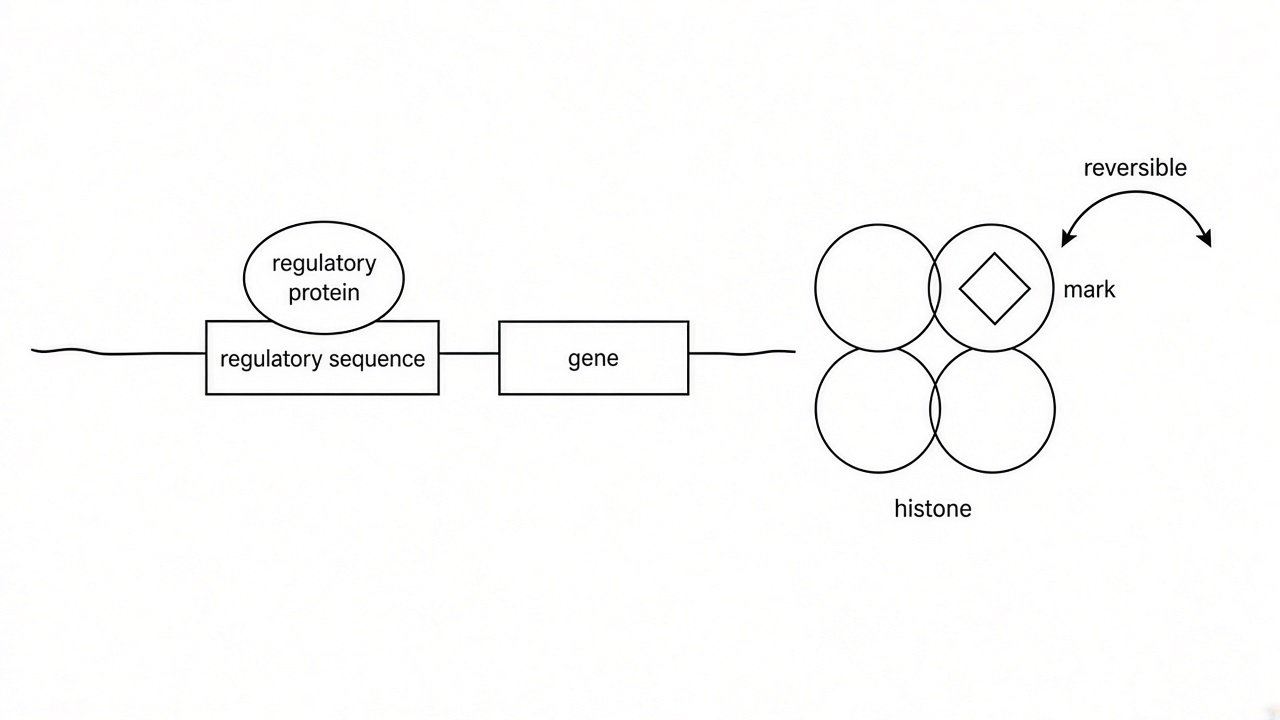
A regulatory protein binds a regulatory DNA sequence and controls transcription of the gene. A chemical mark on a histone can be added or removed, so the effect on expression can be reversed.
Regulatory sequences are stretches of DNA that interact with regulatory proteins to control transcription. A gene that is expressed continuously, because the cell always needs its product, is constitutively expressed. An inducible gene is off until a signal turns transcription up. Cells use the first pattern for products they always need and the second pattern to respond when conditions change.
Epigenetic changes affect expression through reversible modifications of DNA or histones. The nucleotide sequence of the gene stays the same. The marks change how available that DNA is to transcription, so the amount of product can rise or fall. Because the marks can be removed, the change in expression can be undone. DNA methylation commonly reduces transcription. Histone acetylation commonly makes the DNA more accessible. The exam point is the category: reversible marks on DNA or histones, not a list of enzymes that add them.
Observable cell differentiation comes from expressing genes for tissue-specific proteins. During development, induction of transcription factors turns on later genes in order. That sequence of expression builds different cell types. The function of each product and the amount of each product together determine the phenotype of the cell or the organism.
6.5.B
Operons and shared transcription factors
Both prokaryotes and eukaryotes can regulate groups of genes together. The location of the regulatory DNA is what makes that control work. A sequence has to sit where a bound protein can affect transcription of the genes it governs.
In prokaryotes, an operon is a cluster of genes transcribed as one unit. A promoter is where RNA polymerase binds. An operator is a DNA site next to that promoter, often between the promoter and the genes. A repressor protein bound to the operator blocks polymerase from moving into the genes. One promoter and one operator therefore control the whole cluster at once.
An inducible operon is usually off. The repressor sits on the operator. An inducer inactivates that repressor, the operator is cleared, and the genes are transcribed together. A repressible operon is usually on. When the cell has enough product, a corepressor helps the repressor bind the operator and transcription drops. In both systems, one signal coordinates several genes because they share the same regulatory DNA.
Eukaryotic genes that need to act together are often on different chromosomes, so they are not one operon and they do not make one shared mRNA. They can still be coordinated if the same transcription factors bind regulatory sequences at each gene and turn the set on together.
| System | Usual state | What the signal does |
|---|---|---|
| Inducible operon | Off | Inducer inactivates the repressor so the genes are transcribed |
| Repressible operon | On | Corepressor helps the repressor shut the genes off when product is abundant |
| Eukaryotic gene group | Depends on the factors | The same transcription factors act at separate genes |
Key points
- Regulatory sequences bind regulatory proteins and control transcription.
- Constitutive genes stay on. Inducible genes turn on in response to a signal.
- Epigenetic marks on DNA or histones change expression and can be reversed. The gene sequence stays the same.
- Differentiation reflects which tissue-specific genes are on. Transcription factors can turn on later genes in order.
- The function and the amount of gene products determine phenotype.
- A prokaryotic operon uses a shared promoter and operator. It can be inducible or repressible.
- Eukaryotes can coordinate genes on different chromosomes with the same transcription factors.