TOPIC 6.6 · STUDY
Gene Expression and Cell Specialization
RNA polymerase and transcription factors bind promoter or enhancer DNA, which may lie upstream or downstream of the start site, and transcription begins. Negative regulators bind DNA and block transcription. Cells specialize because they express different genes and make different products. Small RNAs can change how much product a target gene makes.
6.6.A
Promoters, enhancers, and blockers
Transcription of a eukaryotic gene starts when RNA polymerase and transcription factors bind promoter or enhancer DNA. Those sequences can lie upstream or downstream of the transcription start site. Polymerase alone is often not enough. The transcription factors help it begin. A stronger or more frequent binding at an enhancer can raise transcription and raise the amount of gene product.
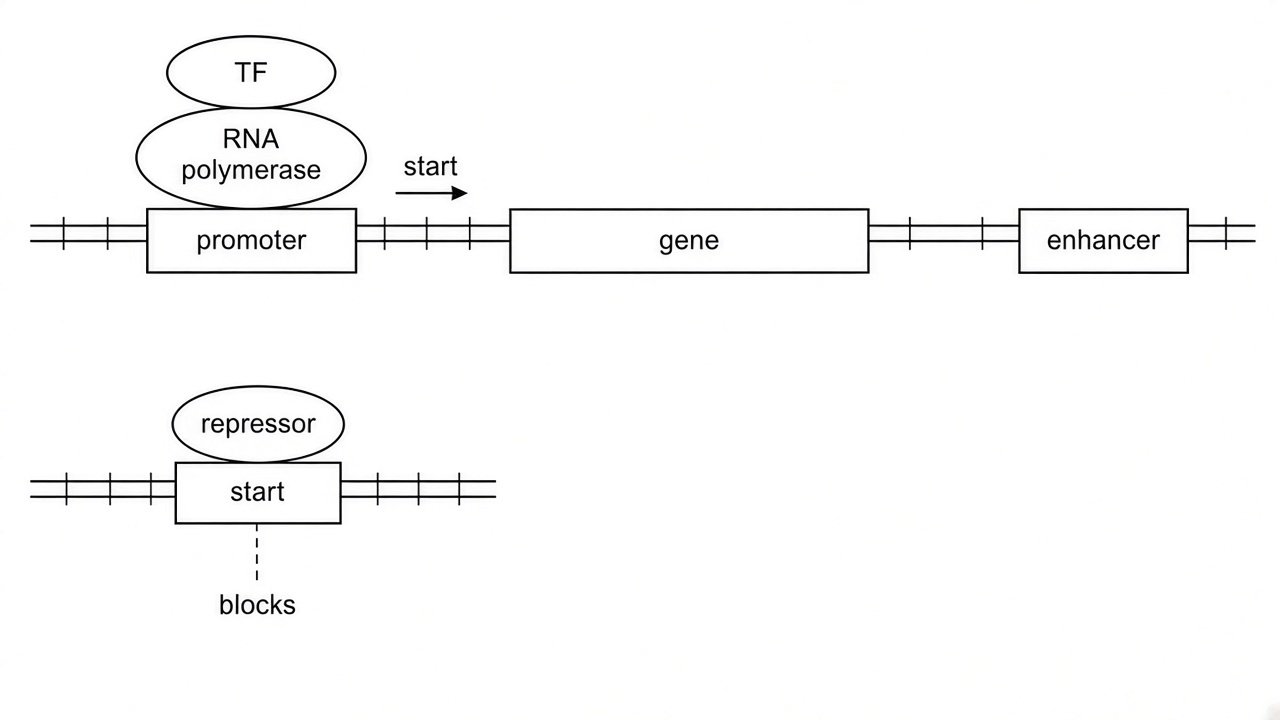
Transcription factors and RNA polymerase bind the promoter, here upstream of the start site. An enhancer can sit downstream of the gene and still help start transcription. A repressor bound at a start site blocks transcription.
A downstream enhancer can still affect the promoter because the DNA can loop and bring the two sequences together. The exam point is the placement: promoter and enhancer sequences are not limited to one side of the start site. If an enhancer for a gene is destroyed, transcription of that gene tends to fall, and a trait that depends on the product can change.
Negative regulatory molecules inhibit gene expression by binding DNA and blocking transcription. A repressor sitting on the promoter or over the start site keeps RNA polymerase from making the RNA. Less RNA means less protein. If that protein helps build a trait, the phenotype changes. Transcription factors at an enhancer promote initiation. A negative regulator does the opposite job at the DNA it binds.
The path from a transcription factor to a trait is short to state and long inside the cell. The factor binds regulatory DNA, transcription of the target rises or falls, the amount of protein changes, and the trait that depends on that protein changes with it.
6.6.B
Specialization and small RNAs
Gene regulation produces differential gene expression, and that difference changes cell products and cell functions. A liver cell and a muscle cell from one person share a genome. They specialize because regulation turns on different sets of genes. One cell can make a protein the other cell barely makes. The phenotype of each cell follows from those products.
Certain small RNA molecules also regulate gene expression. A small RNA can base-pair with a target mRNA and reduce how much protein is made from it. Introducing a small RNA that lowers one mRNA can change the pathways that depend on that protein, so the cell's phenotype changes. Different cells can use different small RNAs and end up with different product levels even when the genes themselves are the same.
Promoter and enhancer binding, negative regulators, and small RNAs are three ways to change which products a cell accumulates. Specialization is the result of those regulatory differences, not a second copy of the genome.
Key points
- RNA polymerase and transcription factors bind promoter or enhancer DNA to start transcription.
- Those DNA sequences can be upstream or downstream of the transcription start site.
- More transcription-factor activity at an enhancer can raise the amount of gene product.
- Negative regulators bind DNA and block transcription, which can change phenotype.
- Differential gene expression gives specialized cells different products and functions.
- Small RNAs can reduce a target gene's product and change the cell's phenotype.