TOPIC 6.7 · STUDY
Mutations
A mutation changes DNA and may change a protein's sequence or amount, or leave the protein the same. A one-base substitution can be silent or can create a premature stop. An insertion or deletion that is not a multiple of three shifts the reading frame. Copying errors, repair errors, radiation, and reactive chemicals create these changes, and so can mistakes in mitosis or meiosis. Prokaryotes also gain DNA by transformation, transduction, conjugation, and transposition. A change that helps survival and reproduction can be favored by the environment.
6.7.A
Types of mutation
A mutation is a change in a DNA sequence. It can change the type of protein made, the amount of protein made, or neither. The result for the organism can be beneficial, detrimental, or neutral, depending on what happens to the nucleic acid or the protein and on the phenotype that protein confers. The coding sequence used below is 5'-ATG-TTA-GCA-TAG-3'. Read as codons, the mRNA is 5'-AUG-UUA-GCA-UAG-3', which gives methionine, leucine, alanine, and then a stop.
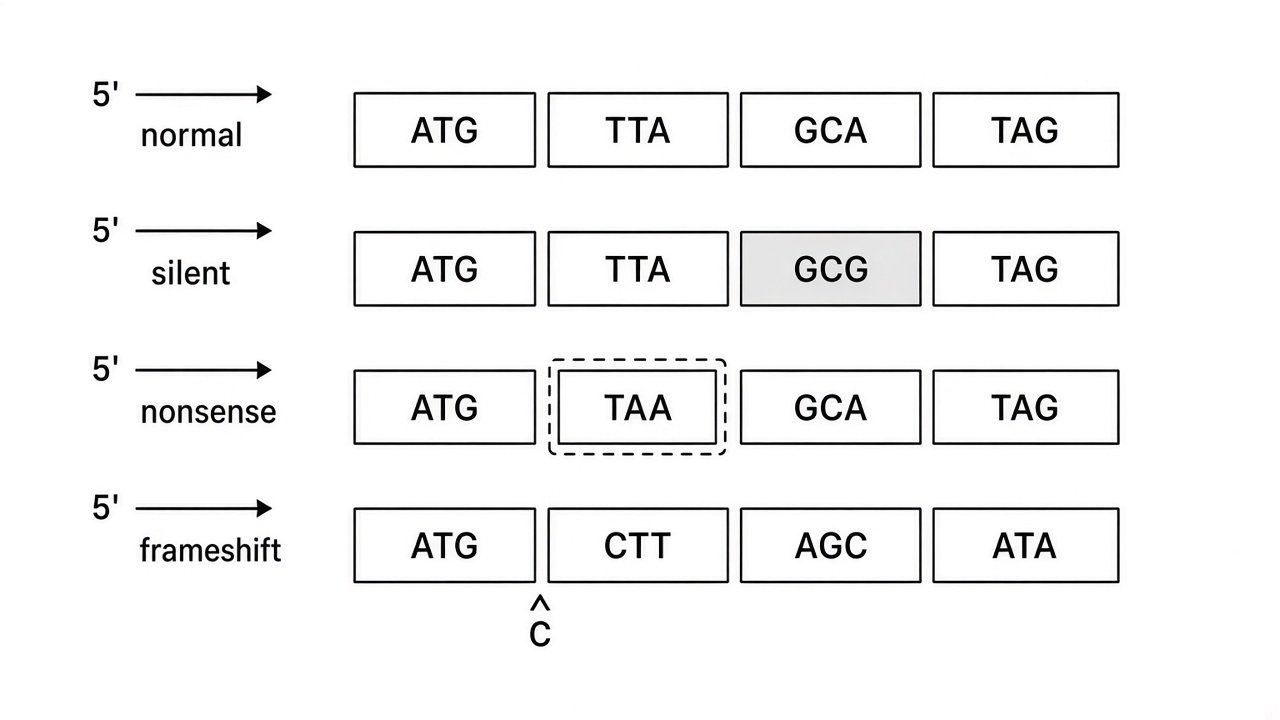
A silent change of GCA to GCG keeps the same amino acid. Changing TTA to TAA creates a stop. Inserting one C after ATG regroups every later codon. Each row is still read 5' to 3'.
A point mutation substitutes one nucleotide for another. If GCA changes to GTA, the mRNA codon changes from GCA to GUA and alanine is replaced by valine. That point mutation changes one amino acid. It is often called a missense change. The rest of the reading frame stays in place.
A silent mutation changes the DNA but not the amino acid sequence. GCA and GCG both code for alanine, so changing GCA to GCG alters a nucleotide and leaves the polypeptide the same. The phenotype can stay the same because the protein sequence did not change.
A nonsense mutation is a point mutation that creates a premature stop. Changing TTA (leucine) to TAA makes a stop codon in the mRNA. Translation ends after methionine instead of finishing the chain. The protein is shorter, and the cell may make little functional product.
A frameshift mutation inserts or deletes nucleotides and shifts the reading frame. Inserting one C just after ATG turns ATG-TTA-GCA-TAG into ATG-CTT-AGC-ATA-G. Every codon downstream is new, and an early stop often appears. Deleting one or two bases does the same kind of damage. Inserting or deleting a multiple of three can add or remove amino acids without shifting the later codons. The frame shifts when the number of bases added or removed is not a multiple of three.
| Type | What changes in the DNA | Typical effect on the protein |
|---|---|---|
| Silent point mutation | One base, codon still means the same amino acid | Amino acid sequence unchanged |
| Missense point mutation | One base, codon means a different amino acid | One amino acid replaced |
| Nonsense point mutation | One base creates a premature stop | Chain ends early |
| Frameshift | Insertion or deletion that shifts codon groups | Many downstream amino acids change |
You do not need to memorize particular named mutations or the details of a specific disease. You do need to classify a change as silent, nonsense, or frameshift and say what it does to the polypeptide.
6.7.B
How genotype changes arise
Random mutations come from errors in DNA replication or DNA repair and from external factors, including radiation and reactive chemicals. Both internal mistakes and outside mutagens add new alleles. Those alleles are a source of genetic variation.
Whether a mutation is beneficial, detrimental, or neutral depends on the environment. The same allele can help survival in one setting, hurt it in another, and make no difference in a third. The DNA change itself does not carry a fixed label.
Errors in mitosis or meiosis can change phenotype without a one-base substitution. Nondisjunction is a failure of chromosomes to separate. It changes chromosome number. Aneuploidy is an abnormal number of a particular chromosome. Triploidy is three full sets of chromosomes. Either change alters gene dosage and often limits development. Alterations in chromosome structure, including deletion, duplication, inversion, and translocation, can also cause genetic disorders. Naming a specific disorder is not required.
6.7.C
Variation that selection can favor
A change in genotype may change a phenotype that natural selection can act on. If the new trait helps the organism survive and reproduce in that environment, the genetic change can be favored. If the trait reduces survival or reproduction, it tends to be removed. Selection acts on the phenotype the genotype produces.
Prokaryotes also pick up genetic information horizontally, which increases variation. Transformation is uptake of DNA from the surroundings. Transduction is viral transmission of DNA from one cell to another. Conjugation is direct cell-to-cell transfer of DNA. Transposition is movement of a DNA segment within a molecule or from one DNA molecule to another. A new allele gained this way can change a trait, and the environment can favor or disfavor that trait.
Related viruses can recombine genetic information if they infect the same host cell. Reproductive processes that increase genetic variation are widespread. They are shared by many kinds of organisms and have been kept because variation is the raw material selection uses.
Key points
- A point mutation replaces one nucleotide. It can be silent, change one amino acid, or create a premature stop.
- A nonsense mutation is a point mutation that puts in an early stop codon.
- A frameshift inserts or deletes bases and shifts the codon reading frame when the count is not a multiple of three.
- Beneficial, detrimental, or neutral depends on the environment. Mutations supply genetic variation.
- Replication errors, repair errors, radiation, and reactive chemicals cause random mutations.
- Nondisjunction changes chromosome number (aneuploidy or triploidy). Structure changes include deletion, duplication, inversion, and translocation.
- Prokaryotes gain DNA by transformation, transduction, conjugation, and transposition. Related viruses can recombine in one host cell.