TOPIC 6.8 · STUDY
Biotechnology
Gel electrophoresis separates DNA fragments by size and charge. Shorter fragments move farther toward the positive electrode. PCR copies a target by denaturing the DNA, annealing primers, and extending new strands. Transformation introduces foreign DNA into bacteria, and sequencing reads the nucleotide order. The patterns, often called a DNA fingerprint, let samples be compared. Recipe-level details of these techniques are outside the exam.
6.8.A
Gels, PCR, transformation, and sequencing
Genetic engineering techniques analyze and manipulate DNA and RNA. Four of them are in scope: gel electrophoresis, polymerase chain reaction (PCR), bacterial transformation, and DNA sequencing. You need the idea of each technique and what the result is used for. Temperatures, buffer recipes, and the internal chemistry of a sequencing machine are outside the exam.
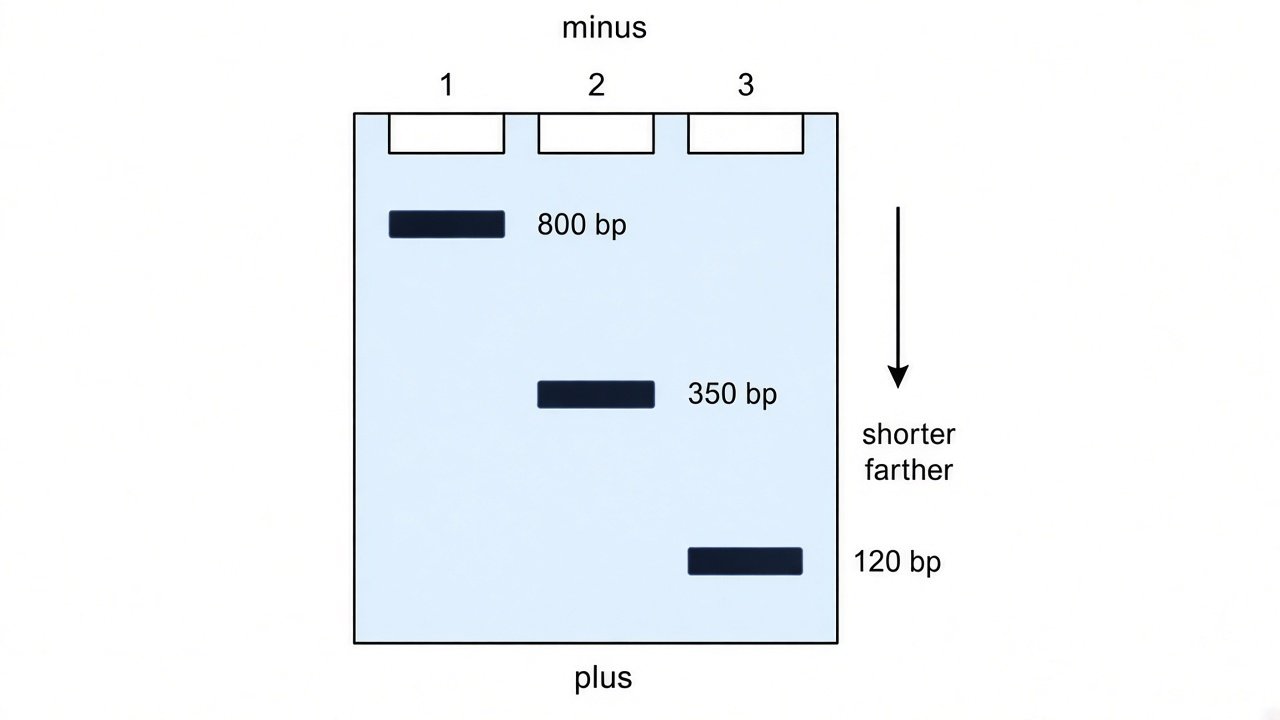
DNA is negatively charged, so fragments move from the negative end toward the positive end. The 800 bp fragment stays nearer the wells. The 120 bp fragment travels farthest.
Gel electrophoresis separates DNA fragments by size and charge. Phosphate groups give DNA a negative charge, so the fragments move toward the positive electrode. The gel slows long fragments more than short ones. In the same amount of time, a short fragment travels farther from the well than a long one. A lane with fragments of 800, 350, and 120 base pairs shows the 800 bp band closest to the wells and the 120 bp band closest to the positive end. Comparing the band patterns from different samples is one way to tell those samples apart.
PCR amplifies a chosen DNA region by repeating three steps. Denaturation uses heat to separate the two strands. Annealing cools the mixture so primers base-pair with the complementary template. Extension uses DNA polymerase to add nucleotides to each primer, building a new strand 5' to 3'. Each cycle can double the number of copies of the target. The copies can then be seen on a gel, sequenced, or cloned. You need those three steps, not a protocol with set temperatures.
Bacterial transformation introduces foreign DNA into bacterial cells. In the lab the DNA is often a plasmid. An origin of replication lets the plasmid be copied and kept as the cell divides. A selectable marker, such as a gene for antibiotic resistance, lets you keep the cells that took the plasmid up: on antibiotic medium, cells without that gene do not grow. Gene cloning uses this setup to propagate a DNA fragment. Transformation in the lab is a tool for moving DNA. It is related to, but not the same lesson as, natural uptake of DNA by a bacterium.
DNA sequencing determines the order of nucleotides in a DNA molecule. A DNA fingerprint is the pattern of fragments or sequence differences used to compare samples. Amplified or sequenced DNA can help identify an organism or a forensic sample. A match supports an identification when the comparison is appropriate. Contamination or an incomplete pattern can weaken that conclusion. A transgenic organism, including a transgenic animal, carries DNA that was introduced from another source and can express it as a new trait.
| Technique | What it does | Result you compare |
|---|---|---|
| Gel electrophoresis | Separates fragments by size and charge | Band positions, shorter fragments farther toward + |
| PCR | Denature, anneal primers, extend | Many copies of one target region |
| Transformation | Puts foreign DNA into bacteria | Cells that grow because they carry the marker |
| DNA sequencing | Reads the order of nucleotides | A sequence or fingerprint compared across samples |
Know what each technique accomplishes and the three PCR steps. Do not memorize buffer ingredients, exact temperatures, or machine-level sequencing chemistry.
Key points
- Gel electrophoresis separates DNA by size and charge. DNA moves toward the positive electrode, and shorter fragments travel farther.
- PCR repeats denaturation, primer annealing, and extension to amplify a target.
- Transformation introduces foreign DNA, often a plasmid, into bacteria.
- A plasmid origin lets it replicate. An antibiotic-resistance gene lets you select cells that took it up.
- Sequencing reads nucleotide order. A DNA fingerprint compares fragment or sequence patterns.
- These tools support identification, forensics, gene cloning, and transgenic organisms.
- Protocol details beyond the steps above are outside the exam.