TOPIC 7.1 · STUDY
Introduction to Natural Selection
Natural selection is a major mechanism of evolution. Competition for limited resources causes individuals with favorable heritable phenotypes to leave more offspring. Fitness is that reproductive success. Biotic and abiotic conditions can change which variants are favored and how fast the population changes.
7.1.A
Causes of natural selection
Natural selection is a major mechanism of evolution. It starts from heritable variation that is already present in the population. Individuals with more favorable phenotypes are more likely to survive and produce more offspring, and those offspring inherit the favorable traits. A change acquired during one lifetime, such as a feature built by use, is not the variation this mechanism passes on.
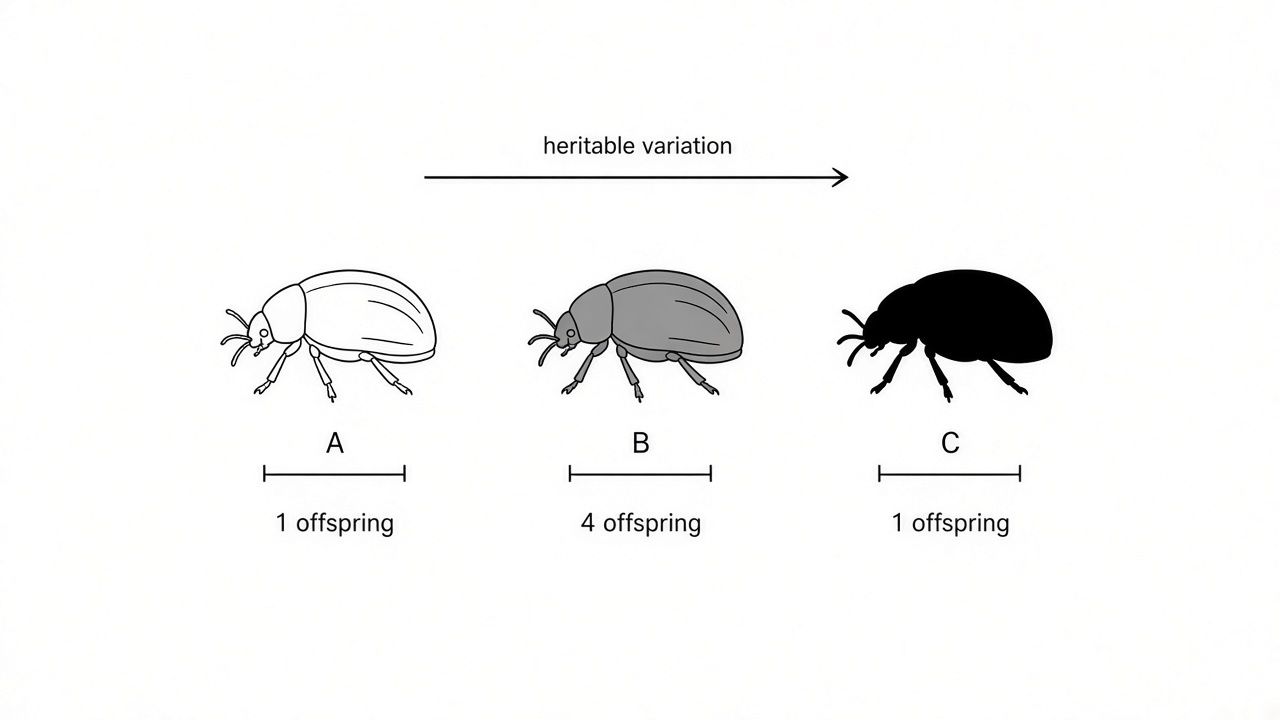
Phenotype B leaves more offspring than A or C. That difference changes the population only when offspring inherit the phenotype.
Competition for limited resources produces the reproductive difference. Food, shelter, and mates are examples of those limits. If every phenotype left the same number of offspring, selection would not shift the population. Selection is a mechanism of evolution because differential reproductive success changes how common heritable traits are over generations.
7.1.B
Fitness and changing conditions
Evolutionary fitness is reproductive success relative to others in the same population. A larger or longer-lived individual is not automatically the fittest. Compare how many offspring each phenotype leaves. In one environment a phenotype that leaves 3 offspring for each 1 left by another phenotype has higher fitness, if the difference is heritable.
Biotic and abiotic conditions fluctuate. Predators, food supply, temperature, and background color can each change which phenotype has higher fitness. Different genetic variations can be selected in each generation. When conditions change, the direction of evolution can reverse: the phenotype that left more offspring before the change may leave fewer afterward. A larger gap in reproductive success also changes the population faster.
Key points
- Natural selection is a major mechanism of evolution.
- Limited resources create differential survival and reproduction.
- Favorable heritable phenotypes leave more offspring and become more common.
- Fitness is reproductive success relative to others in that population.
- Biotic and abiotic conditions can change which variants are favored.
- A trait acquired during one lifetime is not what this mechanism passes on.
Populations change when heritable phenotypes differ in reproductive success. An individual does not evolve by acquiring a trait it needs.