TOPIC 7.2 · STUDY
Natural Selection
Natural selection acts on phenotypic variation already present in a population. A changed environment applies new selective pressures, and the same phenotype can raise or lower fitness depending on conditions. Differences in the number and kinds of molecules inside cells can also change survival and reproduction.
7.2.A
Phenotypes and selective pressure
Natural selection acts on phenotypic variations in populations. Alleles matter because they contribute to those phenotypes. Selection sorts variants that already differ in fitness. It does not create a new phenotype on demand when the environment changes.
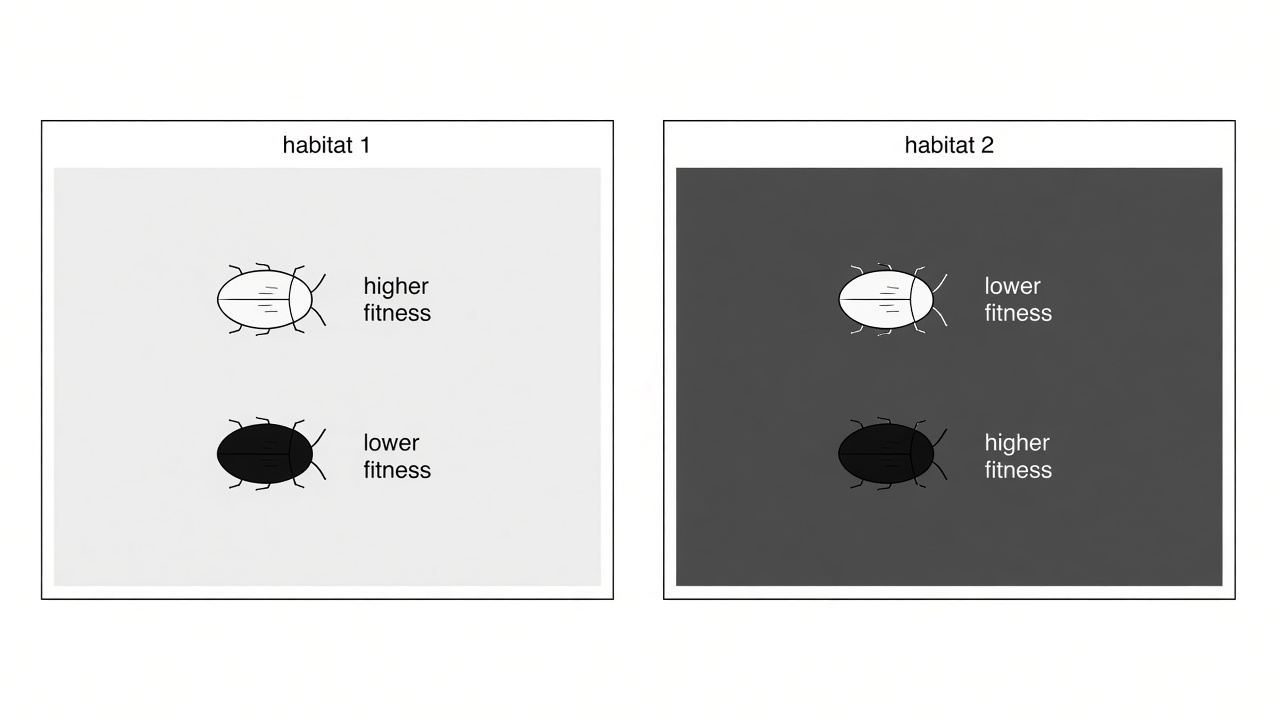
The same body color has higher fitness on a matching background and lower fitness on a contrasting background.
Environments change and apply selective pressures. Flowering time is one case: if the season shifts, plants that flower when pollinators are present can have higher fitness than plants that flower too early or too late. A pesticide such as DDT is another pressure. Insects that already carry a heritable resistant phenotype survive and reproduce. When the pesticide is absent, that same resistance can be costly, so the phenotype is not favorable in every environment.
Sickle cell anemia shows the same conditional fitness. Where malaria is a strong pressure, heterozygotes can have higher fitness than either homozygote. Where that pressure is absent, the allele that causes sickling is deleterious. Phenotypic fitness depends on the selective context.
7.2.B
Molecules inside cells
Variation in the number and types of molecules within cells can give a population a greater ability to survive and reproduce in different environments. More of a protective protein can reduce damage during heat stress. A higher concentration of photosynthetic pigment can increase growth in dim light. Those molecular differences change fitness only when they are heritable and cause some individuals to leave more offspring than others.
A population that contains several molecular phenotypes has more raw material for selection when conditions differ or change. A population with only one molecular form has fewer options if that form performs poorly in the new environment. Allele frequencies shift only if the molecular difference is passed on and changes reproductive success.
Key points
- Selection acts on phenotypic variation already present in the population.
- A new environment applies new selective pressures.
- A phenotype can raise fitness in one setting and lower it in another.
- Sickle cell and DDT resistance show that fitness depends on the environment.
- Differences in cellular molecules can change survival and reproduction.
- Molecular differences shift allele frequencies only if they are heritable and affect reproductive success.
- Selection sorts existing variation. It does not invent a phenotype because it would be useful.
The same allele can be maintained by heterozygote advantage in one environment and be deleterious in another.