Introduction to Natural Selection MCQ Practice

Question 1 of 10

Scenario A. In a coastal population of shore crabs competing for limited shelter sites, which outcome best matches Darwin's description of natural selection?

  1. A. Every individual survives equally, so allele frequencies never change.
  2. B. Individuals with phenotypes that use shelter more effectively leave more offspring on average.
  3. C. Individuals intentionally acquire useful traits during their lifetimes and then pass those acquired traits on.
  4. D. Competition stops after one generation, so selection cannot act again.
Question 2 of 10

Scenario A. Natural selection is described as a major mechanism of evolution because it

  1. A. creates new alleles in every generation by directed mutation.
  2. B. guarantees that every species becomes more complex over time.
  3. C. changes the relative frequencies of heritable phenotypes across generations when fitness differs.
  4. D. acts only on extinct populations preserved as fossils.

Question 3 of 10

Scenario A. Researchers track seed-eating finches that differ in beak or mandible shape. Food is limited. Which statement correctly identifies the selective process?

Phenotype Mean offspring / season
Narrow feeding structure 1.2
Broad feeding structure 2.4
  1. A. Individuals whose feeding structures process available food more efficiently tend to survive and reproduce more.
  2. B. The population evolves because each individual decides which traits are best and chooses them.
  3. C. Limited food prevents any differential survival, so selection cannot occur.
  4. D. Selection acts only if mutation rate is zero.

Question 4 of 10

Scenario A. A student writes, "Giraffes stretched their necks to reach leaves, then offspring were born with longer necks." Which revision best aligns with natural selection?

  1. A. Keep the wording; acquired stretching is the accepted mechanism.
  2. B. Replace "stretched" with "mutated on purpose when hungry."
  3. C. Say that every giraffe survived equally, so necks lengthened by chance alone every generation.
  4. D. Say that heritable neck-length variation existed; taller feeders left more offspring when high foliage was the available resource.

Question 5 of 10

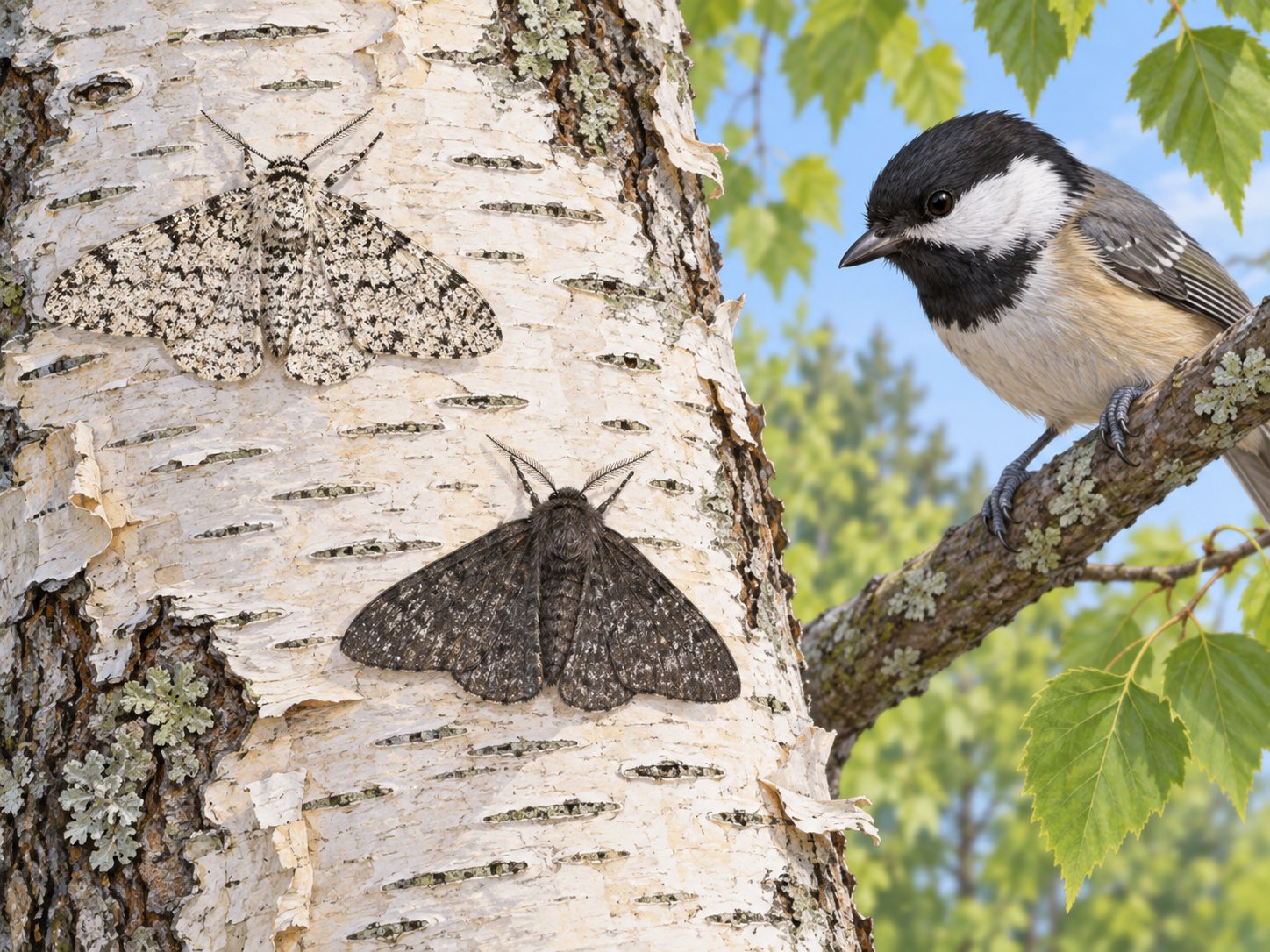
Pale and dark moth variants resting on light bark, with a bird predator nearby.

Pale and dark moth variants resting on light bark, with a bird predator nearby.
  1. A. Color is irrelevant because predators ignore camouflage.
  2. B. Color variants that blend with the background are more likely to survive and reproduce.
  3. C. Selection creates the matching color allele only after predation begins.
  4. D. Only abiotic factors, never biotic ones like predators, can be selective agents.

Question 6 of 10

Scenario A. Which scenario shows competition for limited resources leading to differential survival?

  1. A. Drought shrinks nectar volume; only plants with deeper tubes still feed some pollinators that also visit nearby crops, and long-tongued bees leave more offspring.
  2. B. Unlimited food is provided so every genotype produces the same number of offspring.
  3. C. A laboratory culture is kept free of death and reproduction.
  4. D. A single asexual clone with no phenotypic variation occupies a resource-rich chamber.

Question 7 of 10

Scenario A. Evolutionary fitness of a plant genotype in a wet year is best measured by

  1. A. how long an individual leaf lives.
  2. B. how complex its anatomy appears under a microscope.
  3. C. its relative reproductive success compared with other genotypes.
  4. D. whether biologists subjectively call it "strong."

Question 8 of 10

Scenario A. Abiotic conditions shift from cool-wet to warm-dry over a decade. Why might the direction of selection on leaf-surface area change?

  1. A. Different abiotic environments favor different phenotypes, so which leaf area confers higher fitness can reverse.
  2. B. Abiotic change freezes allele frequencies forever.
  3. C. Selection always favors the same phenotype regardless of environment.
  4. D. Only biotic interactions, never abiotic factors, influence evolutionary direction.

Question 9 of 10

Scenario A. In one generation a predator prefers striped prey; in the next, after a habitat shift, unstriped prey are harder to see. This illustrates that

  1. A. fitness is an unchanging property of a genotype across all environments.
  2. B. biotic and abiotic contexts can fluctuate, changing which genetic variants are favored each generation.
  3. C. natural selection cannot act when environments change.
  4. D. only mutation, not selection, responds to environmental change.

Question 10 of 10

Scenario A. Two beetle genotypes have equal fecundity in a greenhouse with no predators. After birds are introduced, genotype M leaves twice as many offspring as genotype N. The best interpretation is that

  1. A. fitness is identical in both contexts because fecundity potential is genetic.
  2. B. genotype N mutated into M after birds arrived.
  3. C. selection cannot be measured using offspring counts.
  4. D. relative fitness depends on the environment; predation changed which genotype had higher reproductive success.