TOPIC 4.6 · STUDY
Regulation of Cell Cycle
Checkpoints are internal controls that pause the cell cycle, and cyclin-CDK interactions help decide whether the cell advances. If those controls fail, the result can be cancer or apoptosis. Named cyclin-CDK pairs and growth factors are outside this topic.
4.6.A
Checkpoints and cyclin-CDK control
Progression through the cell cycle is regulated by internal checkpoints. A checkpoint asks whether the cell may continue. Failing it means a pause: the cell does not enter the next stage while the requirement is unmet. Passing it means progression is allowed. The point is to keep division tied to the condition of the cell, especially the condition of its DNA.
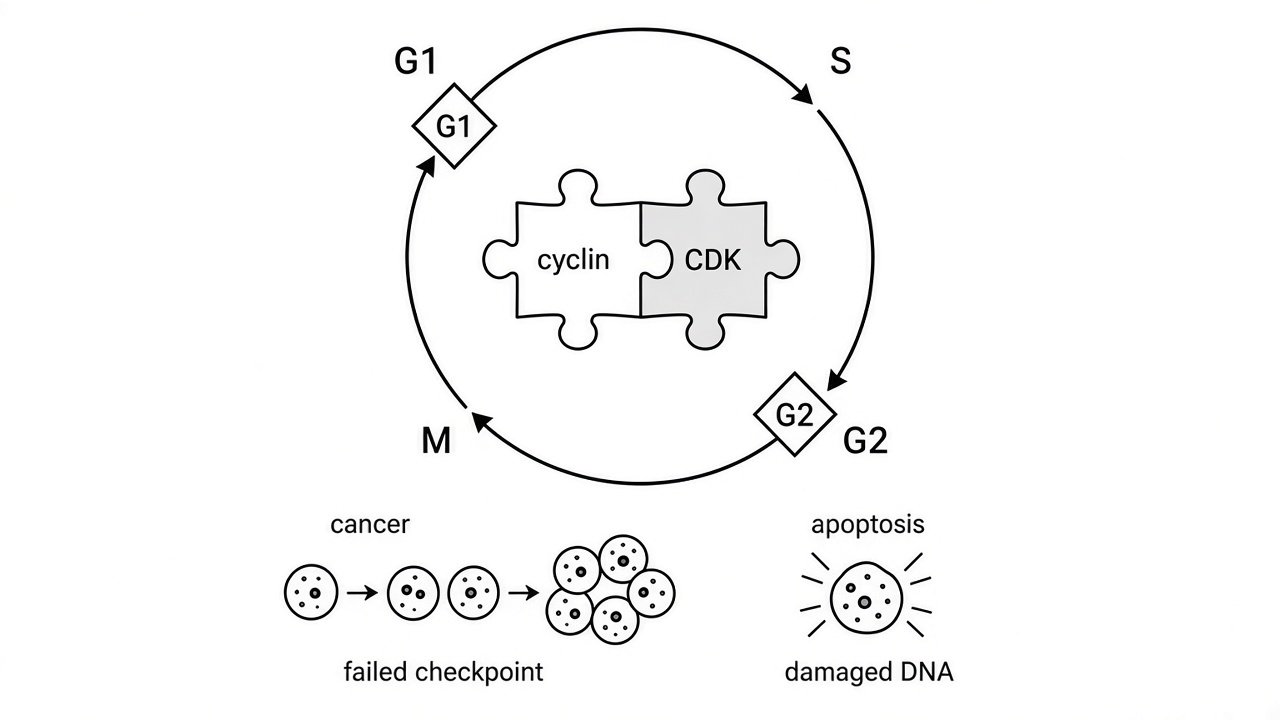
The G1 checkpoint is before S, and the G2 checkpoint is before M. Cyclin and CDK act together. The figure does not name a specific pair. Failed control can lead to extra division. Damage can lead to apoptosis.
Timing is part of the control. A G1 checkpoint can refuse entry into S when the cell is not ready or when the DNA should not be copied. A G2 checkpoint can refuse entry into mitosis when replication is still incomplete. Going on with half-copied DNA would give daughter cells incomplete genomes. The safer cell is the one that pauses. A cell with no such checkpoint may enter mitosis anyway.
Cyclins and cyclin-dependent kinases, called CDKs, work together to control the cycle. When cyclin is available it can activate a CDK partner, and that activity is part of the signal to move forward. You do not need the names of particular cyclin-CDK pairs, and you do not need named growth factors. Those details are outside the exam. What matters is the relationship. Changing how much cyclin is available changes CDK activity, and checkpoints couple that activity to whether the cell should advance. Activity that never turns off can drive division at the wrong time. Activity that never turns on can block division in a tissue that needs new cells.
Key points
- Checkpoints are internal controls on progression through the cell cycle.
- A G1 checkpoint can stop entry into S.
- A G2 checkpoint can stop entry into mitosis if DNA replication is unfinished.
- Cyclins and cyclin-dependent kinases interact to control the cycle.
- Specific cyclin-CDK pairs and growth factors are outside the exam.
- Failing a checkpoint pauses the cycle. Ignoring it lets an unready cell continue.
Memorizing named growth factors misses the point. Learn how a checkpoint uses cyclin-CDK activity to allow or block the next stage.
4.6.B
Cancer and apoptosis
Disruptions of the cell cycle can end in cancer or in apoptosis. Cancer is division that checkpoints no longer hold back, so a cell lineage keeps proliferating. Apoptosis is programmed cell death. One outcome expands a damaged or misregulated lineage. The other removes the cell.
Damage shows why the choice matters. If a control that should block S phase after DNA damage is lost, the damaged cell can copy its DNA and divide. Daughter cells inherit the problem, and over many divisions the tissue has a higher risk of cancer. If the damage response triggers apoptosis instead, that cell is eliminated and does not seed further copies. A treatment that restores checkpoint function should stop damaged cells from moving on. Inactivating a pathway that would have killed a severely damaged cell does the reverse: the cell survives, and cancer risk rises.
The two results are alternatives for the affected cell, not two names for the same event. Uncontrolled passage through checkpoints is the cancer side. Programmed death after damage is the apoptosis side. Losing apoptosis in cells that already carry severe DNA damage tips the outcome toward cells that persist and can accumulate further harm.
Key points
- Disruption of the cell cycle may result in cancer or apoptosis.
- Cancer is linked to division that checkpoints fail to stop.
- Apoptosis is programmed cell death and can remove a damaged cell.
- Copying damaged DNA can pass that damage to daughter cells.
- Losing apoptosis in severely damaged cells raises cancer risk.
Apoptosis here is a possible result of a disrupted cycle. It is not a stage of mitosis.