TOPIC 5.1 · STUDY
Meiosis
Meiosis turns one diploid cell into four haploid cells. Homologous chromosomes separate in meiosis I, and sister chromatids separate in meiosis II. Mitosis and meiosis both move chromosomes with a spindle, but they differ in how many cells they make and in the genetic content of those cells.
5.1.A
Stages that produce haploid cells
Meiosis forms haploid gametes, also called daughter cells, in a sexually reproducing diploid organism. DNA is copied once, before meiosis I, and then two divisions follow, so the chromosome number is cut in half. A spore mother cell with $2n=16$ produces spores with $8$ chromosomes. A primary spermatocyte with $46$ chromosomes produces spermatids with $23$.
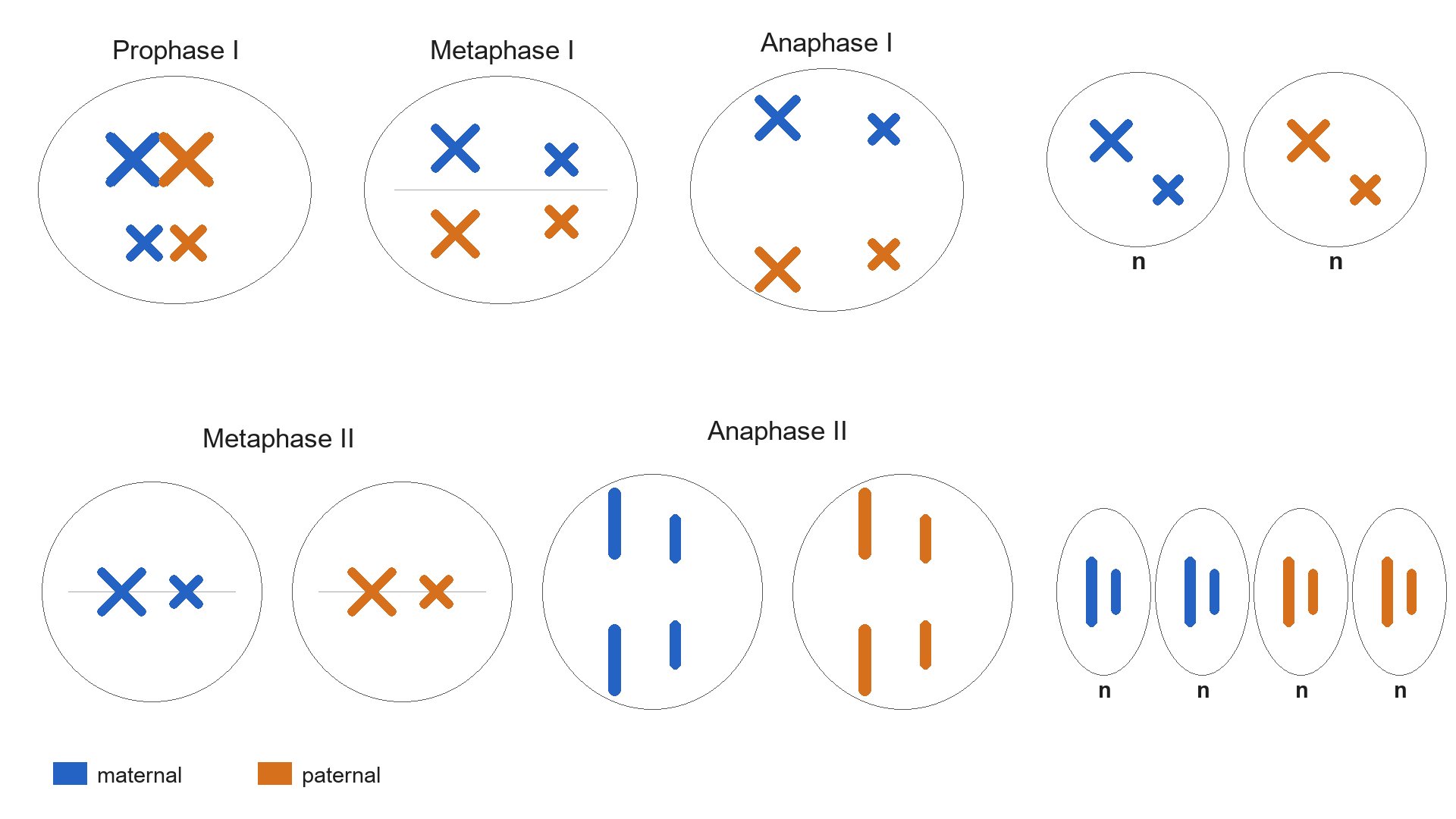
Blue chromosomes are maternal and orange chromosomes are paternal. Meiosis I moves homologs apart while each chromosome stays duplicated. Meiosis II splits those chromatids. Each final cell is haploid.
In prophase I, homologous chromosomes pair and condense. That pairing is synapsis, and chiasmata may form where non-sister chromatids connect. The meiotic spindle begins to form, centrosomes move toward opposite poles, and the nuclear envelope breaks down.
In metaphase I, spindle fibers line the homologous pairs up at the metaphase plate. In a $2n=4$ cell, one long pair and one short pair, both pairs sit at the equator as pairs. In anaphase I the homologs separate and move toward the poles. Sister chromatids stay attached at the centromere. Mitotic anaphase splits sisters instead. In telophase I the spindle breaks down and a new nuclear envelope forms. An animal cell pinches in with a cleavage furrow. A plant cell builds a cell plate. Cytokinesis yields two haploid cells, and each chromosome in those cells still has two chromatids.
Track DNA with a G1 diploid cell as $2C$. After replication the meiocyte is $4C$, and metaphase I is still $4C$. Each nucleus after meiosis I is $2C$ and already haploid. The DNA amount matches the G1 diploid amount only because the chromatids are still doubled. If G1 DNA is $12$ pg, the replicated cell has $24$ pg, and each nucleus after meiosis I has about $12$ pg.
Cells that enter prophase II are haploid. The spindle forms again, and sister chromatids, still joined at the centromere, attach to it. In metaphase II the chromosomes line up singly on the metaphase plate. The kinetochore of each chromatid is attached to a microtubule from one pole. There is no homologous pair on that plate. In anaphase II, proteins holding the centromeres together break down, and the sister chromatids move to opposite poles. This is the division in which sisters finally separate. In telophase II the spindle breaks down, a nuclear envelope forms, and a cleavage furrow or a cell plate appears. Chromatids begin to decondense, and cytokinesis follows. Four haploid cells result, each chromosome a single unduplicated chromatid.
A diploid plant cell with $2n=6$ has $3$ chromosomes in each cell at the end of meiosis I, and each of those chromosomes still has two chromatids. At the end of meiosis II each cell still has $3$ chromosomes, now as single chromatids. A germ cell with $2n=24$ has $12$ chromosomes in each secondary spermatocyte after meiosis I, with two chromatids each, until anaphase II.
5.1.B
How mitosis and meiosis differ
Mitosis and meiosis both use a spindle to move chromosomes. The shared machinery does not make the products the same. One mitosis of a diploid cell produces two diploid cells. Barring mutation, their chromosome number matches the parent cell. Meiosis produces four haploid cells, and the chromosome set is reduced.
A $2n=10$ somatic cell produces two cells with $10$ chromosomes each. Meiosis of a $2n=10$ germ cell produces four cells with $5$ chromosomes each. Homologs pair, then separate, only in meiosis I. Two rounds of mitosis never make that pairing, and they do not produce a haploid set. Sister chromatids separate in mitotic anaphase and in anaphase II. They do not separate in anaphase I.
With G1 diploid cells as $2C$, mitotic metaphase is $4C$ and metaphase I is $4C$, because replication has already happened. Each mitotic daughter is $2C$. Each cell just after meiosis I is $2C$ but haploid, with duplicated chromosomes. Each cell after meiosis II is $1C$. Mitosis builds and repairs diploid tissues. Meiosis makes the haploid cells used in sexual reproduction. A block that stops homologs from separating hits meiosis I. It does not stop the sister-chromatid split used in mitosis and in anaphase II.
| Feature | Mitosis | Meiosis |
|---|---|---|
| Cells from one parent cell | 2 | 4 |
| Ploidy of the products | diploid | haploid |
| Homologs pair | no | yes, in prophase I |
| First separation | sister chromatids | homologous chromosomes |
| Chromosomes line up singly | metaphase | metaphase II |
| Spindle moves chromosomes | yes | yes |
Key points
- Meiosis yields four haploid cells. Homologs separate in meiosis I. Sisters separate in meiosis II.
- Prophase I pairs homologs, and chiasmata may form. Metaphase I places pairs on the plate.
- After meiosis I the cells are haploid, and each chromosome still has two chromatids.
- Anaphase II splits the centromere. The four products have unduplicated chromatids.
- A $2n=16$ cell produces spores with $8$ chromosomes. G1 DNA of $12$ pg is $24$ pg after replication and about $12$ pg per nucleus after meiosis I.
- Mitosis and meiosis both use a spindle. Mitosis makes two diploid cells. Meiosis makes four haploid cells.
- Sister chromatids separate in mitotic anaphase and in anaphase II, not in anaphase I.
Which homolog reaches a given pole is a later question. Topic 5.2 covers how that choice, plus crossing over and fertilization, builds genetic variation.