TOPIC 5.2 · STUDY
Meiosis and Genetic Diversity
Crossing over, independent assortment, and fertilization each add genetic variation in a sexual eukaryote. When chromosomes separate correctly, every gamete gets one haploid set drawn from both parents. Nondisjunction produces gametes that are not haploid.
5.2.A
How meiosis and fertilization vary the set
Correct separation gives every gamete a haploid set, written $1n$. Homologs separate in meiosis I, and sister chromatids separate in meiosis II. That set mixes maternal and paternal chromosomes. It is not a copy of one parent's full diploid genome. After a normal meiosis I, each daughter cell is haploid and its chromosomes are still duplicated.
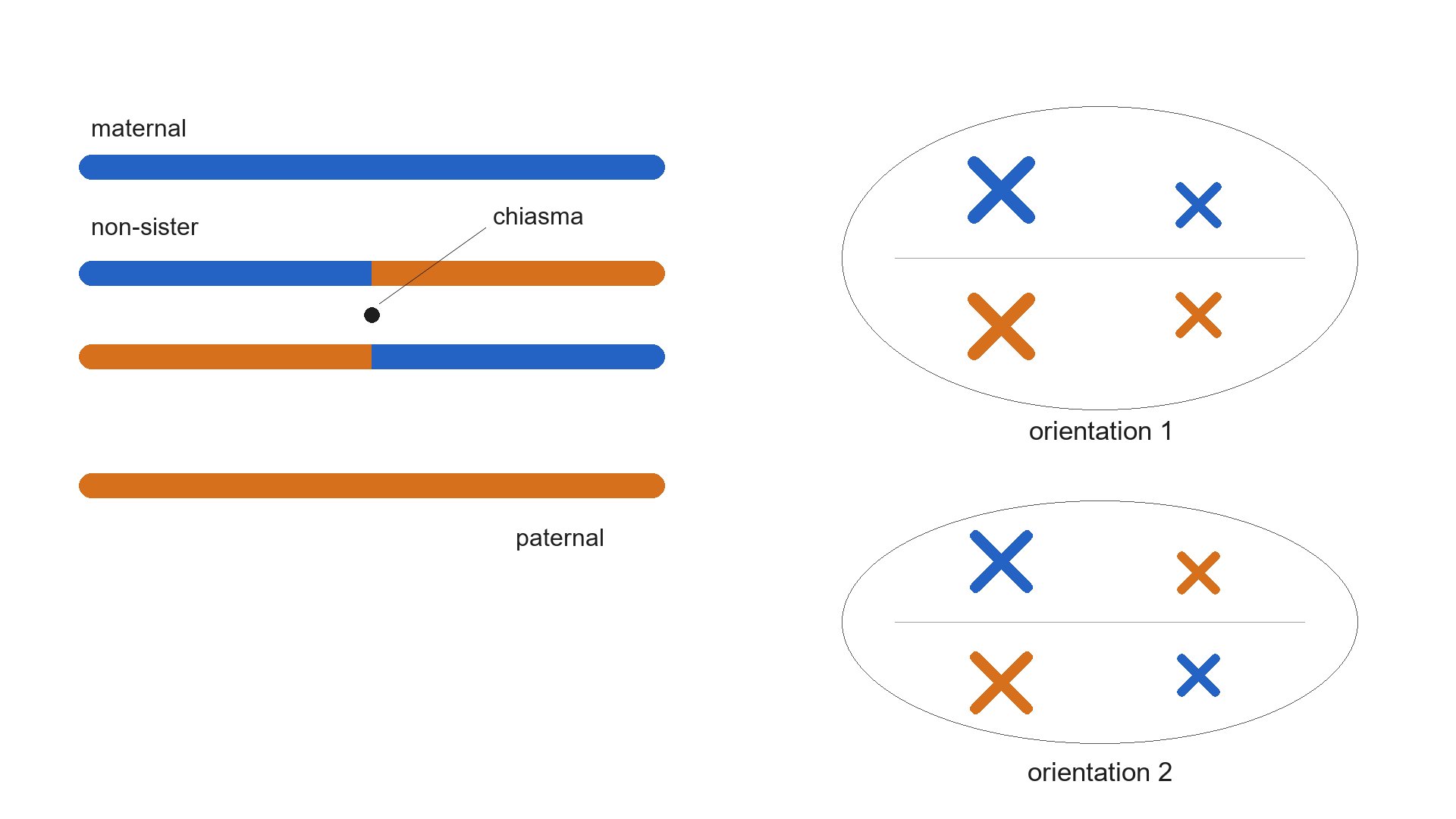
The middle chromatids are non-sisters. Each changed color at the chiasma, so each carries a segment from the other parent. Orientation 2 flips the short pair relative to orientation 1, which changes which chromosomes share a pole.
Independent assortment comes from the way each pair sits on the metaphase I plate. One pair's orientation does not fix the next pair's orientation. With no crossing over, the number of chromosome combinations among the gametes is $2^{n}$. For $n=2$ that is $4$. For $n=3$ that is $8$. For $n=4$ that is $16$. A gene on chromosome 1 and a gene on chromosome 2 assort independently because they are on different chromosomes.
Crossing over happens in prophase I. Non-sister chromatids exchange segments. That exchange is recombination, and a chiasma is the connection where it shows. Sister chromatids of the same chromosome are not the pair that swaps. The swap puts a new allele combination on a chromatid, including for genes that began on the same chromosome. If chiasmata do not form, but homologs still separate, whole chromosomes can still assort. What is lost is the recombinant chromatid.
Fertilization fuses two haploid gametes, restores the diploid number, and combines two genomes that meiosis produced separately. Crossing over, random assortment, and fertilization are the three sources of genetic variation named for sexual eukaryotes in this topic. The stage-by-stage life cycles of particular plants and animals are outside the topic.
Nondisjunction is a failure of separation, and the gametes are then not all haploid. If one pair fails in meiosis I, one secondary cell receives both homologs and the other receives none. Meiosis II still splits sister chromatids, so two gametes carry two copies of that chromosome and two gametes carry none. In a $2n=8$ cell, failure of chromosome 4 in meiosis I leaves one secondary meiocyte with both chromosome-4 homologs and the other with no chromosome 4. If instead the sister chromatids of one chromosome fail to separate in meiosis II, that division makes one gamete with an extra copy and one with none, while the other meiosis II division can still be normal. Those four products are one $n+1$ cell, one $n-1$ cell, and two haploid cells.
Two genes on the same chromosome often travel together unless recombination separates them. A gene on a different chromosome can still assort independently of either one. The map-unit calculation for that separation is topic 5.4.
Key points
- Correct separation gives each gamete one haploid set that mixes maternal and paternal chromosomes.
- Independent assortment alone produces $2^{n}$ gamete combinations. $n=3$ gives $8$.
- Crossing over exchanges segments between non-sister chromatids in prophase I. A chiasma marks that exchange.
- Fertilization restores the diploid number and combines two gametes.
- Meiosis I nondisjunction sends both homologs to one cell and none to the other.
- Meiosis II nondisjunction fails to split sister chromatids in one division. The other division can still be haploid.
- Life-cycle details of particular plants and animals are outside this topic.
A new mutation can create a new allele, but mutation is not one of the three variation sources named for this topic.