TOPIC 5.3 · STUDY
Mendelian Genetics
Segregation and independent assortment describe genes on different chromosomes. Punnett squares and the probability rules predict genotype and phenotype ratios. A chi-square test checks whether counts fit the ratio in the null hypothesis.
5.3.A
Mendel's laws, ratios, and chi-square
The law of segregation says the two alleles of a gene separate, so each gamete carries one of them. A heterozygote $Tt$ makes $T$ gametes and $t$ gametes in equal proportion. The law of independent assortment says alleles of genes on different chromosomes assort independently. Genes tied together on one chromosome are the linked case in topic 5.4, and they are not the case that predicts $9:3:3:1$.
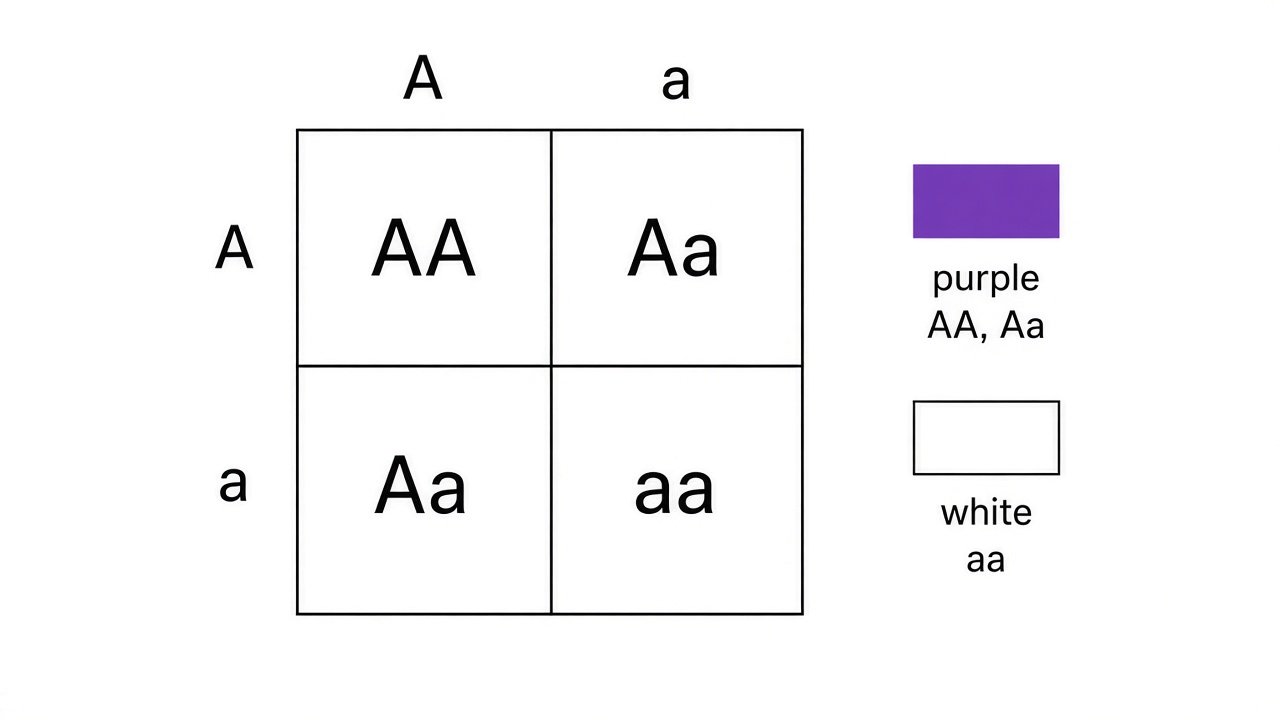
Each cell of the square is equally likely. Under complete dominance, $AA$ and $Aa$ share the purple phenotype and $aa$ is white. The genotypic ratio is $1:2:1$. The phenotypic ratio is $3:1$.
Genotype is the set of alleles an individual inherited. Homozygous means the two alleles match, as in $GG$ or $gg$. Heterozygous means they differ, as in $Gg$. Phenotype is the observable trait. Under complete dominance, $GG$ and $Gg$ can share a phenotype, so two organisms with the same phenotype can still have different genotypes. Fertilization fuses two haploid gametes, restores the diploid chromosome number, and builds a new allele combination in the zygote.
A monohybrid cross follows one gene. For $Aa \times Aa$ with complete dominance, the offspring are $\frac{1}{4}$ $AA$, $\frac{1}{2}$ $Aa$, and $\frac{1}{4}$ $aa$. The phenotypes are $\frac{3}{4}$ dominant and $\frac{1}{4}$ recessive. A test cross mates an individual that shows the dominant phenotype to a homozygous recessive. $Aa \times aa$ gives $\frac{1}{2}$ $Aa$ and $\frac{1}{2}$ $aa$, a $1:1$ phenotypic ratio. If every offspring shows the dominant phenotype, the unknown parent is most likely $AA$.
For genes on different chromosomes, $AaBb \times AaBb$ with complete dominance has the phenotypic ratio $9:3:3:1$. The probability of $aabb$ uses the product rule: $P(aa)=\frac{1}{4}$ and $P(bb)=\frac{1}{4}$, so $P(aabb)=\frac{1}{16}$. A dihybrid test cross $DdEe \times ddee$ gives four genotypes at $\frac{1}{4}$ each: $DdEe$, $Ddee$, $ddEe$, and $ddee$. With complete dominance the phenotypic ratio is also $1:1:1:1$.
If A and B are mutually exclusive, $P(A \text{ or } B)=P(A)+P(B)$. A gamete from $Aa$ carries either $A$ or $a$, so $P(A \text{ or } a)=\frac{1}{2}+\frac{1}{2}=1$. If A and B are independent, $P(A \text{ and } B)=P(A)\times P(B)$. For $Rr \times Rr$ and yellow only when the offspring is $rr$, $P(rr)=\frac{1}{2}\times\frac{1}{2}=\frac{1}{4}$.
A chi-square test compares counts with a stated ratio. The null hypothesis is that ratio, for example $3:1$, not a claim that some other ratio is true. $$\chi^{2}=\sum\frac{(o-e)^{2}}{e}$$ Degrees of freedom equal the number of outcome classes minus 1. The formula sheet lists $3.84$ at df $=1$ and $7.81$ at df $=3$, both for $p=0.05$. A result larger than the critical value means reject the null. A result less than or equal to the critical value means fail to reject. Failing to reject means the counts are still compatible with the null. It does not prove the null.
For $n=80$ and a $3:1$ null, the expected counts are $60$ and $20$. Observed $64$ and $16$ give $$\chi^{2}=\frac{(64-60)^{2}}{60}+\frac{(16-20)^{2}}{20}=\frac{16}{15}\approx 1.07.$$ Because $1.07<3.84$, fail to reject. Observed $48$ and $32$ give $$\chi^{2}=\frac{(48-60)^{2}}{60}+\frac{(32-20)^{2}}{20}=9.6.$$ Because $9.6>3.84$, reject that $3:1$ null. For a $9:3:3:1$ prediction with $n=160$, the expected counts are $90$, $30$, $30$, and $10$. Observed $88$, $32$, $28$, and $12$ give $$\chi^{2}=\frac{4}{90}+\frac{4}{30}+\frac{4}{30}+\frac{4}{10}\approx 0.71,$$ and $0.71<7.81$, so fail to reject. A $1:1$ test cross uses df $=1$. Observed $46$ and $54$ against expected $50$ and $50$ give $\chi^{2}=0.64$, also a fail to reject.
Pedigrees often show whether a trait is autosomal and whether an allele behaves as dominant or recessive. An autosomal recessive trait can appear in a child of two unaffected parents, and those parents are heterozygous carriers. Their probability of an affected child is $\frac{1}{4}$. Sex-linked pedigrees and map units are topic 5.4.
| Degrees of freedom | Critical value at $p=0.05$ |
|---|---|
| 1 | 3.84 |
| 2 | 5.99 |
| 3 | 7.81 |
Key points
- Segregation puts one allele in each gamete. Independent assortment applies to genes on different chromosomes.
- Genotype is the allele set, homozygous or heterozygous. Phenotype is the observed trait.
- $Aa \times Aa$ under complete dominance: genotypes $1:2:1$, phenotypes $3:1$.
- A test cross to a homozygous recessive separates $AA$ from $Aa$.
- Independent events multiply. $P(aabb)$ from $AaBb \times AaBb$ is $\frac{1}{16}$.
- Chi-square compares observed and expected counts. Reject the null when the value exceeds the critical value.
- Two unaffected heterozygous parents can have an autosomal recessive child. The probability is $\frac{1}{4}$.
A phenotypic ratio is not a genotypic ratio. $3:1$ and $1:2:1$ answer different questions. State the null as the expected ratio, not as its alternative.