TOPIC 5.4 · STUDY
Non-Mendelian Genetics
Linked genes, incomplete dominance, codominance, sex linkage, pleiotropy, and organelle DNA all depart from simple Mendelian ratios. Recombination frequency gives the map distance between linked genes. A chi-square test flags ratios that do not fit independent assortment.
5.4.A
Inheritance that does not fit Mendelian ratios
Many traits do not follow the ratios predicted by segregation and independent assortment. The check is quantitative. When a chi-square test rejects the Mendelian null, the observed counts do not fit that prediction. For a dihybrid test cross the null is $1:1:1:1$. Rejection rules out independent assortment for those data. It does not, by itself, name which other pattern is operating.
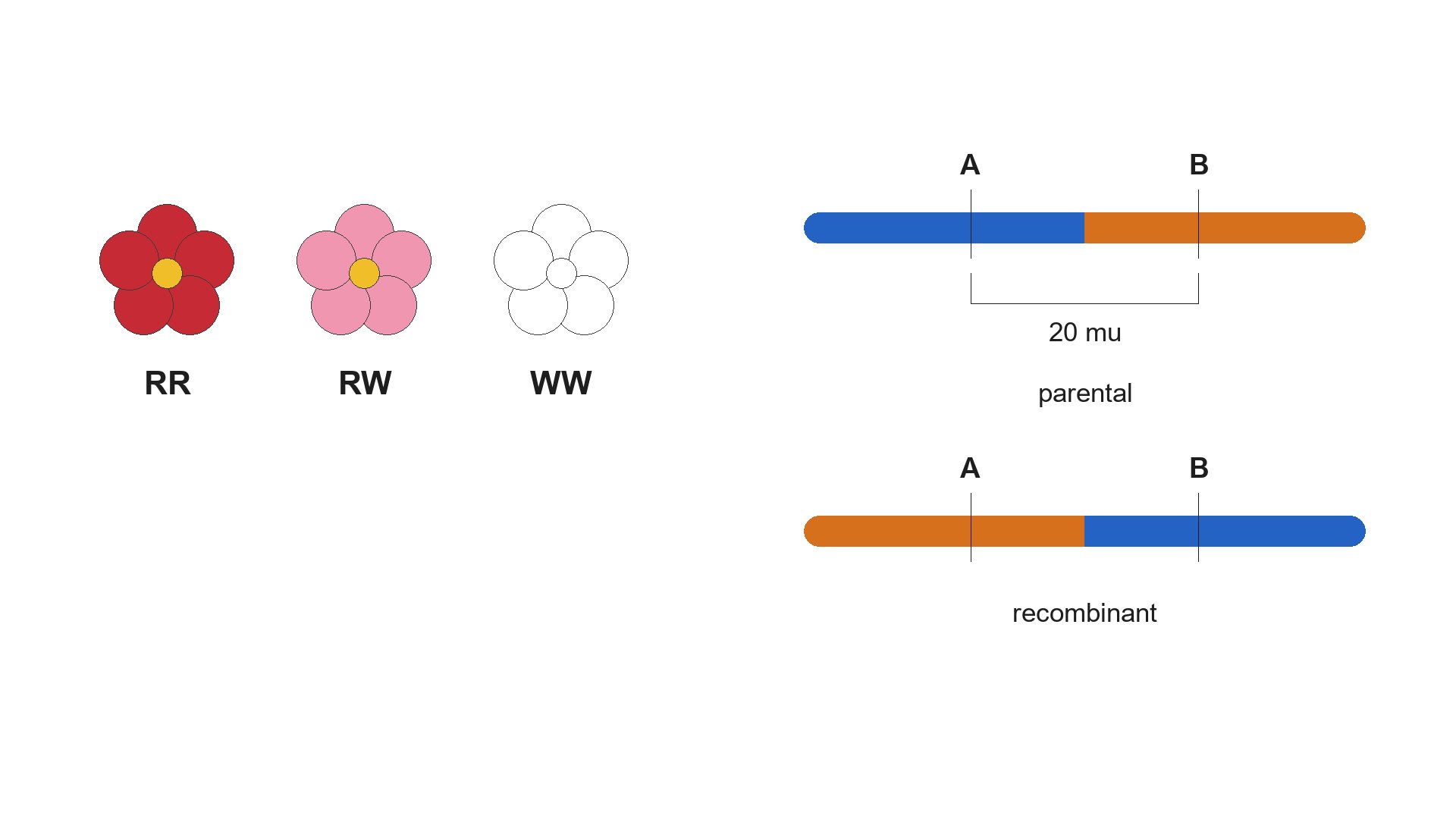
$RW$ is a blend, so incomplete dominance gives a $1:2:1$ phenotype ratio rather than $3:1$. The bracket is $20$ map units between A and B. The recombinant chromatid reverses the parental colors because a crossover fell between the loci.
Genes on the same chromosome are genetically linked and tend to be inherited together. Recombination frequency is recombinant offspring divided by the total. Map distance in map units is that frequency times $100$. One map unit means a recombination frequency of $0.01$. Loci $12$ map units apart recombine in about $12\%$ of test-cross offspring. Sixteen recombinants among $200$ offspring are $(16/200)\times 100=8$ map units. A dihybrid in coupling, both dominant alleles on one homolog, produces two common parental classes and two rarer recombinant classes in a test cross. Unlinked genes recombine about half the time and fit $1:1:1:1$. If a chromosomal inversion suppresses crossing over between two loci, recombination frequency falls toward $0$. The probability that the alleles stay together is about $1$ minus the recombination frequency, so $8$ map units means they stay together in about $0.92$ of gametes.
A dihybrid test cross with $n=100$ and a $1:1:1:1$ null expects $25$ in each class. Observed counts $40$, $40$, $10$, and $10$ give $$\chi^{2}=4\times\frac{15^{2}}{25}=36.$$ With df $=3$, the $p=0.05$ critical value is $7.81$. Because $36>7.81$, reject independent assortment. The large classes are parentals and the small classes are recombinants. Map distance is $\frac{10+10}{100}\times 100=20$ map units.
In incomplete dominance, neither allele hides the other, and the heterozygote is a blend. Red $RR$ crossed with white $WW$ gives pink $RW$. Pink crossed with pink gives $\frac{1}{4}$ red, $\frac{1}{2}$ pink, and $\frac{1}{4}$ white. That phenotypic ratio is $1:2:1$, not $3:1$. In codominance, both alleles are expressed, and the heterozygote differs from either homozygote. Blood type $I^{A}I^{B}$ shows both A and B antigens at once, which is not a blend into a third color. A $1:2:1$ count can be either pattern. Read the heterozygote before you name it.
| Pattern | Heterozygote phenotype |
|---|---|
| Complete dominance | matches the dominant homozygote |
| Incomplete dominance | a blend of the two homozygotes |
| Codominance | both allele phenotypes at once |
Sex-linked traits are determined by genes on a sex chromosome. In an XY system, an X-linked recessive trait shows up more often in XY individuals than in XX individuals, because the single X is expressed. An affected XY child of two unaffected parents inherited the allele on the X from a heterozygous mother. The father contributed the Y. An affected XY father passes his X to daughters and his Y to sons, so sons do not inherit that X-linked allele. Daughters who also receive a normal X from the mother are carriers when the allele is recessive. A Y-linked trait passes from an XY parent to XY offspring and not to XX offspring. Birds use a ZW system, and honeybees use haplodiploidy, so sex chromosomes are not always X and Y. The life cycles of those systems are not part of this topic.
Pleiotropy means one gene affects several traits. Those traits do not segregate as if they were separate genes, because one gene causes all of them. A gene that changes leaf color, height, and root branching is one pleiotropic gene. Chloroplast and mitochondrial genes sit on organelle DNA and are assorted to gametes more or less at random, so they do not follow a simple Mendelian ratio. In animals, mitochondria usually come from the egg rather than the sperm. An affected mother typically passes the trait to all of her children, and an affected father typically passes it to none. In plants, mitochondria and chloroplasts are transmitted in the ovule rather than the pollen, so those traits are typically maternal as well.
Key points
- Reject a Mendelian null when chi-square exceeds the critical value. Four classes use df $=3$ and cutoff $7.81$.
- Map units equal recombinant offspring divided by the total, times $100$. Twenty recombinants out of $100$ is $20$ map units.
- Incomplete dominance: $RW \times RW$ gives $\frac{1}{4}$ red, $\frac{1}{2}$ pink, and $\frac{1}{4}$ white.
- Codominance shows both allele phenotypes in the heterozygote, as in $I^{A}I^{B}$.
- An X-linked recessive trait appears more often in XY individuals. A Y-linked trait passes from XY parent to XY offspring.
- Pleiotropy is one gene with several traits, so those traits do not assort as separate genes.
- Animal mitochondrial DNA, and plant mitochondrial and chloroplast DNA, are typically inherited from the mother.
Failing to reject a $1:1:1:1$ null means the counts still fit independent assortment. It does not prove the genes sit on different chromosomes.