Mendelian Genetics MCQ Practice

Question 1 of 10

In pea plants, allele $T$ (tall) is completely dominant to $t$ (short). A $Tt$ plant is crossed with a $tt$ plant. What is the expected phenotypic ratio among offspring?

Gamete T t
t Tt tt
t Tt tt
  1. A. 3 tall : 1 short
  2. B. 1 tall : 1 short
  3. C. All tall
  4. D. All short

Question 2 of 10

Mendel’s law of segregation is best illustrated by which statement?

  1. A. Linked genes never recombine.
  2. B. Mitochondrial genes follow paternal inheritance only.
  3. C. The two alleles of a gene separate into different gametes during meiosis.
  4. D. All genes on different chromosomes mutate at the same rate.

Question 3 of 10

Two genes assort independently. A dihybrid $AaBb$ is self-crossed. What fraction of offspring is expected to be $aabb$?

  1. A. $1/16$
  2. B. $1/8$
  3. C. $1/4$
  4. D. $3/16$

Question 4 of 10

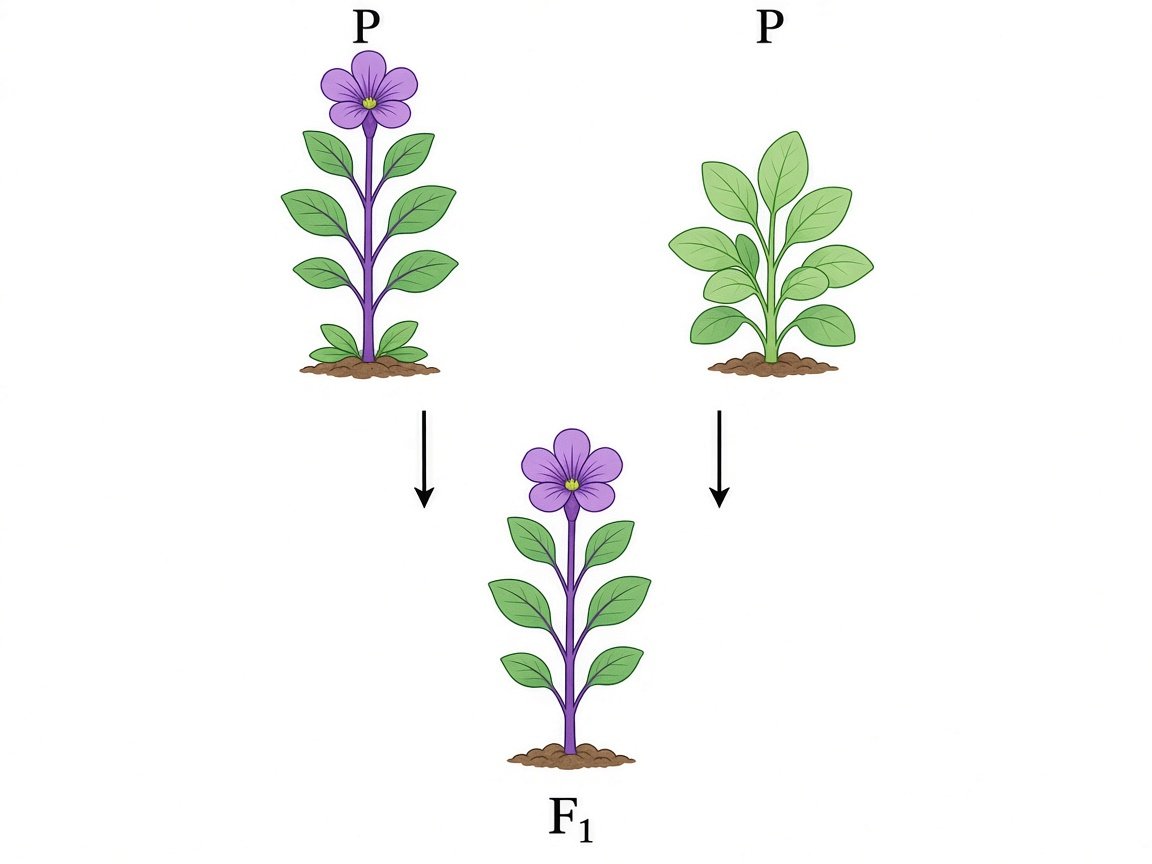
A plant of unknown genotype for a dominant flower-color trait is crossed to a homozygous recessive plant. Offspring are 47 purple and 0 white. The unknown parent is most likely

Parental and F1 plants illustrating a monohybrid cross outcome.
  1. A. homozygous recessive.
  2. B. homozygous dominant.
  3. C. heterozygous.
  4. D. haploid for the flower-color gene.

Question 5 of 10

Students count F2 plants from a monohybrid cross expected to fit 3:1. Observed: 78 dominant and 22 recessive ($n=100$). Using $\chi^2$ with critical value 3.84 (df=1, $p=0.05$), which conclusion is correct?

Class Observed Expected (3:1)
Dominant 78 75
Recessive 22 25
  1. A. Reject the null because $\chi^2=12.0>3.84$.
  2. B. Fail to reject the null because $\chi^2=5.2>3.84$.
  3. C. Fail to reject the null because $\chi^2=0.48<3.84$.
  4. D. Reject the null because $\chi^2=0.48<3.84$.

Question 6 of 10

If events A and B are independent, $P(A\text{ and }B)$ equals

  1. A. $P(A)+P(B)$
  2. B. $P(A)-P(B)$
  3. C. $P(A)/P(B)$
  4. D. $P(A)\times P(B)$

Question 7 of 10

In a pedigree for an autosomal recessive trait, two unaffected parents have an affected child. The parents’ genotypes are best described as

Two-generation pedigree: unaffected parents have one affected child and two unaffected children.
  1. A. both heterozygous carriers.
  2. B. both homozygous dominant.
  3. C. one homozygous recessive and one homozygous dominant.
  4. D. both hemizygous.

Question 8 of 10

Genotype refers to _____; phenotype refers to _____.

  1. A. observable traits; allele set
  2. B. allele set inherited; observable expression of traits
  3. C. only recessive alleles; only dominant alleles
  4. D. mitochondrial DNA only; nuclear DNA only

Question 9 of 10

A dihybrid cross is expected to fit 9:3:3:1. Observed counts among 160 offspring are 86, 28, 30, and 16. Critical value for df=3 at $p=0.05$ is 7.81. Which statement is correct?

Phenotype class Observed Expected (9:3:3:1)
Class 1 86 90
Class 2 28 30
Class 3 30 30
Class 4 16 10
  1. A. $\chi^2\approx 3.91<7.81$, so fail to reject the 9:3:3:1 null.
  2. B. $\chi^2\approx 3.91>7.81$, so reject the null.
  3. C. $\chi^2\approx 15.2>7.81$, so reject the null.
  4. D. $\chi^2\approx 0.02<7.81$, so the data prove the genes are linked.

Question 10 of 10

Independent assortment applies to genes that are

  1. A. always on the same chromosome and completely linked.
  2. B. only mitochondrial.
  3. C. on different chromosomes (or far enough apart to behave as if unlinked).
  4. D. never inherited through gametes.