Meiosis and Genetic Diversity FRQ Practice

Responses receive AI feedback against a rubric after submission. Scores are practice estimates.

Question 1 of 5

A diploid organism has three chromosome pairs. (a) Calculate the number of gamete chromosome combinations from independent assortment alone (no crossing over). (b) Explain how crossing over further increases diversity beyond that number. (c) Pose one testable question a student could ask about the effect of a recombination-blocking drug on offspring genotype diversity.
Question 2 of 5

Nondisjunction occurs for chromosome 4 during meiosis I in a $2n=8$ organism. (a) Describe the chromosome 4 content of the two secondary meiocytes after meiosis I. (b) Predict possible chromosome 4 counts in the four resulting gametes after meiosis II (assume meiosis II is normal). (c) Explain why such gametes are no longer simply haploid for the full genome.

Question 3 of 5

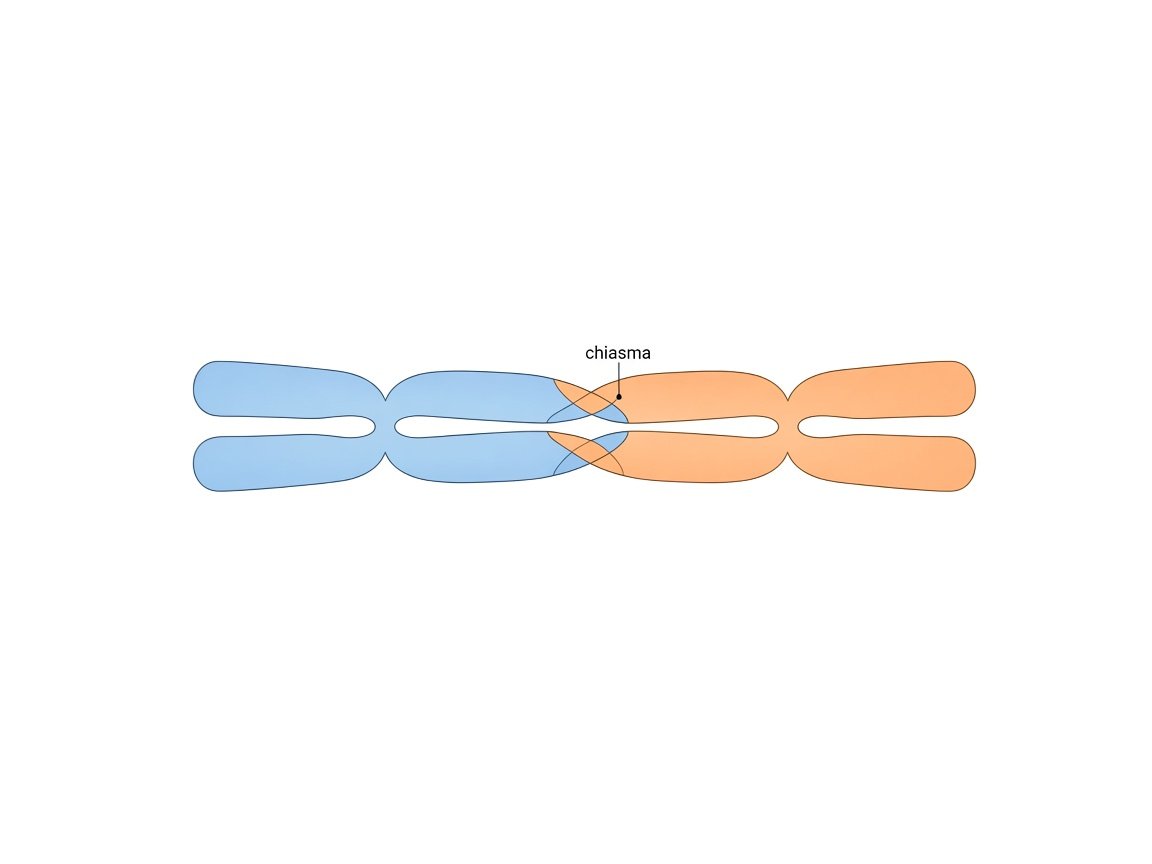
The figure shows a tetrad with a chiasma. (a) Identify which chromatids exchange segments at a chiasma (sister vs non-sister). (b) Explain how this exchange affects alleles of linked genes on that chromosome. (c) Identify one additional meiotic process (besides crossing over) that diversifies gametes.

Tetrad with chiasma between non-sister chromatids.

Question 4 of 5

Two parents produce offspring through sexual reproduction. (a) Explain how random fertilization contributes to genetic variation among siblings. (b) Contrast this with asexual budding that produces genetically identical offspring (barring mutation). (c) State why knowledge of detailed sexual life-cycle differences among all plant and animal taxa is not required for this explanation on the AP Exam.

Question 5 of 5

Students model metaphase I for a cell with two homologous pairs (labeled pair R and pair S). (a) Sketch verbally two different metaphase I orientations that produce different gamete chromosome combinations. (b) Explain why both orientations are equally likely if assortment is independent. (c) Predict how adding crossing over on pair R would change diversity of chromatids for genes on R.