TOPIC 4.2 · STUDY
Introduction to Signal Transduction
A signal transduction pathway links reception of a ligand to a cellular response. Receptor shape change, phosphorylation cascades, and second messengers such as cAMP relay and often amplify the signal.
4.2.A
Reception, transduction, and response
A signal transduction pathway connects reception of a signal to what the cell does about it. Read the pathway as three stages in order. Reception is recognition of the signal. Transduction is the relay inside the cell. Response is the action that follows, such as growth, secretion, or a change in gene expression.
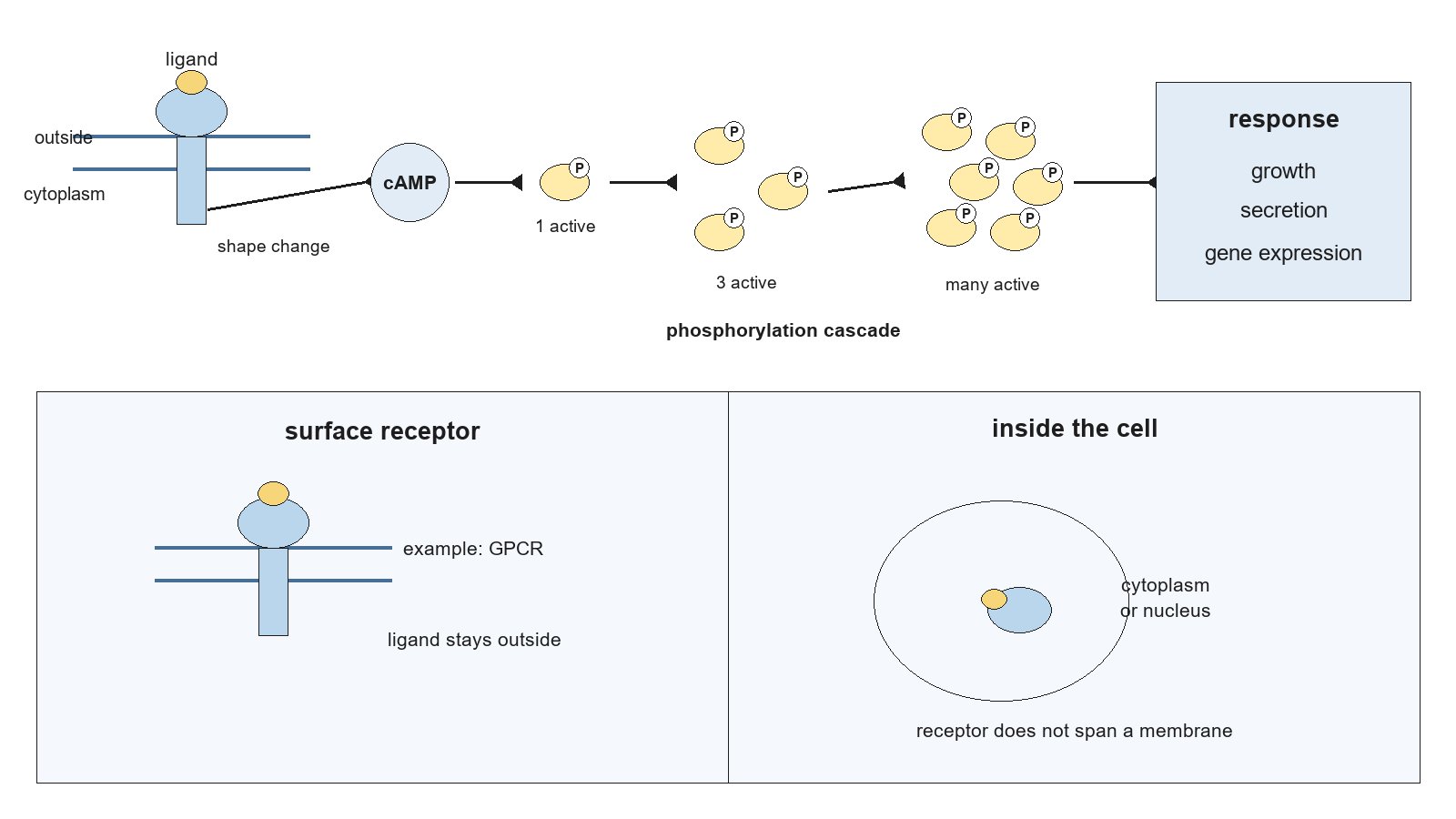
Binding changes the cytoplasmic side of a surface receptor and starts a relay. cAMP is one second messenger, and a phosphorylation cascade amplifies the signal. A receptor in the cytoplasm or nucleus does not span a membrane.
Many pathways pass the message by modifying proteins. A common modification is phosphorylation. A kinase attaches a phosphate group to the next protein and switches that protein on. The newly active kinase can phosphorylate many copies of the following target. One active molecule at the start can therefore produce a much larger number of active molecules a few steps later. That increase is amplification. A sparse ligand outside the cell can still drive a strong response inside.
The stages are not the same step. If a middle kinase is blocked, ligand can still bind, but phosphorylated relay proteins stay scarce and the response drops or fails. Calling the whole pathway reception is too small: binding only starts the process. Relay proteins can also be switched back off. The cell can then detect a new signal instead of staying locked in the response.
Key points
- A pathway links signal reception to a cellular response.
- The order is reception, then transduction, then response.
- Many pathways use protein phosphorylation cascades.
- Each active kinase can activate many next targets, so the signal is amplified.
- Blocking a middle kinase cuts the relay even if the ligand still binds.
- Relay proteins can be inactivated again so the response can stop.
Amplification is why a few ligand molecules can change the activity of many proteins inside the cell.
4.2.B
Ligands, receptors, and responses
Signaling begins when a ligand, the chemical messenger, fits a receptor on a target cell. The ligand-binding domain recognizes one kind of messenger. That messenger may be a peptide, which is a protein, or a smaller molecule. The fit is specific. A receptor built for one ligand does not treat every chemical as its signal.
Receptors are not all in one place. Some span the plasma membrane, with the binding site outside and a domain in the cytoplasm. G protein-coupled receptors are one example of a membrane receptor in eukaryotes. After the ligand binds, that class of receptor passes the signal onward inside the cell. Other receptors sit in the cytoplasm or in the nucleus and do not span a membrane. Many peptide ligands cannot cross the membrane, so they bind at the surface. Some small messengers enter the cell and bind an internal receptor.
After a surface receptor binds its ligand, the intracellular domain changes shape, and that change starts transduction. Enzymes and small second messengers, including cyclic AMP (cAMP), carry the message and often amplify it. A ligand-gated channel is a different immediate effect: binding opens or closes the channel, and ion flow changes. Gene-expression responses take longer because they change transcription. Either route can end in growth, secretion, or a change in which genes are active. Hormones are messengers that may travel a long distance in the blood before they meet a receptor and open one of these pathways.
Key points
- A ligand is the chemical messenger, and the receptor binding domain is specific for it.
- Receptors can be on the cell surface or in the cytoplasm or nucleus.
- G protein-coupled receptors are a eukaryotic membrane-receptor example.
- Ligand binding changes the shape of the intracellular domain and starts transduction.
- Enzymes and second messengers such as cAMP relay and amplify the intracellular signal.
- Ligand-gated channels open or close and change ion flow.
- Responses include growth, secretion, and gene expression. Hormones can travel far in the blood.
cAMP is the second messenger named for this topic. Not every pathway uses cAMP, and a channel response is faster than a change in transcription.