Question 1 of 5
Scenario A. (a) Define a signal transduction pathway in one sentence. (b) Identify the role of phosphorylation cascades within many such pathways. (c) Explain how linking reception to response benefits a multicellular organism.
Responses receive AI feedback against a rubric after submission. Scores are practice estimates.
Scenario A. (a) Define a signal transduction pathway in one sentence. (b) Identify the role of phosphorylation cascades within many such pathways. (c) Explain how linking reception to response benefits a multicellular organism.
Scenario A. A pathway includes reception, a three-kinase cascade, and a change in gene expression. (a) Classify each of those three parts as reception, transduction, or response. (b) Describe how protein modification in the cascade transmits information without the original ligand entering the nucleus. (c) Predict what happens to the response if the middle kinase cannot be phosphorylated.
Scenario A. Students measure active kinase molecules after ligand addition (table). (a) Describe the trend. (b) Explain the trend using amplification in a phosphorylation cascade. (c) Propose one cellular reason amplification is useful when few ligand molecules arrive.
| Step | Active molecules (relative) |
|---|---|
| Receptor complexes | 1 |
| Kinase 1 | 10 |
| Kinase 2 | 100 |
| Kinase 3 | 1000 |
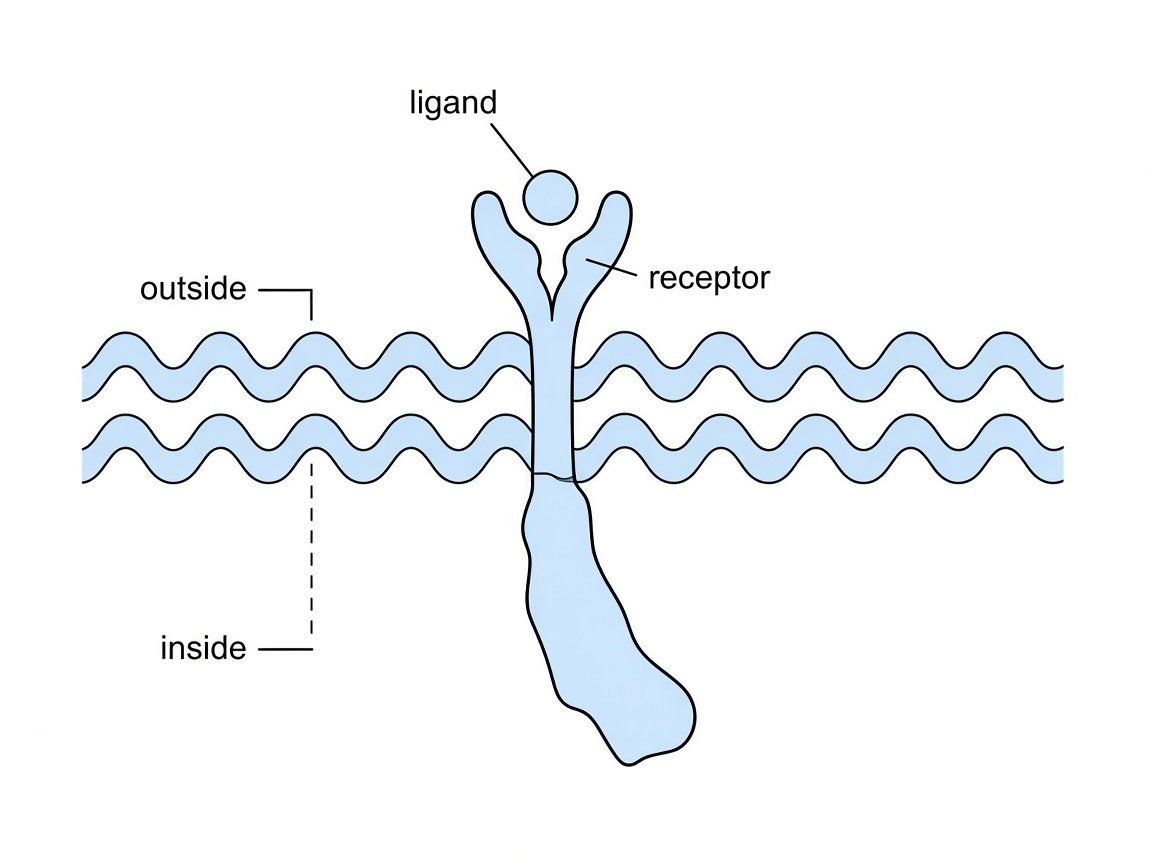
Scenario A. (a) Identify the chemical messenger that binds a receptor to start signaling. (b) Describe what happens to the receptor’s intracellular domain after binding. (c) Give one example of a cellular response that can result from the cascade (growth, secretion, or gene expression).
Scenario A. Use the receptor–ligand figure. (a) State where receptors may be located in a target cell. (b) Explain the role of G protein–coupled receptors as an example class in eukaryotes. (c) Contrast a ligand-gated channel response with a cascade that uses cAMP as a second messenger.