Question 1 of 5
Scenario A. (a) State two possible outcomes of signal transduction for a cell’s phenotype or fate. (b) Explain how changing gene expression can alter phenotype. (c) Distinguish apoptosis from uncontrolled cell proliferation.
Responses receive AI feedback against a rubric after submission. Scores are practice estimates.
Scenario A. (a) State two possible outcomes of signal transduction for a cell’s phenotype or fate. (b) Explain how changing gene expression can alter phenotype. (c) Distinguish apoptosis from uncontrolled cell proliferation.
Scenario A. Cytokines can regulate gene expression to allow cell replication and division. (a) Identify the type of cellular response illustrated. (b) Provide reasoning that connects the external signal to a change in cell behavior. (c) Predict what would happen to division-related gene expression if the cytokine pathway were fully inhibited.
Scenario A. HOX genes help regulate animal body plans during embryonic development via signaling contexts that change gene expression. (a) Explain why altered HOX expression can change phenotype. (b) Relate this to the general claim that transduction can change cell function. (c) Evaluate the claim that every transduction event must end in apoptosis.
Scenario A. (a) Explain how a mutation in any pathway component can alter cellular responses. (b) Give one example of a chemical that could activate or inhibit a pathway. (c) Predict the effect of inhibiting a required relay enzyme after reception.
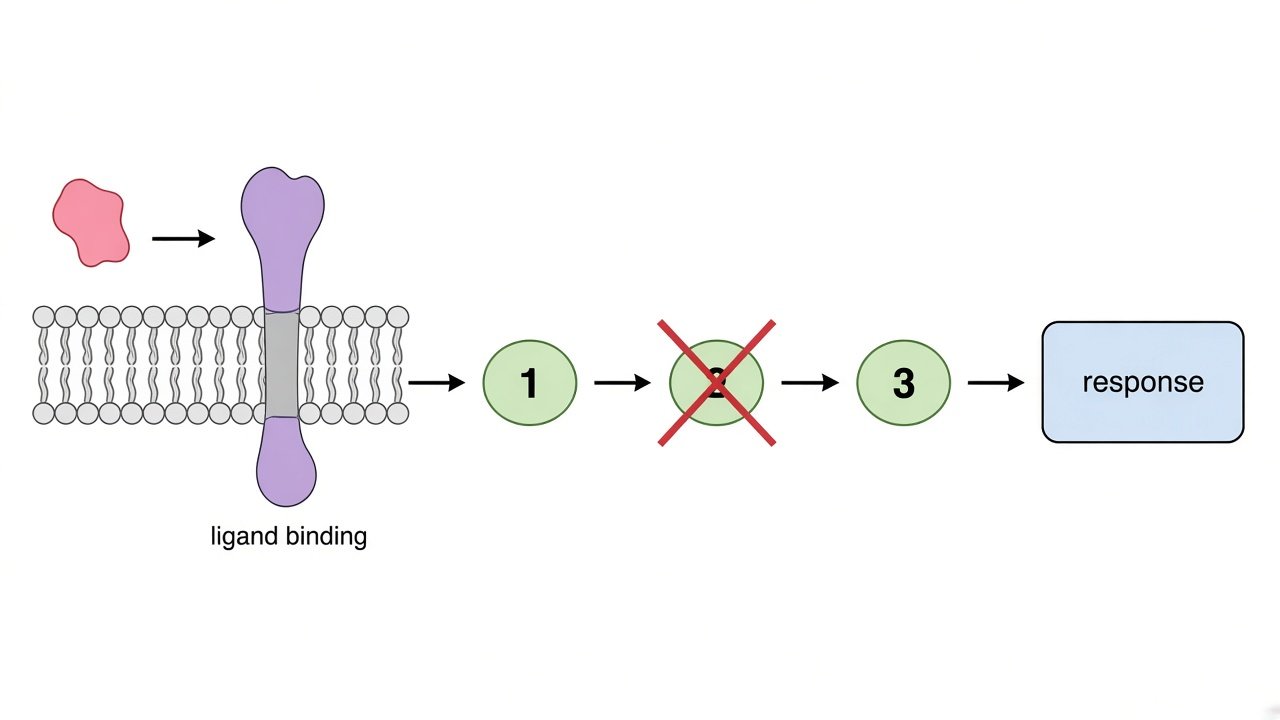
Scenario A. The figure shows a disrupted intermediate in a pathway. (a) Identify whether reception or transduction is directly marked as disrupted. (b) Justify a claim about the expected cellular response. (c) Explain how a different mutation that only destroys ligand binding would produce a similar end result through a different primary defect.