Introduction to Signal Transduction MCQ Practice

Question 1 of 10

Scenario B. Signal transduction pathways connect

  1. A. reception of a signal to cellular responses
  2. B. only DNA packing to spindle formation
  3. C. feedback loops to meiosis exclusively
  4. D. ribosomes directly to the extracellular matrix without receptors
Question 2 of 10

Scenario B. Protein modifications in many pathways commonly involve

  1. A. removing all peptide bonds from the ligand
  2. B. converting the nucleus into a vacuole
  3. C. phosphorylation cascades
  4. D. permanent loss of all membrane receptors before any response

Question 3 of 10

Scenario B. Which component is part of transduction rather than the final cellular response?

  1. A. Secretion of a hormone from the target cell
  2. B. Activation of a relay kinase by phosphorylation
  3. C. Apoptosis of the target cell
  4. D. A lasting change in the cell’s phenotype due to new transcription

Question 4 of 10

Scenario B. A researcher blocks all kinase activity downstream of a receptor but leaves ligand binding intact. The most likely outcome is

  1. A. uninterrupted phosphorylation cascades
  2. B. normal amplification of the intracellular signal
  3. C. reception failing because ligands cannot bind
  4. D. reception occurring but transduction and subsequent responses being impaired

Question 5 of 10

Scenario B. Which statement about pathway organization is accurate?

  1. A. Reception, transduction, and response are linked stages that convert an external message into cellular action.
  2. B. Transduction always occurs before any ligand exists.
  3. C. Responses never involve changes in gene expression.
  4. D. Pathways cannot amplify signals under any circumstances.

Question 6 of 10

Scenario B. Compared with a pathway lacking a cascade, a phosphorylation cascade is more likely to

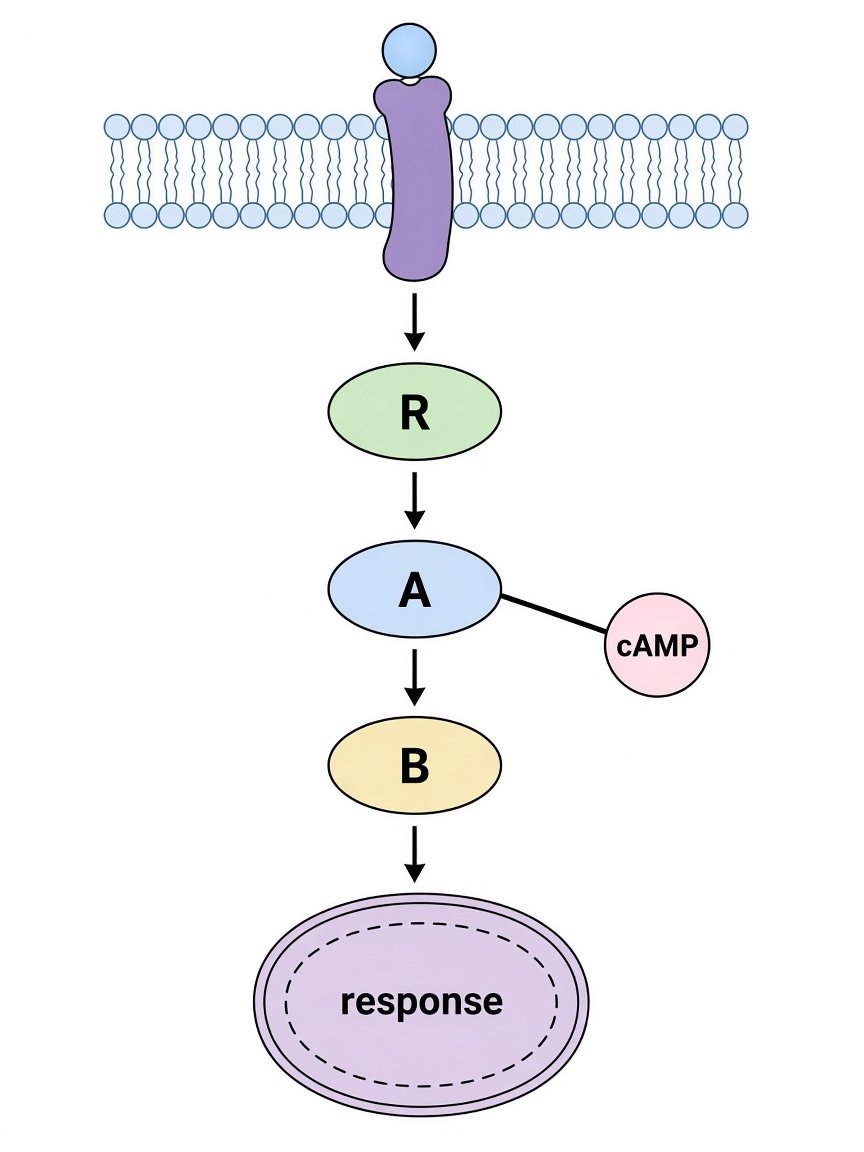
Signal cascade from receptor through relay proteins and cAMP to a response.
  1. A. prevent any shape change in the receptor
  2. B. eliminate the need for specificity between ligand and receptor
  3. C. increase the number of activated molecules at successive steps
  4. D. force all signaling to occur only during telophase

Question 7 of 10

Scenario B. A ligand is best defined as

  1. A. any chromosome condensed during prophase
  2. B. a chemical messenger recognized by a receptor’s binding domain
  3. C. the mitotic spindle fiber that pulls chromatids
  4. D. a checkpoint protein that only acts in G0

Question 8 of 10

Scenario B. Hormones that travel long distances in the bloodstream are examples of

  1. A. signaling messengers that can act on distant target cells
  2. B. ligands that never leave the emitting cell’s nucleus
  3. C. receptors embedded only in plant cell walls
  4. D. cyclins that pair with CDKs at checkpoints

Question 9 of 10

Scenario B. G protein–coupled receptors are

  1. A. found only in the mitochondrial matrix
  2. B. ligands rather than receptor proteins
  3. C. exclusive to prokaryotic cell walls
  4. D. an example of receptor proteins in eukaryotes

Question 10 of 10

Scenario B. Which outcome is a valid cellular response after a signaling cascade?

  1. A. The ligand becomes a cyclin-dependent kinase
  2. B. The receptor permanently leaves the organism through the bloodstream as insulin
  3. C. The cell alters gene expression, secretes molecules, or changes growth
  4. D. All chromosomes are deleted from the nucleus