TOPIC 4.3 · STUDY
Signal Transduction Pathways
Signal transduction can change gene expression and cell function, which may alter phenotype or trigger apoptosis. A mutation or a chemical acting on any pathway component can activate or inhibit the response.
4.3.A
Gene expression, phenotype, and apoptosis
The result of a pathway is a change in what the cell does. Often the cell changes gene expression: different genes are transcribed, different proteins are made, and phenotype or behavior changes. A pathway can also change a function that is already in place, such as enzyme activity, without changing chromosome number.
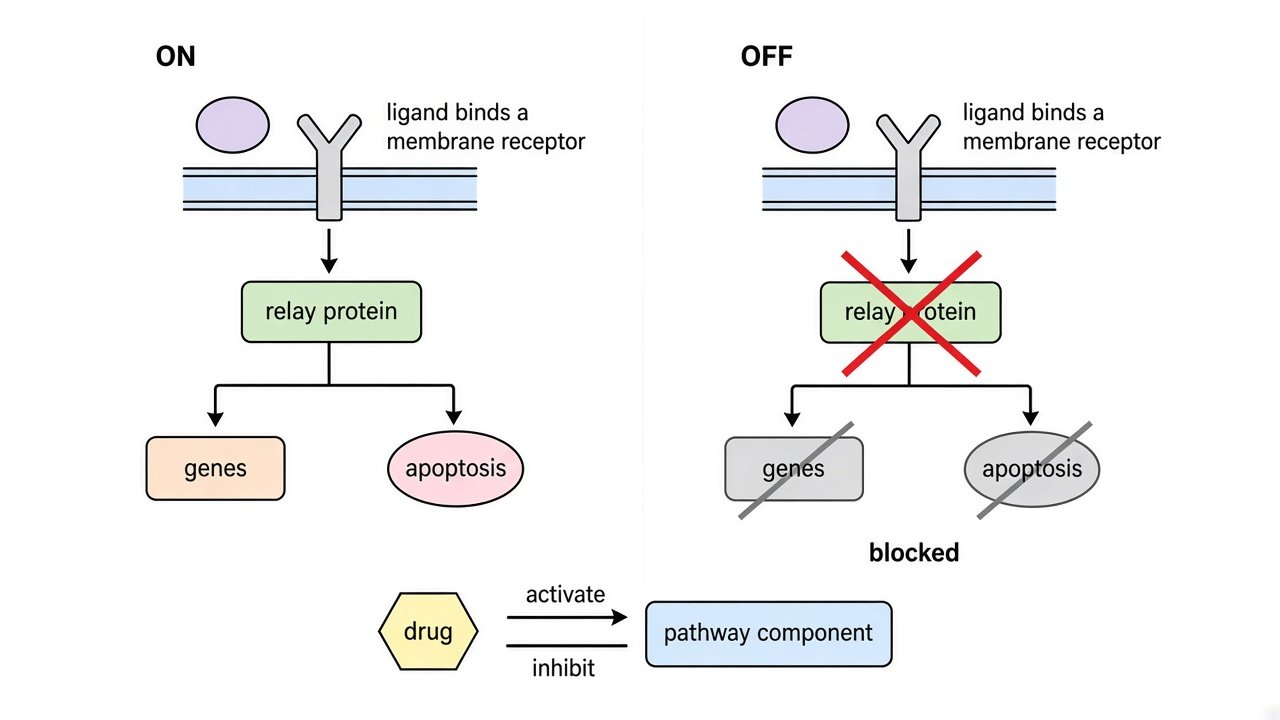
Gene expression and apoptosis are possible responses, not steps that every pathway performs together. Blocking a relay protein stops those responses. A drug may activate or inhibit a component.
Several cases are changes in gene expression or cell function. Epinephrine in mammals turns on pathways that break glycogen down, so cells can mobilize glucose. Yeast mating pheromones turn on mating genes. Cytokines can turn on genes that let a cell prepare for replication and division. Ethylene changes which enzymes a fruit cell produces, and the fruit ripens. HOX genes, expressed in the right pattern, help set an animal body plan during development. Microbes use chemical messengers in quorum sensing both to communicate with nearby cells and to open pathways that depend on population density.
A pathway can also cause apoptosis, which is programmed cell death. That ending is controlled. It is not a random collapse, and it is not cancer. Apoptosis removes a cell. Uncontrolled division makes more cells. Death is one possible response when the pathway calls for it. It is not required at the end of every signal.
Key points
- Pathways can change gene expression and cell function.
- Those changes can alter phenotype.
- A pathway can trigger apoptosis, which is programmed cell death.
- Epinephrine pathways break down glycogen and change cell function in mammals.
- Quorum sensing, yeast mating pheromones, cytokines, ethylene, and HOX genes are gene-expression cases.
- Apoptosis removes a cell. It is not the same process as uncontrolled division.
A shape change or a new enzyme activity after epinephrine is a change in cell function, not a change in chromosome number.
4.3.B
Mutations and chemicals in a pathway
Changing any signaling molecule can change the rest of the pathway. A mutation in the ligand-binding domain can stop the messenger from being recognized, so reception fails. A mutation in the intracellular domain, or in a relay protein farther along, can leave binding intact and still block transduction. Either fault can erase or distort the response. A mutation can also lock a component in the active form, so the cell responds when no normal ligand is present.
Chemicals can do the same kinds of things. A drug or toxin that interacts with any component may activate the pathway or inhibit it. Blocking ethylene receptors cuts off the enzyme changes those receptors would have started, so ripening is reduced. A chemical that forces a receptor on without the normal ligand drives the downstream steps. If a required relay is then inhibited, that abnormal response falls even though the receptor itself is stuck on.
Use that organization when two cells bind the same ligand equally but only one responds. Reception matches, so the difference is in transduction or in the response steps. Shared intracellular parts do not force every signal to end the same way. Which receptor is used, and how the pathway is wired, decides which genes or functions change.
Key points
- A change in any pathway component can change the cellular response.
- A mutation in any receptor domain or any relay protein can alter later transduction.
- Normal ligand binding with no response points to a defect downstream of reception.
- Chemicals that hit a component may activate or inhibit the pathway.
- Blocking a receptor, such as an ethylene receptor, reduces the response that receptor starts.
- A receptor forced on without ligand drives inappropriate signaling until a later step is blocked.
Reception can look normal in a binding test while the cell still fails to respond. Check the relay, not only the ligand.