TOPIC 4.4 · STUDY
Feedback
Negative feedback reduces the original stimulus and returns a variable toward its set point, as insulin and glucagon do for blood glucose. Positive feedback amplifies a change away from the starting point, as in labor, lactation, and fruit ripening.
4.4.A
Negative and positive feedback
Organisms use feedback to keep internal conditions workable while the surroundings and the body keep changing. A loop senses a change and then either opposes that change or strengthens it. Negative feedback opposes it and pulls the variable back toward a target set point. Positive feedback strengthens it and moves the variable farther from the start. Both occur in healthy organisms. Both can operate at the molecular level, the cellular level, or the level of the whole organism.
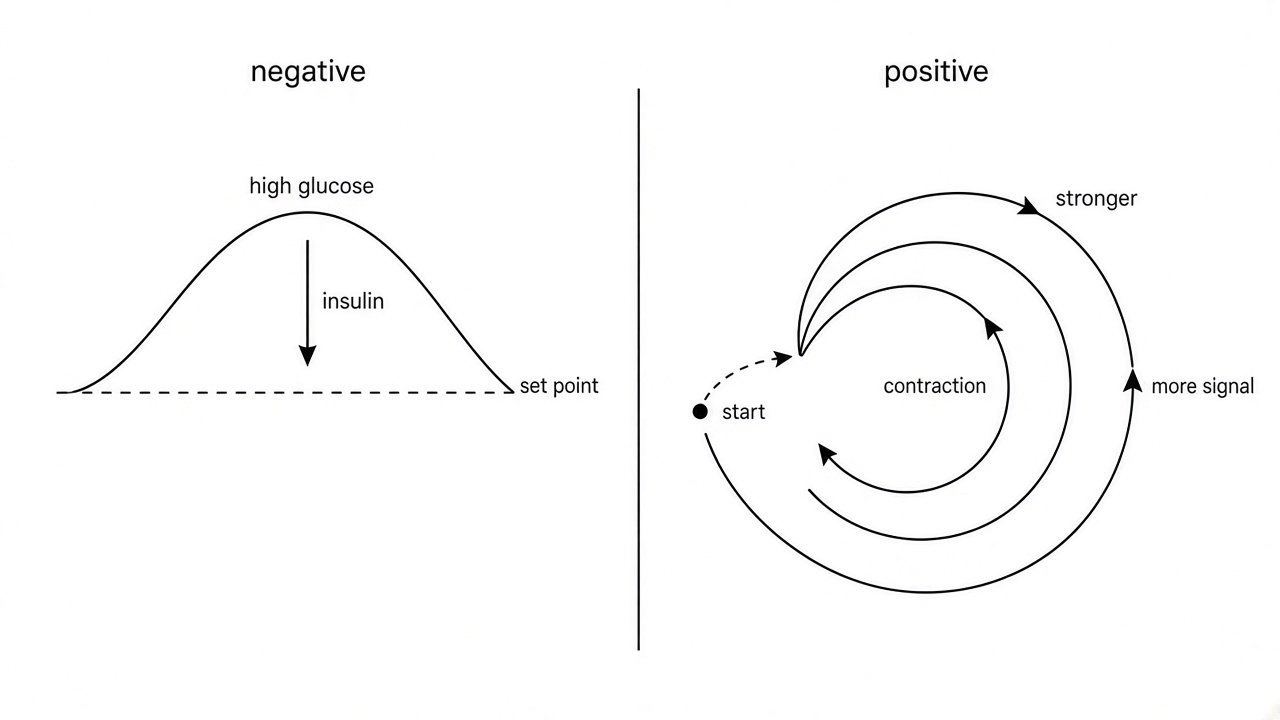
Negative feedback returns glucose toward the set point. Positive feedback makes contractions stronger instead of correcting them back to the start.
Negative feedback reduces the stimulus that set it off. Blood glucose is the standard case, regulated by insulin and glucagon. After a meal, glucose rises. Insulin promotes uptake, use, and storage of glucose, so the blood level falls back toward the set point. If glucose falls too low, glucagon promotes release of glucose into the blood. The two hormones push in opposite directions and defend a range. If insulin cannot act on its targets, high glucose stays high because the correcting arm of the loop is missing. A trace that leaves the set point after a disturbance and then returns is the negative-feedback pattern.
Positive feedback amplifies. The initiating variable moves farther from its starting value, and the stronger stimulus causes still more response. During labor, contractions promote signals that cause stronger contractions. The loop ends when birth removes that stimulus, not when a set point is restored. During lactation, suckling promotes signals that increase milk release, so the response intensifies while nursing continues. Fruit ripening can intensify the same way: ripening signals promote more ripening. Amplification is useful when a process should run to completion. The same pattern would be harmful for blood glucose, because glucose would be driven away from its set point.
| Example | Type | What the loop does |
|---|---|---|
| Blood glucose, insulin and glucagon | Negative | Pushes glucose back toward the set point. |
| Onset of labor | Positive | Contractions intensify until birth. |
| Lactation | Positive | Suckling increases milk release. |
| Fruit ripening | Positive | Ripening signals intensify ripening. |
Key points
- Feedback helps maintain the internal environment as conditions change.
- Negative feedback reduces the original stimulus and returns the system toward a set point.
- These mechanisms operate at molecular, cellular, and organismal levels.
- Insulin lowers high blood glucose. Glucagon raises low blood glucose.
- Positive feedback amplifies a response and moves the variable farther from the start.
- Labor, lactation, and fruit ripening are positive-feedback examples.
- Positive feedback can finish a healthy process. It does not mean the organism has no homeostasis.
If the effector that should restore the set point is blocked, the variable stays offset after a disturbance.