TOPIC 4.5 · STUDY
Cell Cycle
The eukaryotic cell cycle moves through G1, S, G2, mitosis, and cytokinesis, and a cell may leave division and sit in G0. Mitosis gives two daughter cells a complete identical genome. Animal cells split with a cleavage furrow and plant cells with a cell plate.
4.5.A
Stages of the cell cycle
The cell cycle is the regulated sequence eukaryotic cells use to grow and to reproduce. A dividing cell moves through interphase and then through mitosis and cytokinesis. Interphase has three parts in order: G1, then S, then G2. A cell that is not dividing can leave this sequence or be held at one stage.
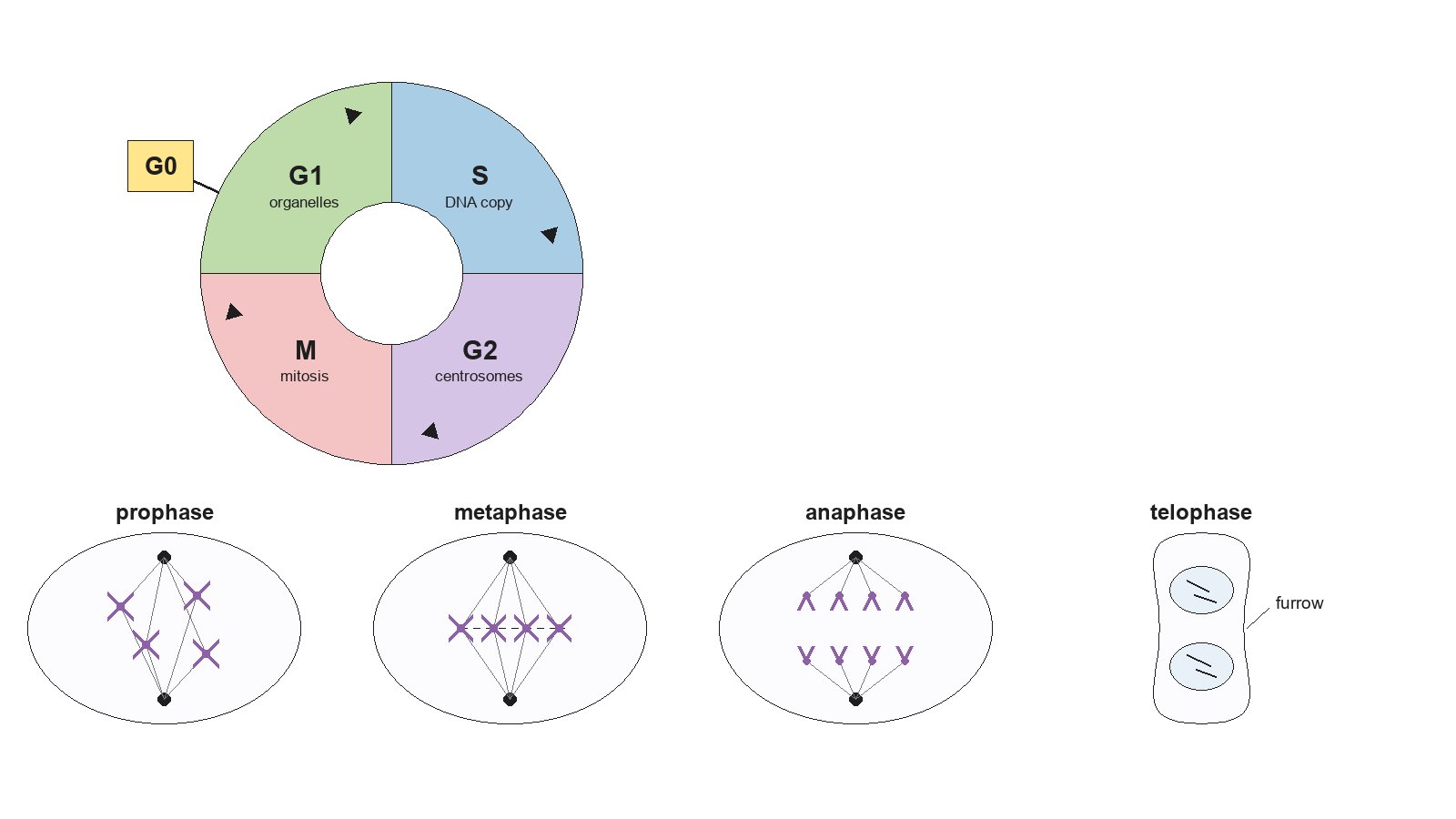
Read the ring clockwise from G1 to S to G2 to M. G0 leaves from G1. The four chromosomes are a counting aid, not a universal chromosome number. Telophase shows an animal cleavage furrow. A plant cell builds a cell plate instead.
In G1 the cell is metabolically active. It duplicates organelles and other parts of the cytosol. In S, DNA is in chromatin form and is replicated. Each chromosome becomes two sister chromatids joined at a centromere. In G2 the cell synthesizes proteins, produces ATP in large amounts, and replicates its centrosomes so the later spindle can have two poles. A cell may also enter G0, stop dividing, and reenter the cycle when the right cues arrive.
DNA amount follows those stages. Call the G1 amount C. Replication in S raises it, so a G2 cell has about 2C. After a normal mitosis and cytokinesis, each daughter is back at C. S has to finish before mitosis. A cell that entered mitosis with unreplicated DNA could not give both daughters a complete genome. G2 supplies the proteins, ATP, and centrosomes that the spindle will need.
Stage counts are reported as percents. Suppose 140 cells are in G1, 50 are in S, 40 are in G2, and 20 are in mitosis. The total is 250. The percent in S is 50 divided by 250, times 100, which is 20 percent. Interphase is G1 plus S plus G2, so 230 of the 250 cells, or 92 percent. If the percent of cells in mitosis rose over time, a larger share of the population would be dividing.
Key points
- The cycle is interphase (G1, S, G2), then mitosis and cytokinesis.
- G1 is metabolically active and duplicates organelles and cytosolic components.
- In S, chromatin is replicated into sister chromatids joined at a centromere.
- G2 includes protein synthesis, a large ATP supply, and centrosome replication.
- G0 is a nondividing state. The cell can reenter when appropriate cues arrive.
- DNA content about doubles in S and returns to the G1 amount in each daughter.
- Percent in a stage is the count in that stage divided by the total, times 100.
S is the stage in which DNA amount doubles. G1 and G2 are the gaps around that copy step, and they are not idle.
4.5.B
Mitosis and cytokinesis
Mitosis passes a complete genome from a parent cell to two daughter cells in eukaryotes. The daughters are genetically identical to each other. The process is used for growth, for repair of tissue, and for asexual reproduction. Mitosis alternates with interphase. The S phase that came before it is what provides two chromatids to separate, so each daughter can receive one full set.
The stages follow a fixed order. In prophase, sister chromatids condense, the mitotic spindle begins to form, and centrosomes move toward opposite poles. In metaphase, spindle fibers align the chromosomes along the equator. In anaphase, paired sister chromatids separate, and the fibers pull the chromatids toward the poles. In telophase, the spindle breaks down and a new nuclear envelope forms around each set. The cytoplasm divides after that.
| Stage | What happens |
|---|---|
| Prophase | Chromatids condense, the spindle starts to form, and centrosomes move apart. |
| Metaphase | Spindle fibers align chromosomes at the equator. |
| Anaphase | Sister chromatids separate and move to opposite poles. |
| Telophase | The spindle breaks down and new nuclear envelopes form. |
| Cytokinesis | An animal cell pinches in with a cleavage furrow. A plant cell builds a cell plate. |
Cytokinesis is the split of the cytoplasm, and it produces two separate daughter cells. In an animal cell the membrane pinches inward as a cleavage furrow. In a plant cell a cell plate forms across the middle and becomes the new boundary. Mitosis without cytokinesis can leave two nuclei in one cell, because the nucleus has divided and the cytoplasm has not. A normal division gives each daughter a complete genome matching the parent. The figure uses four chromosomes only so the copies are easy to count. Real chromosome numbers depend on the species.
Key points
- Mitosis produces two genetically identical daughter cells, each with a complete genome.
- Roles include growth, tissue repair, and asexual reproduction.
- The order is prophase, metaphase, anaphase, then telophase, alternating with interphase.
- Prophase condenses chromatids, starts the spindle, and moves centrosomes toward opposite poles.
- Metaphase aligns chromosomes at the equator. Anaphase separates sister chromatids.
- Telophase rebuilds nuclear envelopes. Animals use a cleavage furrow. Plants use a cell plate.
In anaphase the structures moving to the poles are separated chromatids, not chromosomes that are still joined as an X.