TOPIC 4.1 · STUDY
Cell Communication
Cells communicate by direct contact or by chemical signals. Local regulators act on nearby cells, while hormones such as insulin travel long distances, often in the blood, to target cells of another type.
4.1.A
Direct contact and chemical signals
Cells share information in two broad ways. They can touch, using molecules built into their surfaces, or one cell can release a chemical that travels to a target. Both ways are communication. The response is not limited to survival or growth. A signal can change behavior, change which genes are active, or even order the death of the target cell.
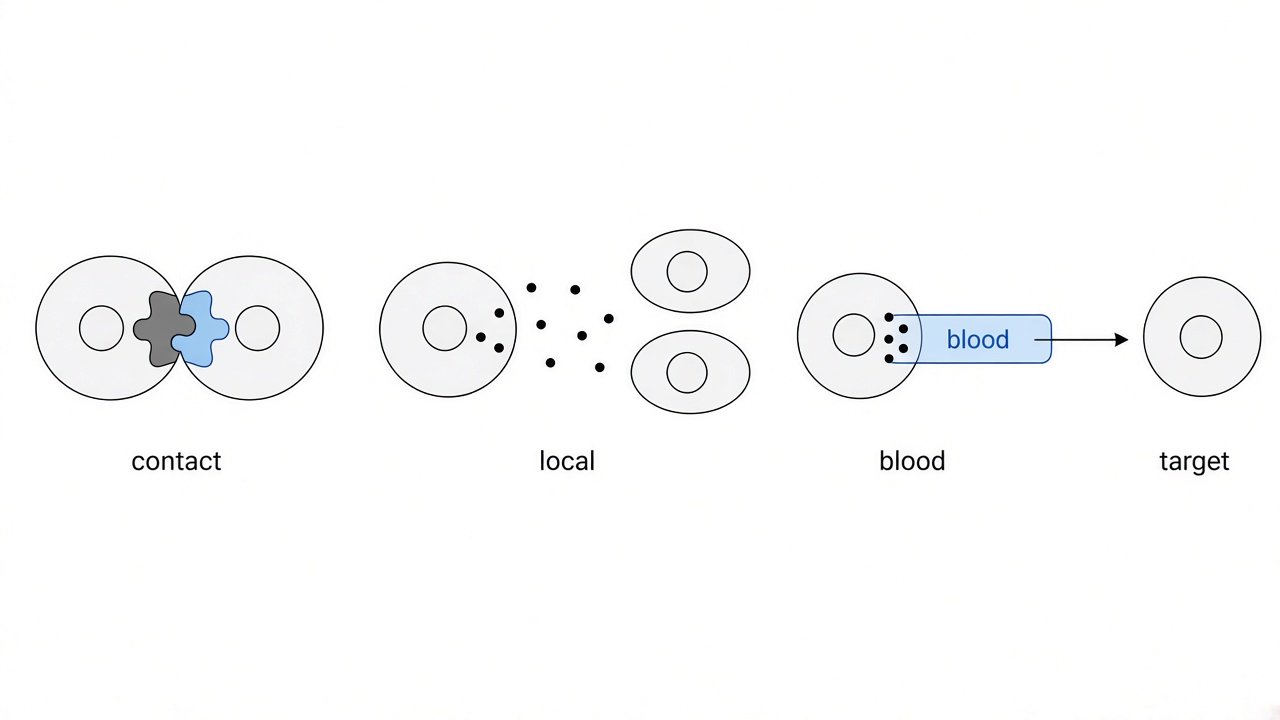
Contact uses matching surface proteins. Local chemicals reach neighbors. A hormone can travel in the blood to a distant target.
Direct contact means the cells are neighbors and their surfaces interact. Immune cells do this when an antigen-presenting cell shows a fragment to a helper T cell, and when a killer T cell recognizes an infected cell by binding antigens on that cell. Plant neighbors can share small molecules through plasmodesmata, cytoplasmic channels that connect their interiors. Many animal neighbors pass ions and small signals through gap junctions. In each case the route is structural. The messenger is not drifting away through the body.
Chemical signaling uses a released messenger, so the cells do not have to touch. The trip may be very short or very long. A porous barrier that stops the cells from touching but lets dissolved molecules through separates the two modes. If the response disappears, the cells needed contact. If the response remains, a diffusible chemical was enough. Simply sitting side by side is not the signal. The surfaces have to carry matching molecules.
Key points
- Cells communicate by direct contact or by chemical signals.
- Direct contact uses matching surface molecules on cells that touch.
- Antigen-presenting cells, helper T cells, and killer T cells use contact.
- Plasmodesmata in plants and gap junctions in animals link neighboring cells.
- A released chemical signal does not require the cells to touch.
- A response can include the death of the target cell.
Killer T cell recognition is still communication when the infected cell dies. The definition does not require the target to survive.
4.1.B
Short and long distances
Short-distance communication uses local regulators. The chemical leaves one cell and acts on targets nearby, not on organs elsewhere in the body. Neurotransmitters cross the tiny gap at a synapse. A damaged plant cell can warn the cells beside it with a local immune signal. In an embryo, morphogens spread from a source and form a gradient. Cells at different positions in that gradient receive different amounts and can follow different paths. Bacteria release an autoinducer and respond together once the local concentration crosses a threshold. That density-dependent behavior is quorum sensing.
Long-distance communication sends a signal from one cell type to target cells of another type. In animals the usual carrier is the blood. Insulin from pancreatic beta cells, human growth hormone from the pituitary, thyroid hormones, testosterone, and estrogen all travel this way. The cell that releases the hormone does not touch the liver, bone, or other distant targets. Blocking blood flow would interrupt that delivery. It would not, by itself, stop a morphogen that is already spreading inside a local tissue.
Do not classify a signal just because it is a chemical. Neurotransmitters, morphogens, plant immune signals, and quorum-sensing molecules are chemical, and they are still short-range. Insulin and the hormones listed above are chemical, and they are long-range. Distance and route make the difference. A local signal lost by the neighbors does not automatically reach distant organs unless a separate body-wide signal exists.
Key points
- Local regulators act on cells near the cell that released them.
- Neurotransmitters, plant immune signals, morphogens, and quorum sensing are short-distance examples.
- A morphogen gradient can give nearby cells different instructions.
- Long-distance signals travel from one cell type to a different target cell type.
- Insulin, human growth hormone, thyroid hormones, testosterone, and estrogen travel in the blood.
- Quorum sensing is local density signaling among microbes, not a blood-borne hormone.
Chemical signaling includes both distances. A neurotransmitter is not a long-distance hormone, and insulin is not direct contact.