Cell Communication MCQ Practice

Question 1 of 10

Scenario B. Cells that exchange information only when their plasma membranes physically interact are using

  1. A. direct contact communication
  2. B. endocrine long-distance signaling exclusively
  3. C. second messengers without any ligand
  4. D. mitotic spindle checkpoints

Question 2 of 10

Scenario B. Helper T cells and antigen-presenting cells communicate during immune activation primarily by

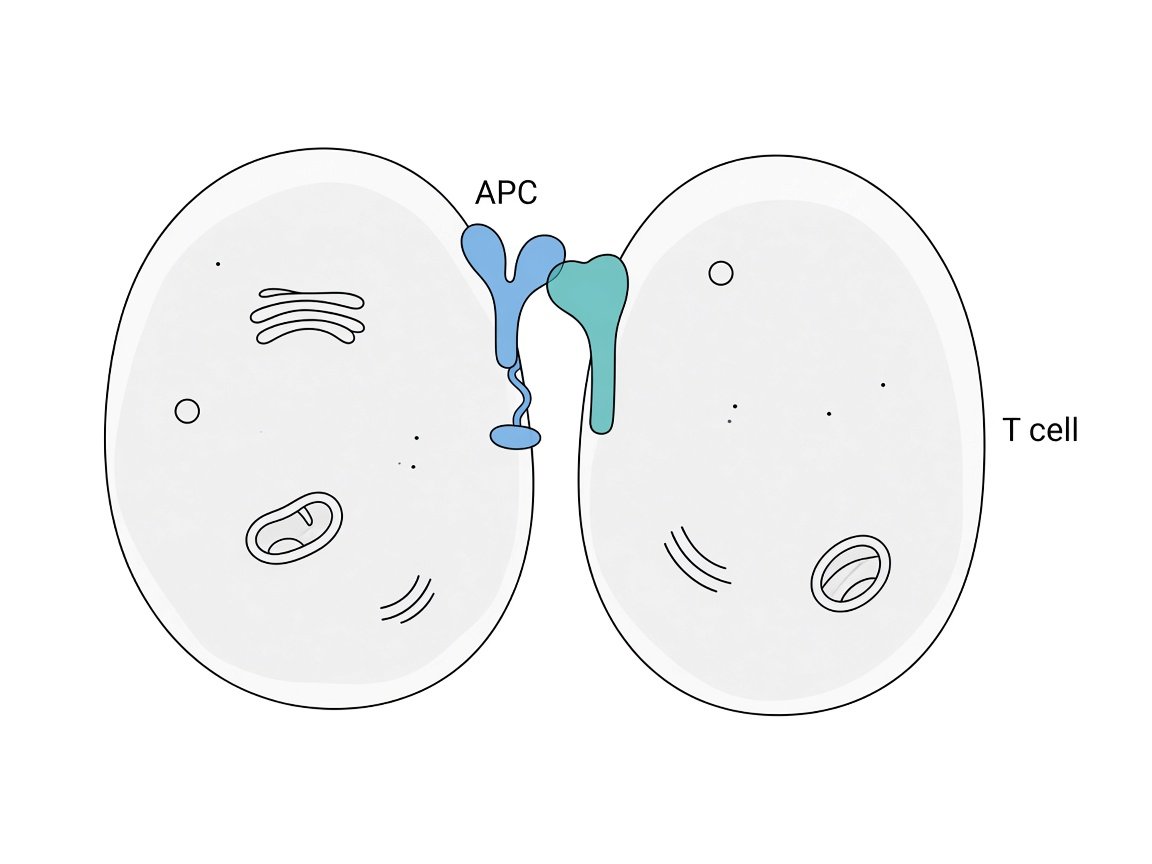
APC and T cell interacting through touching membrane proteins.
  1. A. releasing insulin into the bloodstream
  2. B. fusing into a single multinucleate cell
  3. C. binding complementary surface molecules during cell-to-cell contact
  4. D. exchanging chromosomes through plasmodesmata

Question 3 of 10

Scenario B. Which statement correctly contrasts contact-dependent signaling with chemical signaling from a distance?

  1. A. Contact signaling never involves proteins; distance signaling always does.
  2. B. Contact signaling can only occur in prokaryotes.
  3. C. Distance signaling requires the two cells to share cytoplasm.
  4. D. Contact signaling requires interacting surfaces of adjacent cells, whereas distance signaling uses messengers that travel through extracellular fluid or blood.

Question 4 of 10

Scenario B. A student lists “direct contact” as the mode for insulin action on liver cells. The error is that insulin

  1. A. never binds a receptor
  2. B. travels through the bloodstream to reach distant target cells rather than requiring pancreatic cells to touch hepatocytes
  3. C. acts only inside the nucleus of the emitting cell
  4. D. is produced by neurons and travels only across synaptic clefts

Question 5 of 10

Scenario B. Which experimental result would best support the claim that two cell types communicate by direct contact rather than a diffusible factor alone?

  1. A. Separating the cells with a membrane permeable to small molecules abolishes the response, but allowing membrane contact restores it.
  2. B. Collecting medium from one culture and adding it to the other fully reproduces the response.
  3. C. Blocking blood flow between organs eliminates the response.
  4. D. Increasing ligand concentration in the shared medium increases the response even when cells never touch.

Question 6 of 10

Scenario B. Killer T cells destroy infected cells after recognizing surface antigens. Relative to thyroid hormone signaling, this immune interaction is

  1. A. identical because both are long-distance endocrine pathways
  2. B. identical because both require mitotic checkpoints
  3. C. contact-dependent recognition of an adjacent target rather than a circulating hormone acting on distant tissues
  4. D. restricted to plant cells with plasmodesmata

Question 7 of 10

Scenario B. Local regulators are best described as signals that

  1. A. always travel through the entire bloodstream before acting
  2. B. affect target cells in the vicinity of the emitting cell
  3. C. function only inside the nucleus of the emitting cell
  4. D. require chromosomes to condense before release

Question 8 of 10

Scenario B. Which example is long-distance signaling between different cell types?

  1. A. Neurotransmitter crossing a synaptic cleft
  2. B. Morphogen gradient across a few cell diameters
  3. C. Bacterial autoinducer within a local colony
  4. D. Thyroid hormone circulating to multiple target tissues

Question 9 of 10

Scenario B. Plant immune responses often rely on local chemical alerts among neighboring cells. This pattern is most analogous to

  1. A. neurotransmitter signaling over short distances
  2. B. estrogen traveling from gonads to distant tissues
  3. C. human growth hormone acting systemically after pituitary release
  4. D. testosterone circulating through the bloodstream

Question 10 of 10

Scenario B. The table compares three signals. Which conclusion is best supported?

Signal Route Typical targets
Insulin Bloodstream Distant tissues
Neurotransmitter Synaptic cleft Adjacent neuron/muscle
Autoinducer Local extracellular fluid Nearby bacteria
  1. A. All three signals must be classified as long-distance because they are chemicals.
  2. B. Insulin is short-distance because it binds a receptor.
  3. C. Insulin is long-distance while the neurotransmitter is short-distance, based on travel route and target vicinity.
  4. D. Quorum-sensing molecules are long-distance mammalian hormones.