Cell Communication MCQ Practice

Question 1 of 10

Scenario A. Which statement best describes how cells can communicate with one another?

  1. A. Only cells that share a common cytoplasm can exchange information.
  2. B. Cells can communicate by direct contact or by chemical signals that travel short or long distances.
  3. C. Communication occurs only when a cell engulfs another cell.
  4. D. Cells communicate exclusively through changes in membrane potential and never via chemicals.
Question 2 of 10

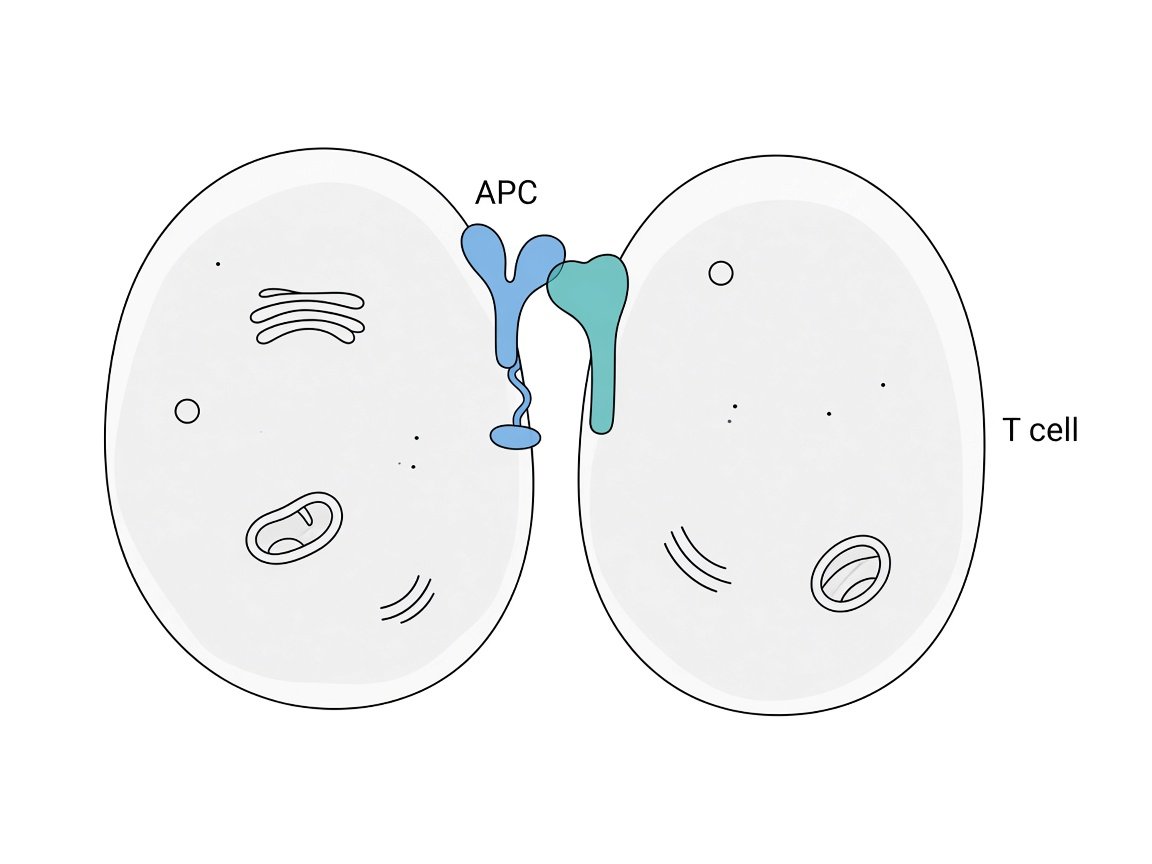
Scenario A. An antigen-presenting cell displays a processed antigen fragment to a helper T cell through membrane proteins that physically touch. This interaction is an example of

Two cells touching at membrane proteins labeled APC and T cell.
  1. A. long-distance endocrine signaling only
  2. B. quorum sensing among bacteria
  3. C. direct cell-to-cell contact communication
  4. D. intracellular second-messenger amplification without a receptor

Question 3 of 10

Scenario A. Researchers compare four signaling situations. In which case do the communicating cells rely primarily on physical contact rather than a diffusible messenger traveling through extracellular fluid?

  1. A. A killer T cell recognizes a virus-infected cell by binding surface antigens on that cell.
  2. B. Pancreatic beta cells release insulin into the bloodstream.
  3. C. A damaged plant cell releases a local chemical that alerts neighboring cells.
  4. D. Neurons release neurotransmitter into a synaptic cleft a few nanometers wide.

Question 4 of 10

Scenario A. Plasmodesmata allow plant cells to share small signaling molecules through cytoplasmic channels. Relative to animal endocrine signaling, this plant mechanism is most similar to

  1. A. hormone travel through the bloodstream to distant organs
  2. B. ligand-gated ion channel opening in a neuron
  3. C. apoptosis triggered by a mutated receptor
  4. D. direct contact communication between neighboring cells

Question 5 of 10

Scenario A. Which pair correctly matches a communication mode with an illustrative biological example?

  1. A. Direct contact — insulin traveling from the pancreas to muscle
  2. B. Direct contact — antigen-presenting cell interacting with a helper T cell
  3. C. Long-distance chemical signaling — two adjacent plant cells linked only by plasmodesmata
  4. D. Direct contact — thyroid hormone circulating to many tissues

Question 6 of 10

Scenario A. A student claims that “all chemical signaling is long-distance signaling.” Which observation most directly refutes that claim?

  1. A. Some receptors are located in the cytoplasm rather than on the plasma membrane.
  2. B. Signal transduction can amplify a message inside a single cell.
  3. C. Neurotransmitters act on nearby target cells a short distance from the releasing neuron.
  4. D. Hormones can alter gene expression in target cells.

Question 7 of 10

Scenario A. Morphogens released during embryonic development primarily illustrate short-distance communication because they

  1. A. form concentration gradients that affect cells in the vicinity of the emitting source
  2. B. travel exclusively through the bloodstream to organs meters away
  3. C. require physical fusion of two embryonic nuclei
  4. D. act only after the embryo has completed organogenesis

Question 8 of 10

Scenario A. Human growth hormone produced by the pituitary reaches skeletal tissues through the circulation. This is best classified as

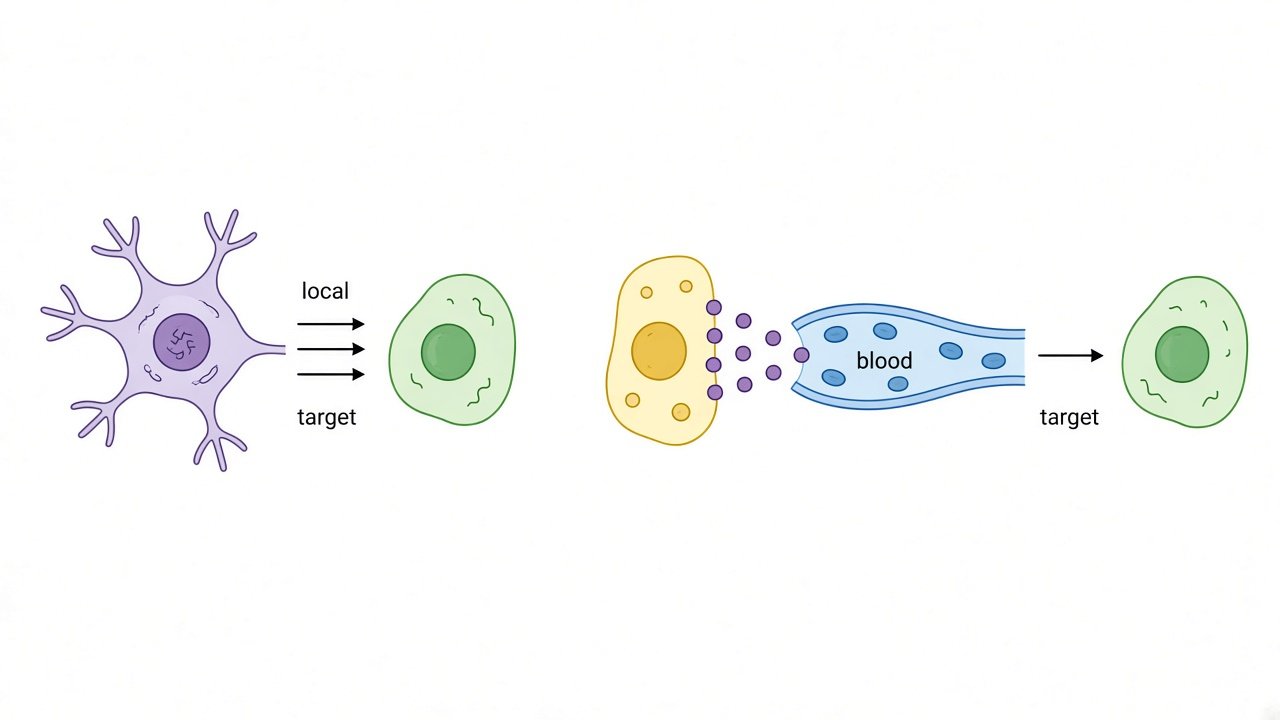
Local chemical release near a target cell contrasted with a signal traveling through blood to a distant target.
  1. A. direct membrane contact between pituitary and bone cells
  2. B. quorum sensing limited to neighboring pituitary cells
  3. C. short-distance synaptic signaling only
  4. D. long-distance chemical signaling between different cell types

Question 9 of 10

Scenario A. The table lists signal molecules and typical travel distances. Which row is correctly matched?

Signal Typical range
Insulin Long (bloodstream)
Neurotransmitter Short (local)
Estrogen Long (bloodstream)
  1. A. Insulin — nanometers across a synaptic cleft only
  2. B. Neurotransmitter — short distance to a neighboring target cell
  3. C. Quorum-sensing autoinducer — exclusively long-distance blood transport in mammals
  4. D. Estrogen — only direct contact between adjacent ovarian cells

Question 10 of 10

Scenario A. A bacterial colony increases autoinducer concentration until a threshold triggers coordinated gene expression. Compared with insulin signaling in humans, quorum sensing differs mainly because it

  1. A. never uses chemical messengers
  2. B. requires direct membrane contact between every bacterium
  3. C. coordinates nearby cells of the same population based on local signal density rather than a distant endocrine organ
  4. D. can only inhibit, never activate, gene expression