Cell Communication FRQ Practice

Responses receive AI feedback against a rubric after submission. Scores are practice estimates.

Question 1 of 5

Scenario A. (a) Distinguish direct-contact communication from chemical signaling between cells that are not touching. (b) Give one vertebrate immune-system example of direct contact. (c) Explain why the existence of direct-contact pathways does not mean chemical messengers are unnecessary in multicellular organisms.
Question 2 of 5

Scenario A. Plant cells connected by plasmodesmata and animal cells forming an immune synapse both exchange information. (a) Identify the shared communication mode. (b) Describe one structural feature that enables information transfer in each system. (c) Predict whether blocking membrane protein recognition on the immune cells would stop signaling even if the cells remain physically adjacent, and justify.

Question 3 of 5

Scenario A. A researcher argues that gap junctions and endocrine hormones are “the same kind of signaling” because both involve chemicals. (a) Critique that claim using distance and pathway structure. (b) Provide one example suited to gap-junction-style contact and one suited to endocrine signaling. (c) Explain how misclassifying these modes could lead a student to wrongly predict the time scale of a response.

Question 4 of 5

Scenario A. (a) Define short-distance cell communication using local regulators. (b) Explain how insulin exemplifies long-distance signaling. (c) Using one additional example (neurotransmitter, morphogen, or plant immune signal), justify why its range is classified as short rather than long.

Question 5 of 5

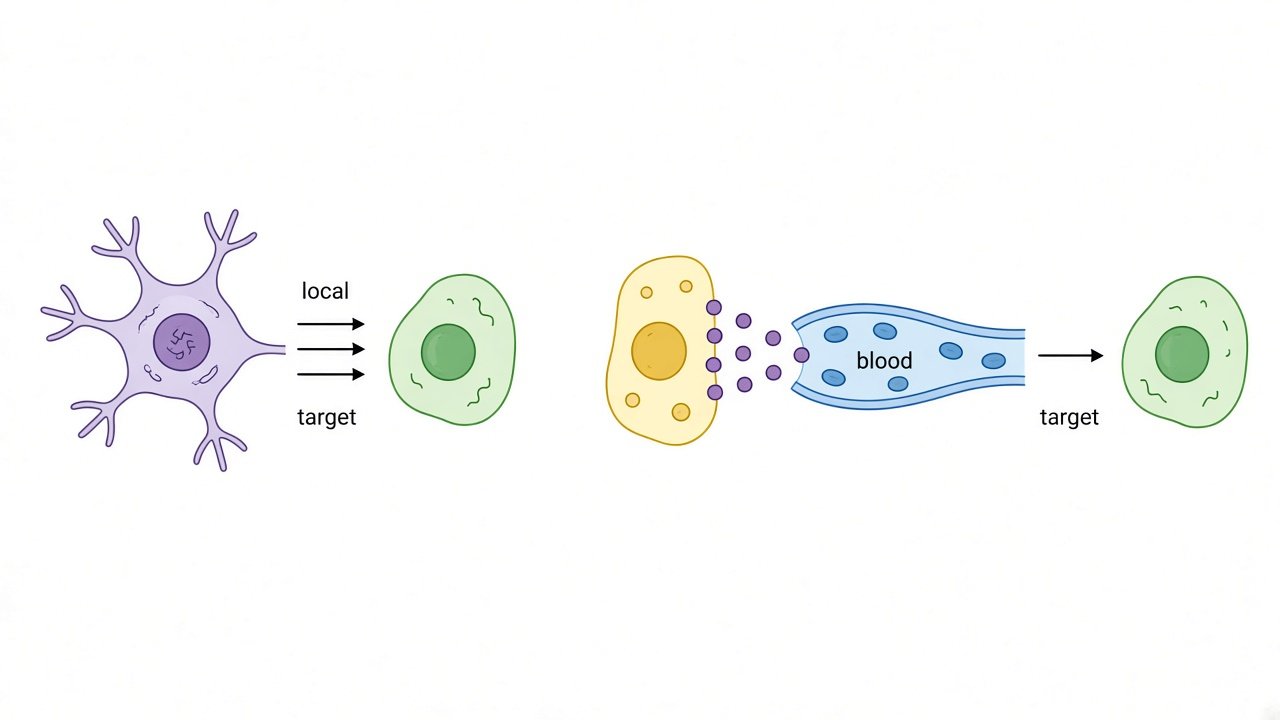
Scenario A. The figure contrasts a local chemical release with a blood-borne signal. (a) Assign each panel to short- or long-distance communication and cite one CED-aligned example for each. (b) Explain why testosterone and estrogen are grouped with long-distance signals. (c) A mutation prevents a local regulator from leaving the emitting cell. Predict the effect on neighboring cells and on distant organs, with reasoning.

Local signaling near a target versus long-distance signaling through blood.