TOPIC 3.5 · STUDY
Cellular Respiration
Cellular respiration captures energy from biological macromolecules to make ATP. In eukaryotes, glycolysis in the cytosol feeds pyruvate to the mitochondrion. The Krebs cycle in the matrix releases carbon dioxide and loads electron carriers. Oxidative phosphorylation uses a proton gradient across the inner membrane, with oxygen as the aerobic terminal acceptor. Fermentation lets glycolysis continue without oxygen.
3.5.A
Mitochondria and oxidative phosphorylation
Cellular respiration uses energy from biological macromolecules to synthesize ATP. Respiration and fermentation are characteristic of all forms of life. In eukaryotes, aerobic cellular respiration is a series of coordinated enzyme-catalyzed reactions that capture energy from those macromolecules.
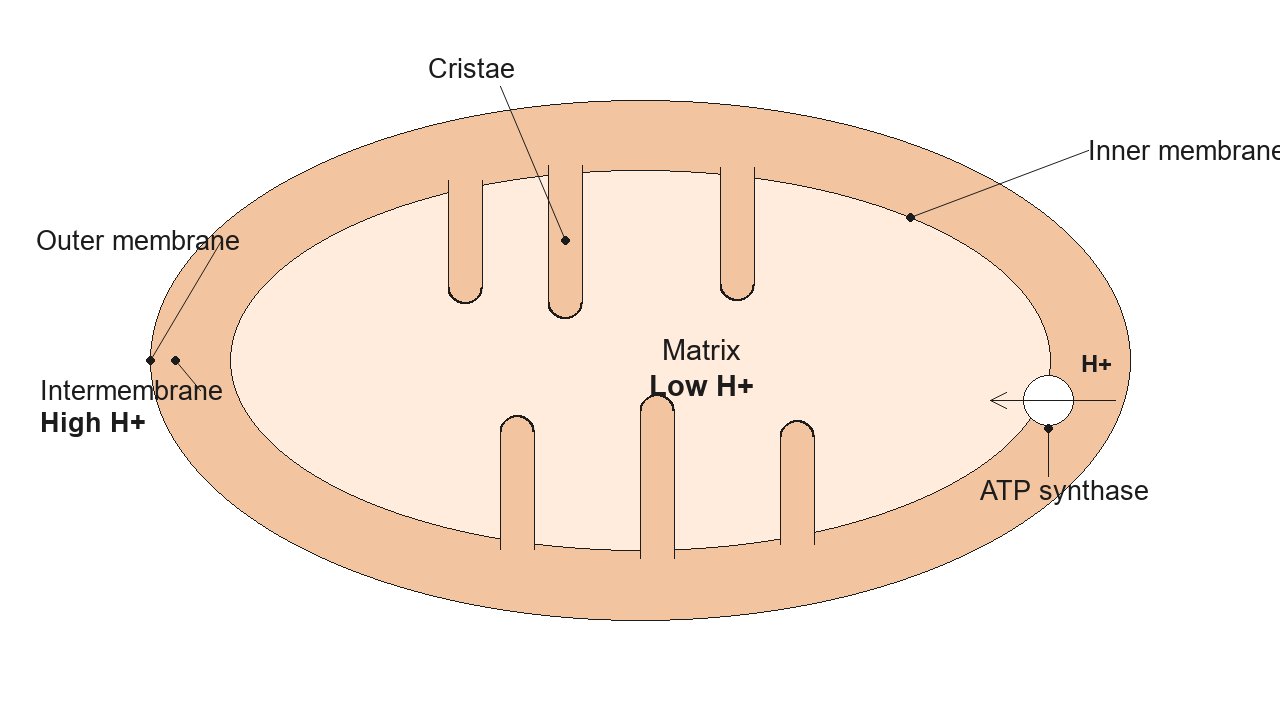
Cristae increase inner-membrane surface area, so more ATP can be made. Proton concentration is high in the intermembrane space and low in the matrix, where the pH is higher.
The electron transport chain transfers electrons in a series of oxidation-reduction reactions and establishes an electrochemical gradient across a membrane. In cellular respiration, electrons delivered by $\mathrm{NADH}$ and $\mathrm{FADH_2}$ are passed to a series of electron acceptors as they move toward the terminal acceptor. In aerobic respiration that acceptor is oxygen. Aerobic prokaryotes also use oxygen. Anaerobic prokaryotes use other molecules as the terminal acceptor. Using a different acceptor at the end of a membrane chain is not the same process as fermentation.
Electron transfer is accompanied by a proton gradient across the inner mitochondrial membrane. The membrane separates a region of high proton concentration outside it, the intermembrane space, from a region of low proton concentration inside it, the matrix. The pH inside the matrix is higher than the pH in the intermembrane space. Folding of the inner membrane into cristae increases surface area, which allows more ATP to be synthesized. In prokaryotes, electron passage is accompanied by proton movement across the plasma membrane. There is no mitochondrion in that case.
Protons flow back through membrane-bound ATP synthase by chemiosmosis. That flow drives formation of ATP from ADP and inorganic phosphate. In aerobic cellular respiration this is oxidative phosphorylation. Decoupling oxidative phosphorylation from electron transport generates heat. Endothermic organisms can use that heat to regulate body temperature. A small mammal in a cold den can increase heat output this way: electron flow continues and oxygen is still reduced, but less ATP is formed from the same electron flow and more energy leaves as heat. The full names of the electron carriers are outside the exam, as are the specific steps, enzyme names, and intermediates of the chain.
3.5.B
Glycolysis, the Krebs cycle, and fermentation
Glycolysis releases energy in glucose to form ATP from ADP and inorganic phosphate, $\mathrm{NADH}$ from $\mathrm{NAD}^{+}$, and pyruvate. In eukaryotes it runs in the cytosol. Memorizing the steps of glycolysis, the structures of the molecules, and the names of the enzymes is outside this course.
Pyruvate is transported from the cytosol to the mitochondrion, where oxidation occurs. Electrons are released during the Krebs cycle, also called the citric acid cycle. $\mathrm{NAD}^{+}$ is reduced to $\mathrm{NADH}$, $\mathrm{FAD}$ is reduced to $\mathrm{FADH_2}$, and carbon dioxide is released. The Krebs cycle takes place in the mitochondrial matrix. Carbon dioxide is released from organic intermediates, ATP is synthesized from ADP and inorganic phosphate, and electrons are transferred by the coenzymes $\mathrm{NAD}^{+}$ and $\mathrm{FAD}$.
Electrons extracted in glycolysis and in Krebs cycle reactions are transferred by $\mathrm{NADH}$ and $\mathrm{FADH_2}$ to the electron transport chain in the inner mitochondrial membrane. Passage of those electrons maintains the proton gradient: matrix pH stays higher than intermembrane-space pH. The names of the individual cycle intermediates are not required.
Fermentation allows glycolysis to proceed in the absence of oxygen. It produces organic molecules such as alcohol and lactic acid, and it regenerates $\mathrm{NAD}^{+}$ from $\mathrm{NADH}$ so glycolysis does not stall. Fermentation does not use oxygen as a terminal acceptor and does not produce the large ATP yield that oxidative phosphorylation adds. During a hard sprint, oxygen delivery to a leg muscle lags. The cell converts pyruvate to lactic acid, regenerates $\mathrm{NAD}^{+}$, and keeps the small glycolytic ATP supply going. When oxygen returns, pyruvate enters the mitochondrion, the matrix cycle releases $\mathrm{CO_2}$, and $\mathrm{NADH}$ plus $\mathrm{FADH_2}$ feed the inner-membrane chain. Aerobic conditions then support a much larger ATP yield. No specific ATP count has to be memorized.
| Stage | Where in a eukaryote | Result to remember |
|---|---|---|
| Glycolysis | Cytosol | ATP, NADH, and pyruvate |
| Krebs cycle | Mitochondrial matrix | CO2, NADH, FADH2, and ATP |
| Electron transport | Inner mitochondrial membrane | Proton gradient; oxygen accepts electrons in aerobic respiration |
| Fermentation | Cytosol, without oxygen | Glycolysis continues; alcohol or lactic acid |
Key points
- Respiration uses energy in macromolecules to make ATP. Respiration and fermentation are characteristic of all forms of life.
- Glycolysis in the cytosol yields ATP, NADH, and pyruvate.
- Pyruvate is oxidized in the mitochondrion. The Krebs cycle in the matrix releases carbon dioxide and forms NADH and FADH2.
- In aerobic respiration, electrons from NADH and FADH2 move to oxygen through the inner-membrane chain.
- Proton concentration is high in the intermembrane space. Matrix pH is higher. Cristae add surface area for ATP synthesis.
- Proton flow through ATP synthase is oxidative phosphorylation. Uncoupling that flow from electron transport releases heat.
- Fermentation regenerates NAD+ without oxygen and yields alcohol or lactic acid. Pathway steps and carrier names are excluded.
Do not memorize glycolysis or Krebs cycle steps, intermediate structures, or enzyme names. Anaerobic prokaryotes may use a terminal electron acceptor other than oxygen. That is still a membrane chain, not fermentation. The thylakoid proton gradient is topic 3.4 and points the other way: high protons inside the sac, not outside an inner membrane.