TOPIC 3.1 · STUDY
Enzymes
Enzymes are proteins that speed biological reactions by lowering activation energy. A substrate reacts only when its shape and charge fit the active site, forming an enzyme-substrate complex. The enzyme is not used up, and the equilibrium of the reaction stays the same.
3.1.A
Enzymes and the active site
Enzymes are proteins that work as biological catalysts. Their structure is what lets them regulate chemical processes in a cell. Catalysis speeds a reaction by lowering the activation energy, the barrier reactant molecules must clear before products form. A lower barrier means a larger share of collisions produce product in the same amount of time. The enzyme does not donate a packet of energy to shove reactants over a taller barrier, and it is not consumed as substrate is converted to product.
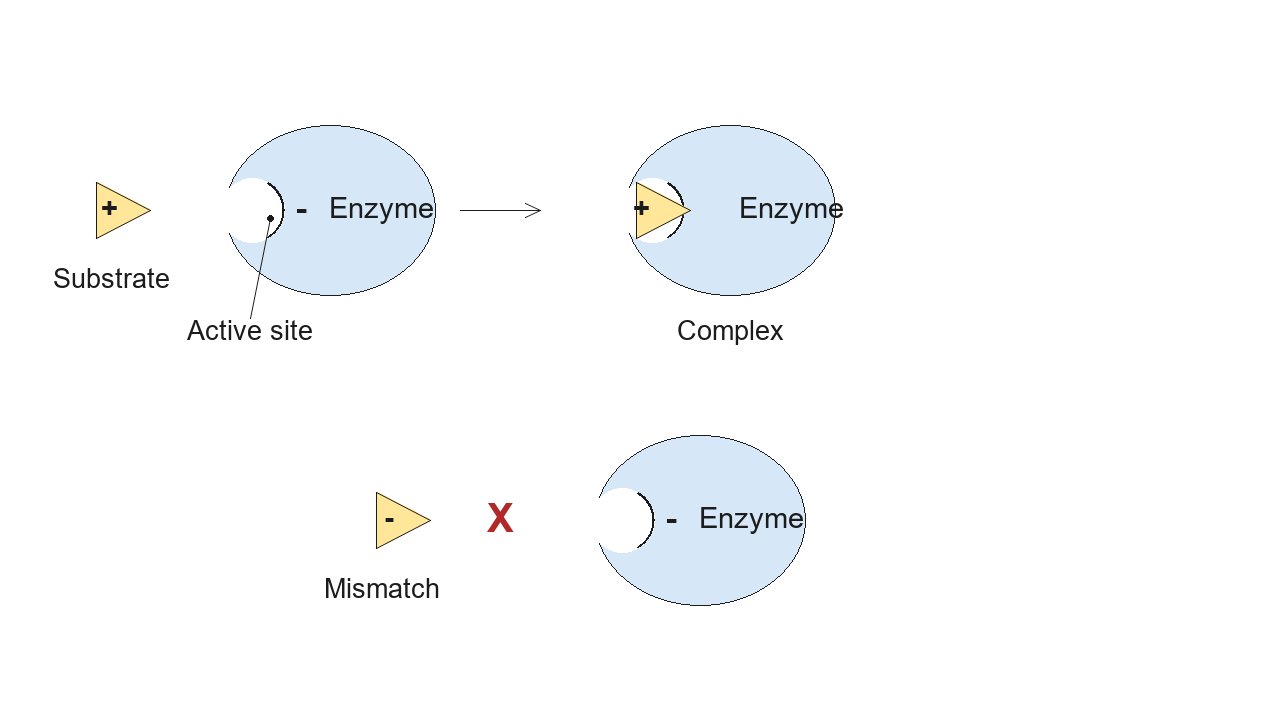
Shape and charge must both match the active site. The seated substrate is the enzyme-substrate complex. The mismatched molecule never forms that complex.
A reaction occurs only when the shape and charge of the substrate are compatible with the active site. The bound pair is the enzyme-substrate complex. Consider a cellular enzyme that clips a short peptide. The active site is a pocket lined with a negative charge. A substrate end that carries a positive charge sits in that pocket, and the peptide is clipped. Reverse only the pocket charge, from negative to positive, and the same peptide no longer binds, so product appears at the slow uncatalyzed rate. A second peptide with the correct charge but a bulky side group that cannot enter the pocket also fails. Matching shape without matching charge is not enough, and matching charge without a shape that fits is not enough either.
The catalyzed and uncatalyzed versions of one conversion start with the same reactants and finish with the same products, so they share the same equilibrium. The enzyme changes the path and the rate, not the balance reached after the reaction settles. Call the reactant substrate G and the product H. Without the enzyme, almost no H appears in the first minute, because few collisions clear a high barrier. With the enzyme, H rises steeply at first. Left long enough, at the same temperature and the same starting amount of G, both tubes settle at the same ratio of H to G. That is how enzyme structure controls which cellular steps run quickly without rewriting the chemistry of the step.
Key points
- Enzymes are proteins and biological catalysts.
- They lower activation energy. They are not consumed, and they do not supply energy to the reactants.
- The equilibrium of the reaction stays the same, because reactants and products do not change.
- Substrate shape and charge must be compatible with the active site.
- The bound pair is the enzyme-substrate complex.
- Example: a negative pocket binds a positive peptide end. Reversing the pocket charge blocks the complex.
- That specificity is how enzyme structure helps regulate biological processes.
Temperature, pH, and inhibitors are topic 3.2. This topic is the fit between enzyme and substrate, and the lower activation energy that fit makes possible.