Enzymes MCQ Practice

Question 1 of 10

Enzymes increase reaction rate primarily by

  1. A. raising the free energy of the products
  2. B. lowering the activation energy of the reaction
  3. C. changing the equilibrium constant toward products
  4. D. increasing the temperature of the cytosol
Question 2 of 10

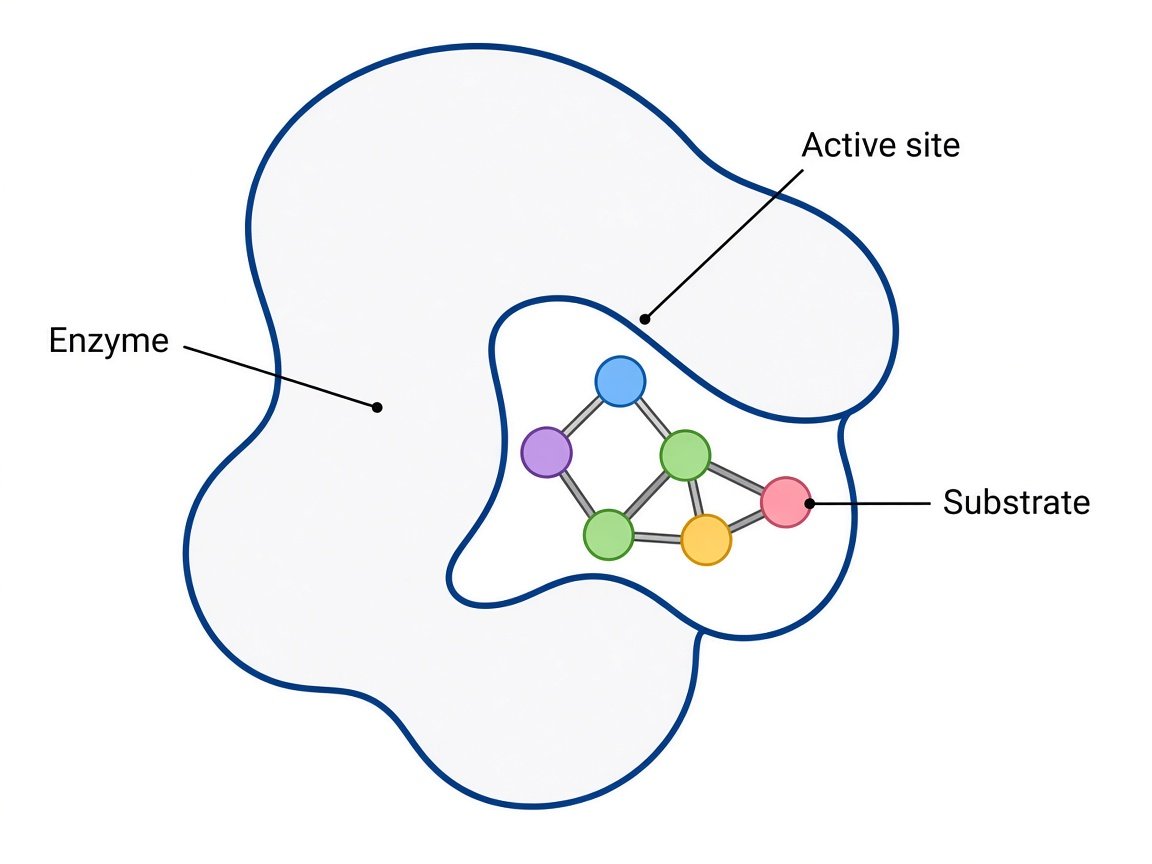
For an enzyme-mediated reaction to occur, which condition must be met at the active site?

Enzyme with substrate fitting into the active site.
  1. A. The substrate must be identical in shape to the enzyme tertiary structure.
  2. B. The substrate shape and charge must be compatible with the active site.
  3. C. The substrate must permanently covalently bind the enzyme.
  4. D. The active site must denature before catalysis begins.

Question 3 of 10

A researcher compares reaction rates with and without enzyme E under otherwise identical conditions. The table lists activation-energy estimates from Arrhenius analysis of rate data.

Condition Estimated Ea (kJ/mol)
No enzyme 72
With enzyme E 41
  1. A. Enzyme E raises Ea, so the reaction proceeds only when heated.
  2. B. Enzyme E lowers Ea, increasing the fraction of collisions that lead to product.
  3. C. Enzyme E changes product free energy, shifting equilibrium strongly.
  4. D. Enzyme E has no catalytic effect because Ea remains positive.

Question 4 of 10

Which statement best describes enzymes as regulators of biological processes?

  1. A. Enzymes are lipids that store energy for later reactions.
  2. B. Enzymes are proteins whose structure and function help control reaction rates in cells.
  3. C. Enzymes are nucleic acids that encode metabolic pathways.
  4. D. Enzymes are consumed stoichiometrically as substrates are converted.

Question 5 of 10

A mutant enzyme has an active-site substitution that replaces a charged residue with a nonpolar one. Substrate binding becomes negligible. The most likely explanation is that

  1. A. the mutation increased the enzyme molecular mass above a catalytic threshold
  2. B. charge complementarity required for substrate recognition was disrupted
  3. C. the enzyme was converted into a competitive inhibitor of itself
  4. D. activation energy became negative, reversing the reaction spontaneously

Question 6 of 10

In the enzyme–substrate complex model, the active site

  1. A. is a random region of the polypeptide with no structural specificity
  2. B. forms only after the products leave the cell
  3. C. is a region whose geometry and chemistry interact specifically with the substrate
  4. D. is identical in all enzymes regardless of substrate

Question 7 of 10

Two reactions have the same reactants and products. Reaction 1 is uncatalyzed; reaction 2 uses a specific enzyme. Which comparison is correct?

  1. A. Reaction 2 has a lower activation energy and a different equilibrium constant.
  2. B. Reaction 2 has a lower activation energy; the equilibrium constant is unchanged.
  3. C. Reaction 2 has a higher activation energy and a larger free-energy change.
  4. D. Reaction 2 proceeds only if the enzyme is permanently consumed.

Question 8 of 10

Which molecule class do enzymes that catalyze most cellular reactions belong to?

  1. A. Steroids
  2. B. Polysaccharides
  3. C. Proteins
  4. D. Triglycerides

Question 9 of 10

A student claims that an enzyme works by supplying energy to the reactants so they can climb the activation barrier. Evaluate the claim.

  1. A. Correct: enzymes donate ATP energy to every substrate molecule.
  2. B. Incorrect: enzymes stabilize the transition state / lower Ea rather than energetically pushing reactants over a higher barrier.
  3. C. Correct: enzymes heat the local microenvironment until reactants melt.
  4. D. Incorrect: enzymes only work by changing the chemical identity of the products.

Question 10 of 10

Assay wells contain equal enzyme concentration. Substrates differ only in a single chemical group near the binding interface. Relative initial rates are shown.

Substrate Relative initial rate
S1 (native) 1.00
S2 (bulky side chain) 0.08
S3 (charge reversed) 0.02
  1. A. All three substrates bind equally; rate differences reflect product free energy only.
  2. B. Compatibility of substrate shape and charge with the active site strongly affects catalysis.
  3. C. Enzymes ignore substrate structure once concentration exceeds Km.
  4. D. S3 is fastest because charge reversal always accelerates collisions.