Environmental Impacts on Enzyme Function MCQ Practice

Question 1 of 10

Denaturation of an enzyme typically means that

  1. A. the primary amino acid sequence is rearranged into a new gene
  2. B. native structure is disrupted so catalytic activity is lost or reduced
  3. C. the enzyme permanently becomes its own substrate
  4. D. activation energy increases only because substrate concentration falls

Question 2 of 10

Temperatures or pH values far outside an enzyme’s optimum often reduce activity because they

  1. A. add new peptide bonds that lock the active site open
  2. B. disrupt hydrogen bonds and alter enzyme structure
  3. C. convert all substrates into irreversible inhibitors
  4. D. remove the need for an active site

Question 3 of 10

An enzyme is briefly exposed to a denaturing condition and then returned to optimal buffer. Activity partially recovers. This best supports that

  1. A. denaturation is always irreversible
  2. B. in some cases denaturation can be reversible
  3. C. enzymes are not proteins
  4. D. recovery proves the gene sequence changed

Question 4 of 10

Which change to an enzymatic system is most likely to alter function or efficiency?

  1. A. A silent change in an unrelated DNA intron only
  2. B. A structural change in the enzyme protein
  3. C. Naming the enzyme differently in a lab notebook
  4. D. Measuring rate with a different brand of stopwatch alone

Question 5 of 10

Rate versus temperature for enzyme Cat1 is graphed.

Enzyme rate rises to an optimum near 37°C then falls at higher temperatures.
  1. A. Activity increases without limit as temperature rises.
  2. B. Activity peaks near an optimum, then declines as structure is disrupted at higher temperature.
  3. C. Temperature has no effect until absolute zero.
  4. D. The decline above optimum proves substrates were destroyed by light.

Question 6 of 10

A chemical environment that unfolds an enzyme’s tertiary contacts will most directly

  1. A. increase gene transcription of the enzyme
  2. B. impair the active site geometry needed for catalysis
  3. C. create new ribosomes
  4. D. force the reaction equilibrium to K = 1

Question 7 of 10

As substrate concentration increases relative to product (before saturation effects dominate), enzymatic reaction efficiency typically

  1. A. falls because enzymes dissolve
  2. B. rises because more enzyme–substrate collisions can occur
  3. C. is unchanged because only temperature matters
  4. D. depends only on the enzyme’s gene name

Question 8 of 10

Higher environmental temperature (within a range below denaturation) can increase reaction rate because molecules

  1. A. move faster on average, increasing enzyme–substrate collision frequency
  2. B. stop colliding entirely
  3. C. permanently freeze into crystals inside the active site
  4. D. lose all kinetic energy

Question 9 of 10

Competitive inhibitors

Competitive inhibitor near the enzyme active site with substrate.
  1. A. bind irreversibly only to DNA
  2. B. can bind reversibly to the active site
  3. C. bind only to ribosomes
  4. D. increase activation energy by heating the cell

Question 10 of 10

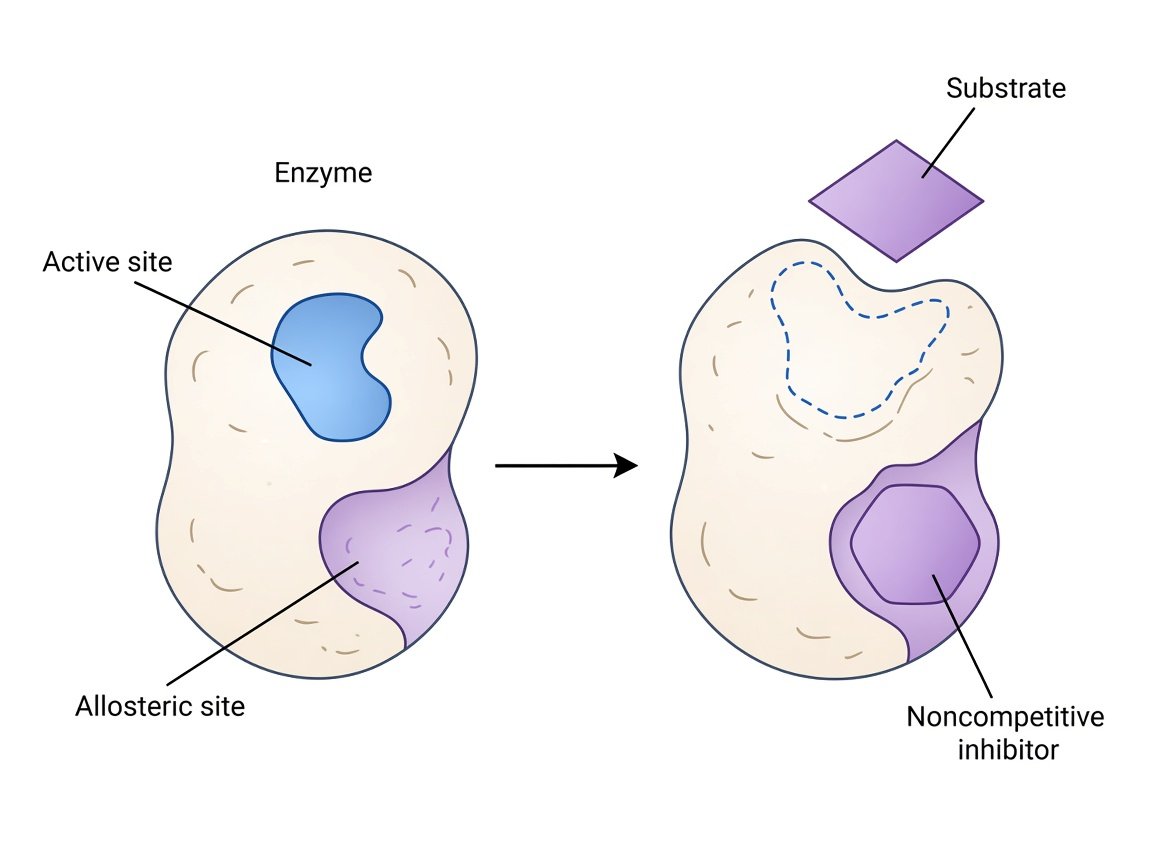
Noncompetitive inhibitors

Noncompetitive inhibitor at an allosteric site altering the enzyme.
  1. A. must covalently destroy the substrate first
  2. B. can bind allosteric sites and change enzyme activity
  3. C. are identical to competitive inhibitors in binding location
  4. D. only activate enzymes at the active site