Question 1 of 5
(a) State the role of enzymes in cells in one sentence. (b) Explain what is meant by lowering activation energy. (c) Give one example of how faster catalysis could help maintain homeostasis.
Responses receive AI feedback against a rubric after submission. Scores are practice estimates.
(a) State the role of enzymes in cells in one sentence. (b) Explain what is meant by lowering activation energy. (c) Give one example of how faster catalysis could help maintain homeostasis.
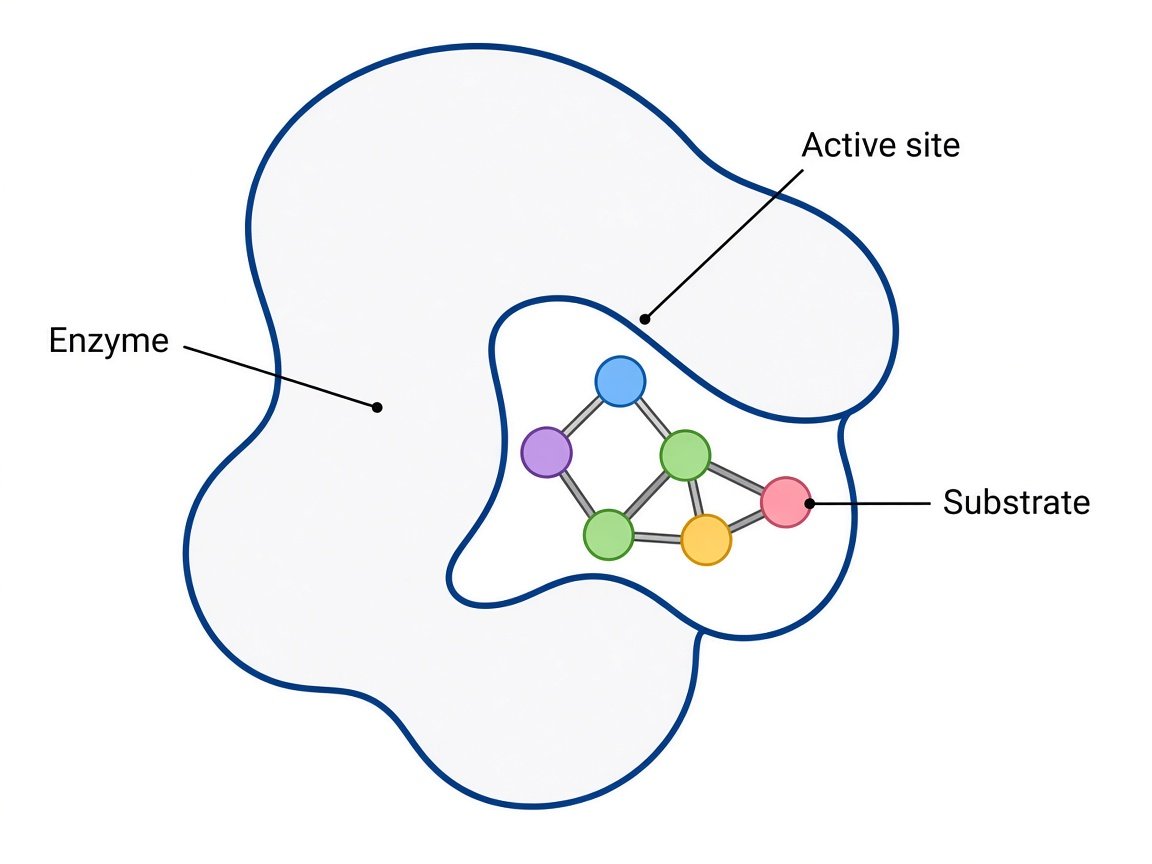
Using the enzyme–substrate model: (a) Identify the active site. (b) Explain compatibility. (c) Predict the effect of a bulky mutation that occludes the active-site pocket.
Students collect the data in the table for conversion of substrate S to product P at 25°C.
| Trial | Enzyme present? | Product after 2 min (µmol) |
|---|---|---|
| 1 | No | 0.4 |
| 2 | Yes | 6.8 |
| 3 | Yes (boiled enzyme) | 0.5 |
(a) Identify the trial that best represents an enzyme-catalyzed rate. (b) Explain the boiled-enzyme result. (c) Justify why trial 1 is an appropriate control.
(a) Compare catalyzed and uncatalyzed pathways for the same reactants/products in terms of activation energy. (b) Explain why enzyme specificity matters for regulation. (c) Describe one way a cell could reduce flux through an enzyme-catalyzed step without destroying the enzyme gene.
A student says enzymes work because they make the products lower in energy than the reactants. (a) Critique the statement as an explanation of catalysis. (b) Provide a correct explanation focused on activation energy. (c) State what must still be true about substrate–active site interaction for catalysis to occur.