Question 1 of 5
(a) Define activation energy in the context of a biological reaction. (b) Explain how an enzyme alters activation energy. (c) State one cellular consequence of faster enzyme-catalyzed conversion of a metabolite.
Responses receive AI feedback against a rubric after submission. Scores are practice estimates.
(a) Define activation energy in the context of a biological reaction. (b) Explain how an enzyme alters activation energy. (c) State one cellular consequence of faster enzyme-catalyzed conversion of a metabolite.
A figure shows an enzyme and a substrate forming a complex at the active site.
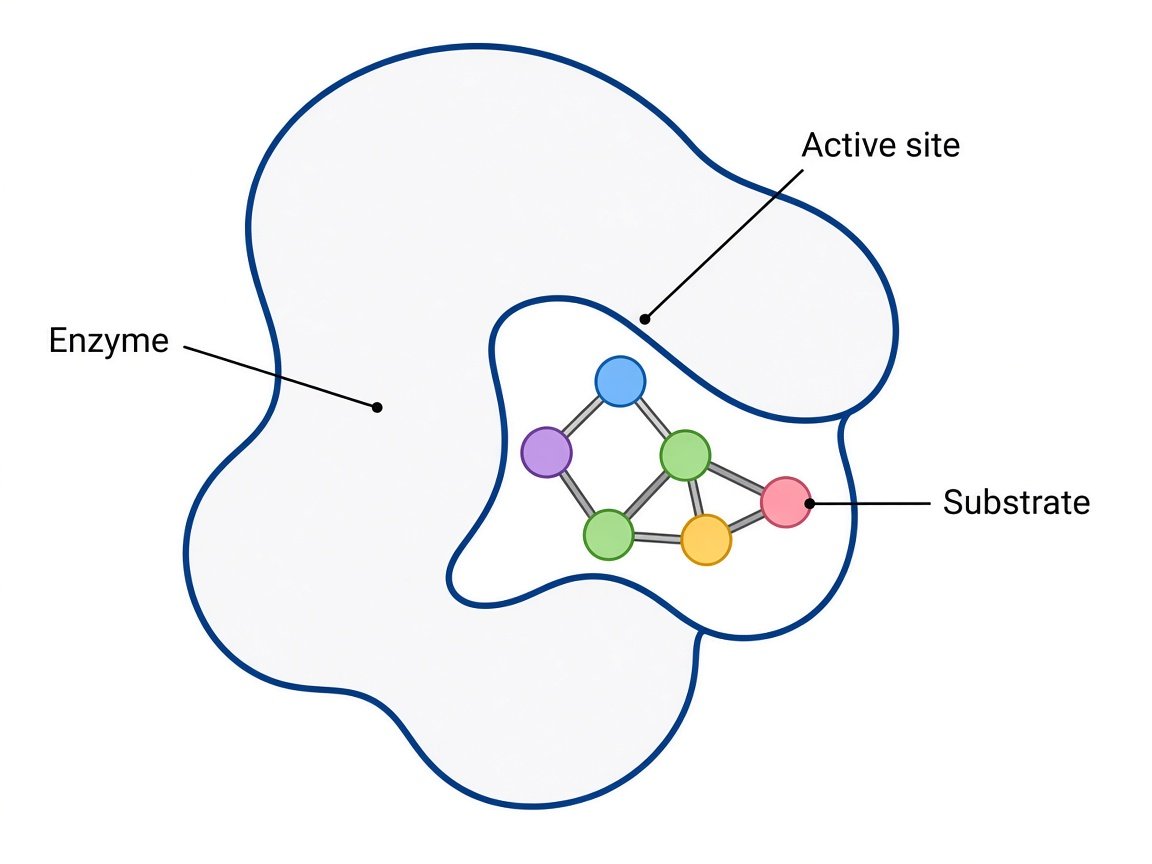
(a) Explain why substrate shape matters for binding. (b) Explain why charge distribution at the active site also matters. (c) Predict the effect of a mutation that reverses a key active-site charge without changing overall fold.
Students measure product formation over time with and without enzyme at constant temperature and substrate concentration. (a) Sketch the expected qualitative difference in early rate. (b) Explain the difference using activation energy. (c) Identify the independent and dependent variables in the assay.
(a) Describe the enzyme–substrate complex. (b) Explain how enzyme structure contributes to regulation of biological processes. (c) Give one reason a non-substrate molecule of similar size might fail to react.
Design a controlled experiment to test whether enzyme Q lowers activation energy for conversion of substrate R to product P. You may use a spectrophotometer, buffers, purified Q, and R. (a) State a hypothesis. (b) Describe treatment and control. (c) Identify what you would measure and how it supports or refutes the hypothesis. Do not invent Gibbs free-energy equations.