TOPIC 3.2 · STUDY
Environmental Impacts on Enzyme Function
Temperature, pH, and the chemical environment can denature an enzyme or move it off its optimum, which changes efficiency. Substrate and product levels also set how fast the reaction proceeds. Competitive inhibitors bind the active site reversibly. Noncompetitive inhibitors bind an allosteric site and change activity.
3.2.A
Structure, denaturation, and the optimum
A change in the molecular structure of the enzyme, or of another component in the enzymatic system, can change function or efficiency. Denaturation disrupts the folded structure of the protein. A shift in temperature, pH, or chemical environment can cause it. Once the fold is lost, the active site is lost, and the enzyme can no longer catalyze the reaction.
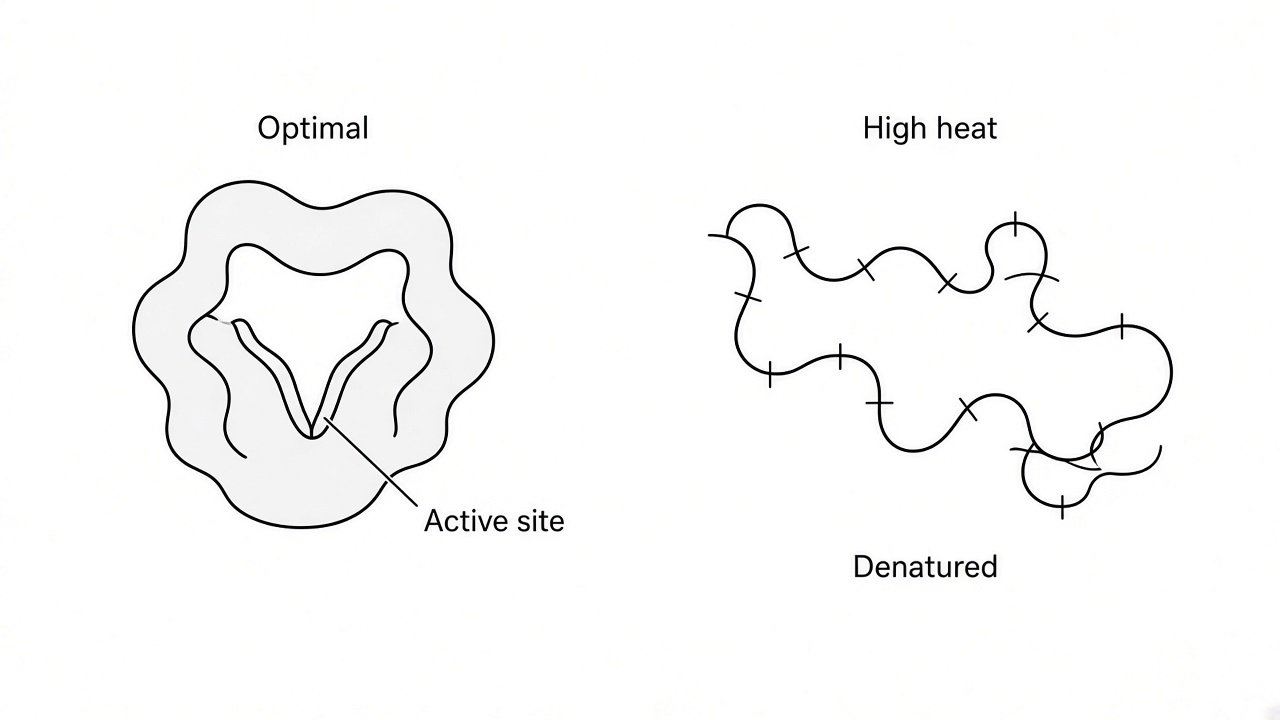
At the optimum the active site is intact. High heat can unfold the chain, erase the active site, and stop catalysis.
Temperature or pH outside the optimal range for a given enzyme disrupts hydrogen bonds that hold the structure together. Efficiency changes even before the chain is fully unraveled. In some cases denaturation is reversible: returned to the optimal condition, the enzyme regains activity. In other cases the loss is permanent and activity does not return.
Take a leaf-cell enzyme whose optimum is near pH 7 and 25 degrees C. At pH 3 the rate falls because hydrogen bonds break and the active site loosens. Bring that sample back to pH 7 and much of the activity returns, so that denaturation was reversible. A second sample held at 75 degrees C loses essentially all activity. Cooling it to 25 degrees C does not bring the rate back, so that denaturation was irreversible. A harsh chemical environment that unfolds the chain can do the same kind of structural damage.
3.2.B
Concentrations, temperature, and inhibitors
The relative concentrations of substrates and products determine how efficiently an enzymatic reaction proceeds. When substrate is high relative to product, enzyme and substrate meet more often, so forward conversion is more efficient. As product builds up, net conversion is less efficient. The rise with added substrate is not unlimited. Once active sites are occupied, still more substrate does not keep increasing the rate.
Below the optimum, a higher environmental temperature increases the average speed of molecules in solution. Enzymes and substrates collide more often, and the rate increases until the optimal temperature is reached. Past that optimum, faster motion no longer helps, because the structure is being disrupted and catalysis falls. For the leaf-cell enzyme above, the rate at 10 degrees C is lower than the rate at 25 degrees C even though the fold is still intact: molecules are simply moving more slowly. At 50 degrees C collisions would be more frequent, but measured activity drops because hydrogen bonds are breaking.
Competitive inhibitor molecules can bind reversibly to the active site and block the substrate. Because inhibitor and substrate compete for that same site, a high substrate concentration can displace the inhibitor and restore much of the uninhibited rate. Noncompetitive inhibitors bind an allosteric site, a place other than the active site, and change the activity of the enzyme. Extra substrate does not remove that inhibitor from the allosteric site, so the rate stays reduced.
A sugar-cleaving enzyme is mixed with a look-alike molecule that sits in the active site. At a low sugar concentration the rate is far below the rate with sugar alone. Raise the sugar concentration sharply and keep the look-alike concentration fixed, and the rate moves back toward the uninhibited value. A different molecule binds a patch on the far side of the enzyme and warps the cleft. The same sharp rise in sugar does not restore the uninhibited rate. The first molecule is a competitive inhibitor. The second is a noncompetitive inhibitor.
| Inhibitor | Where it binds | Extra substrate |
|---|---|---|
| Competitive | Active site, reversible | Can restore much of the rate |
| Noncompetitive | Allosteric site | Does not remove the inhibitor |
Key points
- A structural change in an enzyme can change function or efficiency.
- Denaturation, from temperature, pH, or chemical environment, disrupts the fold and stops catalysis.
- Off-optimum temperature or pH disrupts hydrogen bonds. Some denaturation is reversible.
- Example: pH 3 slows a pH 7 leaf enzyme, and a return to pH 7 can restore activity. Heating to 75 degrees C may not.
- High substrate relative to product increases efficiency until active sites are full. Below the optimum, heat raises collision frequency.
- Competitive inhibitors bind the active site reversibly. A high substrate concentration can restore rate.
- Noncompetitive inhibitors bind an allosteric site and change activity. Extra substrate does not fix that.
Denaturation removes the working shape of the catalyst. Inhibition leaves the protein present but less able to work. Those are different changes.