TOPIC 3.3 · STUDY
Cellular Energy
Living systems stay ordered only when energy input exceeds energy loss. Cells couple energy-releasing processes to energy-requiring ones and run metabolism as a sequence of steps. Glycolysis and oxidative phosphorylation are conserved across Archaea, Bacteria, and Eukarya, which supports common ancestry. The Gibbs free-energy equation is outside this course.
3.3.A
Energy, order, and coupled pathways
All living systems require an input of energy. A cell is a highly ordered system, and that order does not violate the first or second law of thermodynamics. Under the first law, energy is transformed, not created or destroyed. Under the second law, order tends to decrease unless energy is supplied. Energy input must exceed energy loss if the cell is to stay ordered and to power cellular processes. A significant loss of order or of energy flow results in death.
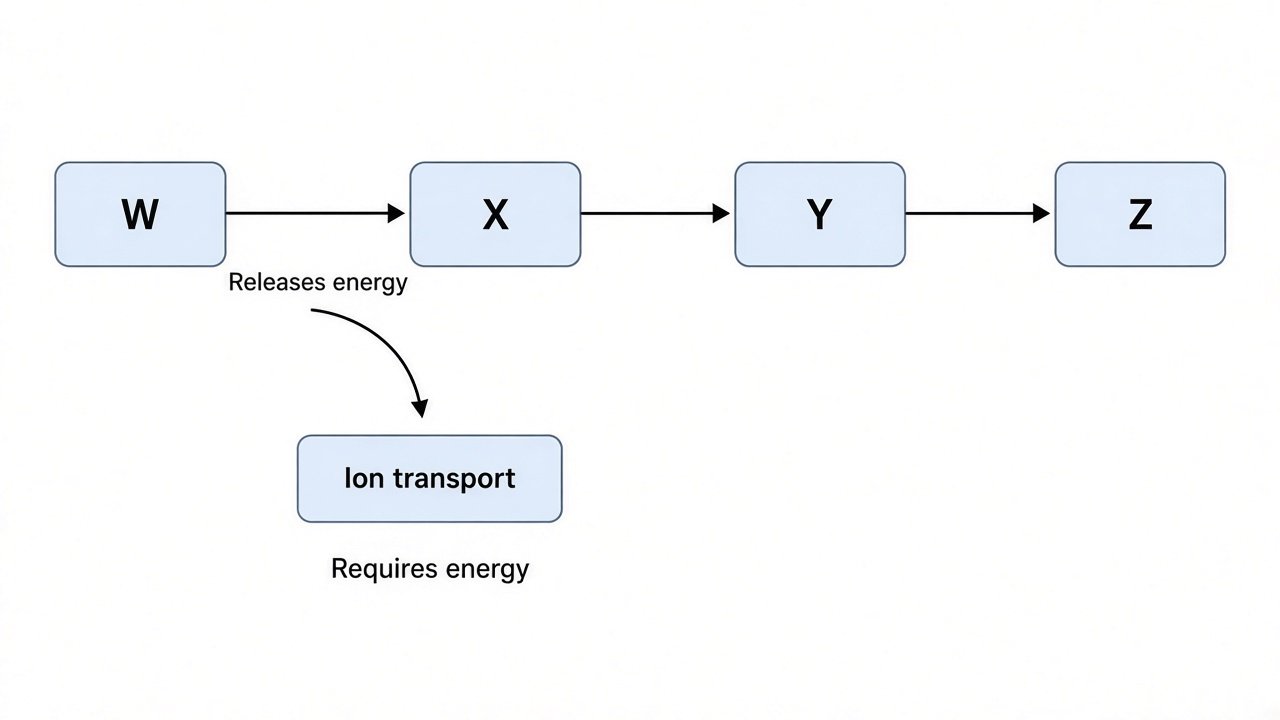
Each product is the reactant for the next step, so energy moves in controlled amounts. A releasing step can be coupled to a step that requires energy.
A cellular process that releases energy may be coupled with a cellular process that requires energy. The cell uses the releasing process to drive the requiring one. Energy-related pathways are sequential so the transfer stays controlled. A product of one reaction is typically the reactant for the next step in the pathway. One uncontrolled release of an entire fuel store would dump energy as heat. A sequence of steps lets the cell capture usable portions along the way.
The concept of energy is required. The equation for Gibbs free energy is beyond the exam, so there is no free-energy formula to memorize and no numerical value to compute. In a growing yeast cell, fuel molecule W is converted to X, then to Y, then to Z. X is the product of the first step and the reactant of the second. Breaking a phosphate bond in ATP releases energy that can be coupled to building a larger molecule from smaller pieces. If the fuel supply stops and ATP is no longer regenerated, ordered structure fails and the cell dies. Continued growth is possible only while energy taken in exceeds energy lost as heat and as waste.
3.3.B
Shared pathways and common ancestry
Core metabolic pathways are conserved across all currently recognized domains: Archaea, Bacteria, and Eukarya. Glycolysis and oxidative phosphorylation are the examples to know. Shared, fundamental processes of this kind support the concept of common ancestry for all organisms. Conservation means the pathways were inherited from ancestors held in common. It does not mean every species has the same habitat, diet, or body plan.
Picture glycolysis operating in a hot-spring archaeon, in a soil bacterium, and in a human muscle cell, and oxidative phosphorylation operating in those same three lineages. The claim that pattern supports is common ancestry of the three domains. It does not support a claim that the archaeon and the human share an ecology. The internal steps of these pathways belong with cellular respiration. Here the point is that the pathways themselves are shared across domains.
Key points
- All living systems require a continual input of energy.
- Life is highly ordered and does not violate the first or second law of thermodynamics.
- Energy input must exceed energy loss to maintain order and power cellular processes.
- A significant loss of order or energy flow results in death.
- Energy-releasing processes can be coupled to energy-requiring processes.
- Pathways are sequential: the product of one step is typically the reactant of the next. Example: W to X to Y to Z in yeast.
- Glycolysis and oxidative phosphorylation are conserved in Archaea, Bacteria, and Eukarya, supporting common ancestry. The Gibbs free-energy equation is excluded.
Photosynthesis is topic 3.4. Mitochondria, fermentation, and the steps of respiration are topic 3.5. This topic is the energy requirement, coupling, pathway order, and the ancestry claim from conserved metabolism.