TOPIC 3.4 · STUDY
Photosynthesis
Photosynthesis uses carbon dioxide, water, and light to make carbohydrates and oxygen. Light reactions in the thylakoid membranes of the grana produce ATP and NADPH. The Calvin cycle in the stroma uses those products to fix carbon. A proton gradient built inside the thylakoid drives ATP synthase.
3.4.A
Chloroplasts and what photosynthesis stores
Photosynthesis is the series of reactions that use carbon dioxide, water, and light energy to make carbohydrates and oxygen. Photosynthetic organisms capture energy from sunlight and produce sugars that can be used in other biological processes or stored. The inputs to track are carbon dioxide, water, and light. The outputs are carbohydrate and oxygen.
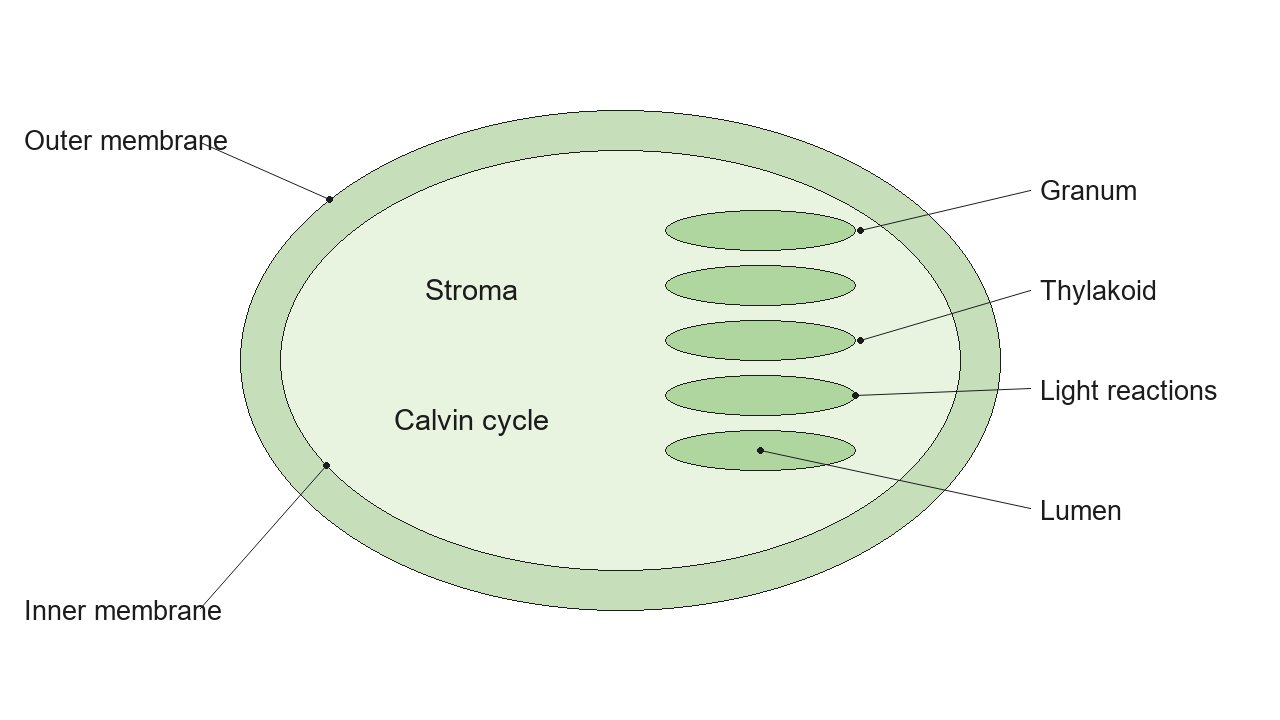
The stroma, inside the inner membrane and outside the thylakoids, is where the Calvin cycle fixes carbon. Light reactions run in the thylakoid membranes of the grana.
Photosynthesis first evolved in prokaryotic organisms. Scientific evidence supports the claim that cyanobacterial photosynthesis was responsible for an oxygenated atmosphere. Prokaryotic photosynthetic pathways were the foundation of eukaryotic photosynthesis. A pond cyanobacterium that releases oxygen only while the culture is lit is running that ancient process. Algae and plants later housed the pathway inside chloroplasts.
The stroma is the fluid within the inner chloroplast membrane and outside the thylakoid. Carbon fixation, the Calvin cycle, occurs in the stroma. Thylakoid membranes contain chlorophyll pigments organized into photosystem I and photosystem II, plus electron-transport proteins. Thylakoids are organized in stacks called grana. The light reactions occur in the grana. Those reactions capture energy present in light and yield ATP and NADPH, which power the production of organic molecules in the Calvin cycle.
Shade a leaf so the light reactions stop. ATP and NADPH fall, and carbohydrate production in the stroma slows even though carbon dioxide is still available. Restore the light and both the light-reaction products and carbohydrate synthesis recover. The stroma cannot fix carbon at the usual rate without the ATP and NADPH the grana supply. Memorizing the steps of the Calvin cycle, the structures of its molecules, and the names of its enzymes is outside the exam. ATP synthase is the named exception.
3.4.B
From light to carbohydrate
Electron-transport-chain reactions occur in chloroplasts, in mitochondria, and across prokaryotic plasma membranes. In photosynthesis, electrons that pass through the thylakoid membrane are picked up and ultimately transferred to $\mathrm{NADP}^{+}$, reducing it to $\mathrm{NADPH}$ at photosystem I. The full names of the specific electron carriers are outside the exam. So are the specific steps, enzyme names, and intermediates of these pathways, other than ATP synthase.
Chlorophylls absorb energy from light, boosting electrons to a higher energy level in photosystems I and II. Water then splits, supplying electrons that replace those lost from photosystem II, and oxygen is released. The two photosystems are embedded in the thylakoid membranes and are connected by the transfer of electrons through the electron transport chain.
As electrons are transferred in a series of oxidation-reduction reactions, an electrochemical gradient of protons ($\mathrm{H}^{+}$) is established across the thylakoid membrane. Proton concentration is high inside the thylakoid and low outside it, in the stroma. Protons flow back out through membrane-bound ATP synthase by chemiosmosis. That flow drives formation of ATP from ADP and inorganic phosphate. ATP formed this way is photophosphorylation. The energy captured in the light reactions and held in ATP and NADPH then powers production of carbohydrates from carbon dioxide in the Calvin cycle, in the stroma.
Block the splitting of water at photosystem II. Replacement electrons run out, oxygen release stops, and $\mathrm{NADPH}$ formation at photosystem I fails. Block only the proton path through ATP synthase while the chain can still move electrons. Photophosphorylation stops, so the Calvin cycle is short of ATP. Either failure cuts carbohydrate production. The high-proton side of this gradient is the interior of the thylakoid, not the stroma.
| Place | Role |
|---|---|
| Stroma | Calvin cycle fixes carbon dioxide into carbohydrate |
| Thylakoid membrane in the grana | Light reactions, photosystems, and electron transport |
| Inside the thylakoid | High proton concentration |
| ATP synthase | Protons flowing out form ATP (photophosphorylation) |
Key points
- Inputs are carbon dioxide, water, and light. Outputs are carbohydrates and oxygen.
- Photosynthesis began in prokaryotes. Cyanobacterial photosynthesis oxygenated the atmosphere and founded the eukaryotic pathway.
- The Calvin cycle runs in the stroma. Light reactions run in the grana, on thylakoid membranes that hold photosystems I and II.
- Chlorophyll absorbs light and boosts electrons. Water replaces electrons lost from photosystem II.
- $\mathrm{NADP}^{+}$ is reduced to $\mathrm{NADPH}$ at photosystem I. Carrier names and Calvin cycle steps are excluded. ATP synthase is in scope.
- Proton concentration is high inside the thylakoid. Flow out through ATP synthase is photophosphorylation.
- ATP and NADPH power carbohydrate production from carbon dioxide in the stroma.
Cellular respiration uses a membrane electron-transport chain as well, but the compartments and the terminal acceptor belong to topic 3.5. Do not swap the high-proton side of the thylakoid with the mitochondrial intermembrane space.