TOPIC 2.4 · STUDY
Membrane Permeability
Selective permeability comes from the hydrophobic interior of the plasma membrane. Small nonpolar molecules pass freely, ions and large polar molecules need proteins, and small polar molecules such as water and ammonia cross only in limited amounts. Cell walls of Bacteria, Archaea, fungi, and plants add structure, a partial barrier, and protection from bursting.
2.4.A
Selective permeability
The plasma membrane separates the internal environment of the cell from the external environment. Selective permeability is a result of the hydrophobic interior, the nonpolar hydrocarbon tails. Molecules that are small and nonpolar can dissolve in that interior and cross. Molecules that are charged or strongly polar cannot.
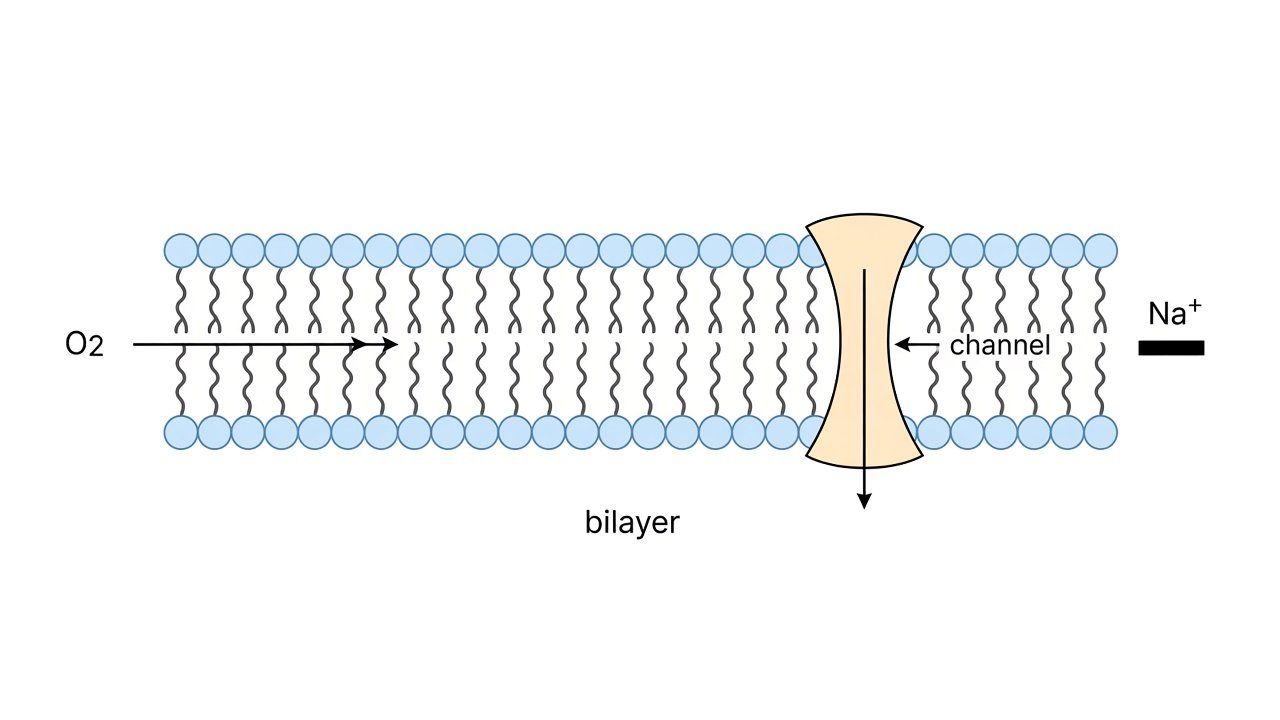
O2 passes through the bilayer. A channel is a protein path across the membrane. Na+ is drawn beside the bilayer, not through the fatty-acid core.
Small nonpolar molecules, including $\mathrm{N_2}$, $\mathrm{O_2}$, and $\mathrm{CO_2}$, pass freely. Hydrophilic substances, such as large polar molecules and ions, cross through embedded channels and transport proteins. The hydrocarbon tails are what stop ions and polar molecules from slipping through on their own. Small polar uncharged molecules, such as $\mathrm{H_2O}$ and ammonia, $\mathrm{NH_3}$, do cross the bilayer, but only in small amounts. When a cell needs a large flow of water, it uses protein channels. Those channels are the subject of facilitated diffusion, not a second route through the tails.
2.4.B
Cell walls
Bacteria, Archaea, fungi, and plants have cell walls. Animal cells do not. The wall is a structural boundary outside the plasma membrane. It is also a permeability barrier for some substances, so it filters traffic between the cell and its surroundings more coarsely than the lipid bilayer does. A third job is protection from osmotic lysis. In a very dilute bath, water enters the cell. An animal cell can swell until it bursts. A walled cell presses against the wall, the wall pushes back, and the cell stays intact.
The wall does not replace the plasma membrane. Selective permeability based on the hydrophobic interior is still the membrane's job. A plant cell in pure water stays alive because of the wall, and it still needs the membrane to decide which solutes enter the cytoplasm. Different groups build walls from different materials. This topic asks for the shared jobs, not the chemistry of each wall.
Key points
- Selective permeability results from the hydrophobic interior of the plasma membrane.
- $\mathrm{N_2}$, $\mathrm{O_2}$, and $\mathrm{CO_2}$ cross freely. Ions and large polar molecules need channels or transport proteins.
- The nonpolar tails block ions and polar molecules. $\mathrm{H_2O}$ and $\mathrm{NH_3}$ cross only in small amounts.
- Cell walls occur in Bacteria, Archaea, fungi, and plants. Animal cells do not have them.
- A wall provides a structural boundary, a permeability barrier for some substances, and protection from osmotic lysis.
- The wall does not make the plasma membrane unnecessary.
Domain and kingdom names matter here: both Bacteria and Archaea have walls, and so do fungi and plants.