Membrane Permeability MCQ Practice

Question 1 of 10

Plasma membranes separate the cell’s internal environment from the external environment. Selective permeability results primarily from

  1. A. the cell wall of all animal cells
  2. B. the hydrophilic exterior alone with no hydrophobic core
  3. C. the hydrophobic interior of the membrane
  4. D. the absence of any phospholipids

Question 2 of 10

Which molecules freely pass across the membrane according to CED essential knowledge?

  1. A. Small nonpolar molecules such as N2, O2, and CO2
  2. B. Large polar molecules without any proteins
  3. C. All ions without channels
  4. D. DNA chromosomes

Question 3 of 10

Hydrophilic substances such as large polar molecules and ions typically cross membranes

  1. A. by dissolving freely in the hydrophobic core without proteins
  2. B. through embedded channels and transport proteins
  3. C. only by destroying the bilayer permanently
  4. D. never, under any circumstances

Question 4 of 10

Nonpolar hydrocarbon tails prevent free movement of

  1. A. all gases including O2
  2. B. small nonpolar molecules only
  3. C. nothing; tails are fully permeable to ions
  4. D. ions and polar molecules across the membrane

Question 5 of 10

Small polar uncharged molecules such as H2O or NH3

  1. A. pass through the membrane in small amounts
  2. B. never cross any membrane
  3. C. require endocytosis exclusively
  4. D. are identical to DNA in permeability

Question 6 of 10

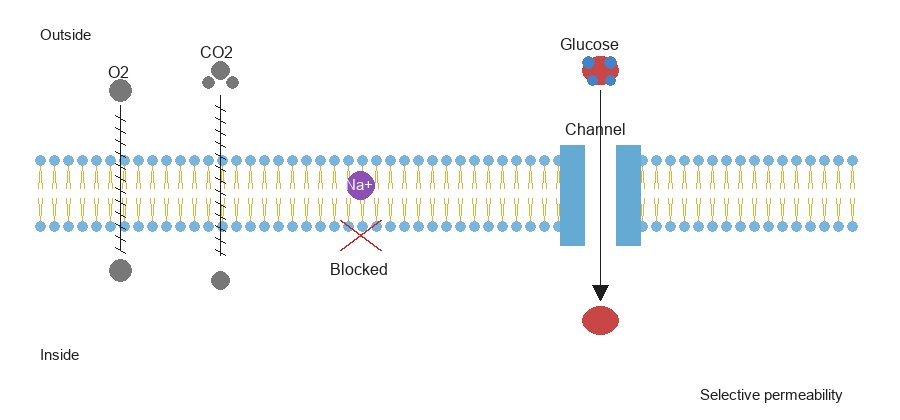
Using the figure, which molecule is shown requiring a protein pathway rather than free diffusion through the bilayer core?

Membrane permeability diagram: O2 and CO2 cross freely, Na+ blocked, glucose at a channel protein.
  1. A. O2
  2. B. CO2
  3. C. Glucose
  4. D. N2 (same class as O2)

Question 7 of 10

Cell walls of plants, fungi, Bacteria, and Archaea provide

  1. A. a substitute for DNA
  2. B. a structural boundary and a permeability barrier for some substances, plus protection from osmotic lysis
  3. C. the only membrane of animal cells
  4. D. chlorophyll for photosynthesis in animals

Question 8 of 10

Which groups are listed in the CED as having cell walls?

  1. A. Bacteria, Archaea, Fungi, and plants
  2. B. Only vertebrate animals
  3. C. Only mitochondria
  4. D. Only viruses

Question 9 of 10

Osmotic lysis is less likely in a walled plant cell in pure water than in an animal cell because the wall

  1. A. pumps out all water actively at all times
  2. B. removes the plasma membrane
  3. C. provides structural protection against bursting under turgor
  4. D. converts water into CO2

Question 10 of 10

A cell wall acts as a permeability barrier for some substances. This means

  1. A. every molecule crosses the wall at equal rates
  2. B. the wall replaces selective permeability of membranes entirely in animals
  3. C. DNA freely exits all walled cells
  4. D. the wall can restrict movement of some substances to internal or external environments