Membrane Permeability MCQ Practice

Question 1 of 10

Selective permeability of plasma membranes is a consequence of

  1. A. having a hydrophobic interior
  2. B. lacking phospholipids
  3. C. being composed only of starch
  4. D. having infinite thickness

Question 2 of 10

N2, O2, and CO2 are examples of molecules that

  1. A. require aquaporins exclusively
  2. B. cannot cross any bilayer
  3. C. freely pass across the membrane as small nonpolar molecules
  4. D. are always blocked by hydrocarbon tails

Question 3 of 10

Ions move across membranes primarily

  1. A. by dissolving in the fatty acid core without proteins
  2. B. through embedded channels and transport proteins
  3. C. by converting into O2 first
  4. D. only during mitosis

Question 4 of 10

Which statement about water is consistent with CED 2.4.A.3?

  1. A. Water never crosses membranes
  2. B. Water is identical to Na+ in charge and permeability
  3. C. Water only crosses via endocytosis
  4. D. Small amounts of water can pass through the membrane; large quantities often use aquaporins (Topic 2.6)

Question 5 of 10

In the permeability figure, the blocked Na+ illustrates that
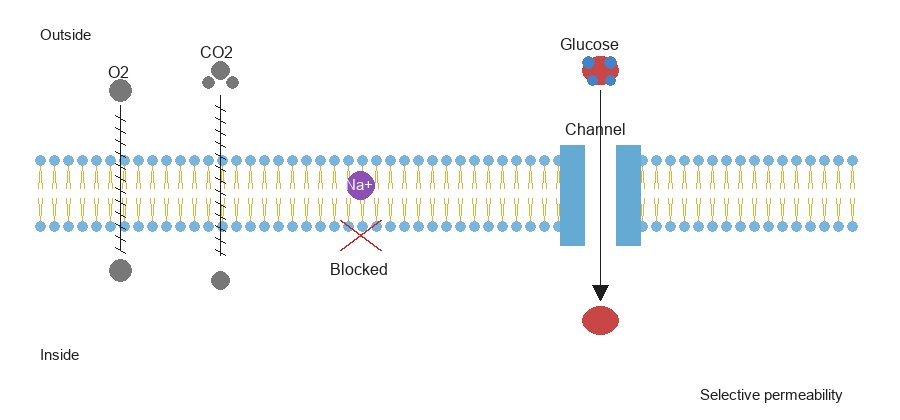
Membrane permeability diagram: O2 and CO2 cross freely, Na+ blocked, glucose at a channel protein.
  1. A. charged ions do not freely cross the hydrophobic interior
  2. B. Na+ is small and nonpolar
  3. C. Na+ is identical to CO2
  4. D. channels always destroy ions

Question 6 of 10

Large polar molecules generally

  1. A. diffuse freely like O2
  2. B. are synthesized only outside cells and never enter
  3. C. require embedded transport proteins to cross
  4. D. pass only through cellulose pores in animal cells

Question 7 of 10

Protection from osmotic lysis is a function of

  1. A. ribosomes alone
  2. B. nuclear pores alone
  3. C. cell walls in Bacteria, Archaea, Fungi, and plants
  4. D. animal extracellular DNA only

Question 8 of 10

A fungal cell wall contributes to

  1. A. structural boundary and permeability barrier for some substances
  2. B. photosynthesis in all fungi
  3. C. replacing mitochondria
  4. D. encoding genes

Question 9 of 10

Which experimental observation best supports the protective role of walls against lysis?

  1. A. Walled cells always die faster in water than animal cells
  2. B. Plant cells in hypotonic solution become turgid without bursting, unlike many animal cells
  3. C. Walls prevent all water entry permanently
  4. D. Animal cells grow cellulose walls overnight in culture always

Question 10 of 10

Archaeal cell walls

  1. A. are absent by definition in all Archaea
  2. B. are identical to vertebrate bone
  3. C. function only as chloroplasts
  4. D. help provide structural boundary and osmotic protection like other walled organisms